Investors underestimate heat risk, according to JLL study
Whether it’s heat, heavy rain or storms, both institutional real estate investors and municipal climate managers recognise the growing risks of climate change and consider closer cooperation to be necessary. This is shown by a study by the real estate service provider JLL, which was presented at the Extreme Weather Congress in Hamburg. 87 institutional investors and 20 municipal climate managers or climate managers from 17 major German cities, including Berlin, Hamburg, Munich, Cologne, Frankfurt am Main, Düsseldorf and Stuttgart, were surveyed.
It is not a lack of awareness of the problem that blocks climate adaptation, but a structural gap in cooperation between municipalities and the real estate industry, according to a central finding of the study. “There is no lack of technical solutions for climate adaptation measures in cities and municipalities, but rather sufficient cooperation between municipalities and real estate investors. This is not a knowledge deficit, but a governance deficit,” says Helge Scheunemann, Head of Research at JLL Germany.
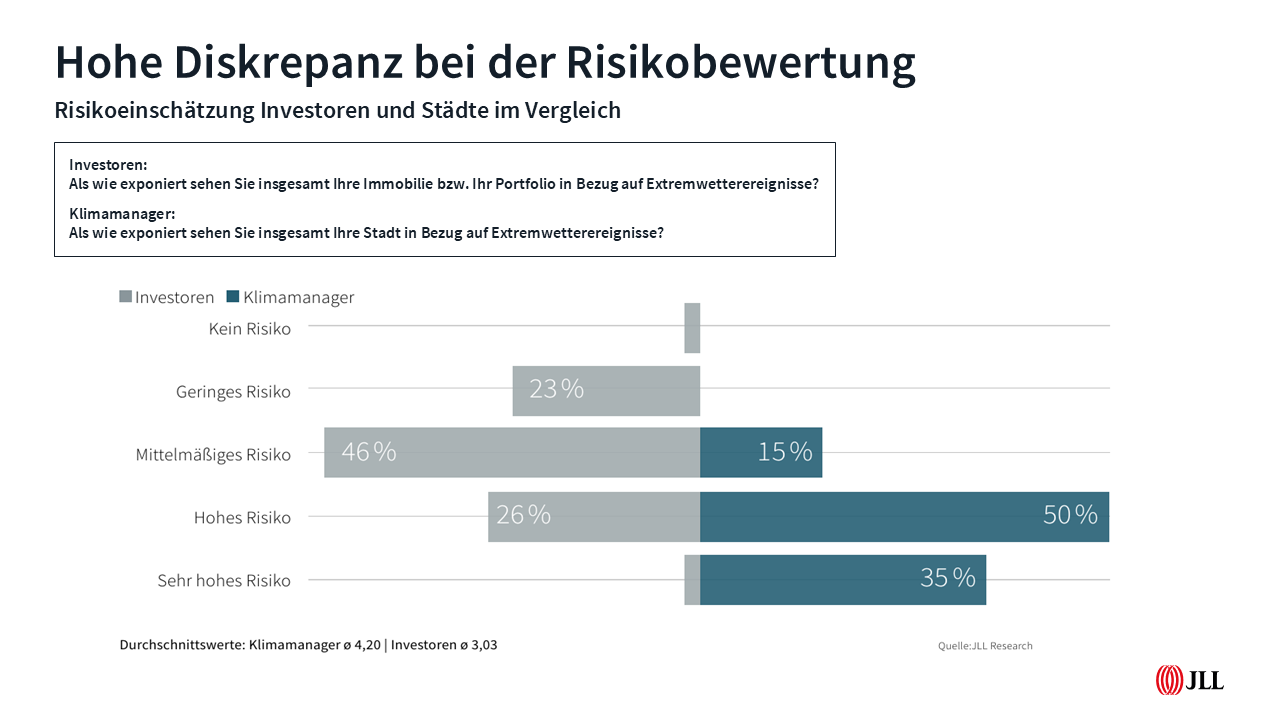
Even the basic risk assessment reveals an initial, clear perception gap: Investors rate the exposure of their portfolio to extreme weather events at an average of only 3.03 on a five-point scale. 46 percent assigned the middle level three, another 26 percent level 4 – while only two percent chose the maximum level five. Climate managers, on the other hand, estimate the risk for their city to be significantly higher at an average of 4.2: 85 percent of them classify it as high or very high. “This difference of more than one scale point makes it clear that investors systematically underestimate the actual risk exposure of their own locations,” Scheunemann emphasizes.
How differently the two sides assess the situation is exemplified by the topic of heat: Only 43 percent of investors even name heat or drought as a relevant extreme weather risk for their properties. Of these, only about a quarter put heat at the top of the risk list. In relation to all investors surveyed, only about one in ten recognizes heat as their most important individual risk. Among climate managers, on the other hand, 100 percent classify heat as a central threat to their city, along with heavy rainfall.
“Air conditioning systems in commercial properties cool the interior, but do not protect against rising energy costs or damage to outdoor surfaces and building technology,” says Scheunemann , citing one possible reason. The blind spot runs through all types of use. However, healthcare and logistics properties have the highest level of awareness – “plausible, since employees, residents and patients experience heat directly physically”.
Largest discrepancy in the evaluation of cooperation
There is also a large gap in the evaluation of cooperation: climate managers rate its quality at an average of 2.65 out of five points, while investors rate it at 3.55 – a difference of 0.90 scale points and the largest discrepancy in the entire survey. Both sides also name different main blockages: Investors complain about long approval times (78 percent) and a lack of flexibility from authorities (67 percent), while climate managers complain about a lack of financing (85 percent) and staff shortages (75 percent).
“Both sides block each other,” says Scheunemann , adding: “A perception gap is not a relationship problem, but a structural problem, and these can be solved if it is clearly named instead of concealed.”
The study thus refutes a widespread prejudice: neither municipalities nor investors lack awareness of the problem or good will. Feedback from 14 of the 17 cities surveyed is that closer cooperation with the real estate industry is important for the implementation of climate adaptation measures. Around half of the investors are already implementing such measures in significant parts or even portfolio-wide. At the same time, economic awareness is growing: around 40 percent of investors are concerned or very concerned about a future climate-related loss in the value of their properties, and around 85 percent are already observing the effects of climate risks on transaction prices and valuations in the German market. “What is missing are binding structures that translate the common will into joint action. This is good news – because governance gaps can be closed, unlike a lack of commitment.”
“Climate Improvement District” as a solution
As a practical solution, JLL proposes so-called “Climate Improvement Districts” (KID) – a further development of existing Business Improvement Districts, which is already legally possible in eleven federal states. In this project, owners, municipalities and states jointly finance district-specific climate adaptation measures, such as façade greening, retention areas or rainwater management.
“The real estate industry manages a large part of the space that is crucial for the climate resilience of our cities. In the cities surveyed alone, the office space stock amounts to over 120 million square meters,” explains Scheunemann. “Institutional investors think in terms of decades and portfolios. This makes them a reliable, long-term partner for municipalities – not a counterpart that has to be convinced first.