Rising prime yields in all five cities influence office performance
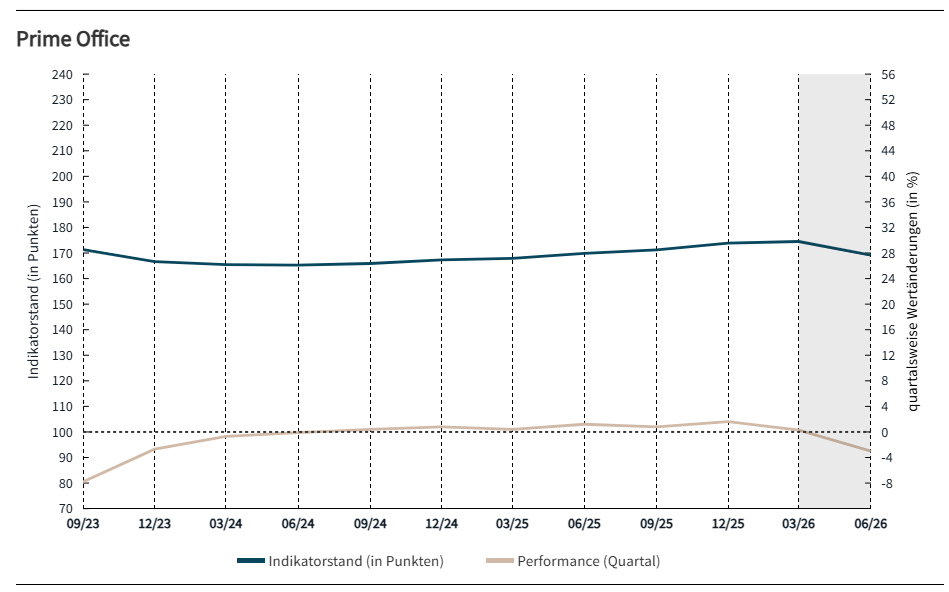
The office performance indicator Victor Prime Office, published quarterly by JLL, shows an adjustment of office property prices to the changed market conditions for the second quarter of 2026. After seven quarters of stable to slightly positive movements, the indicator level for the observed top locations in the German real estate strongholds of Berlin, Düsseldorf, Frankfurt, Hamburg and Munich fell by three percent to 169.2 points at the end of June 2026 compared to the first quarter. The decline was mainly due to increases in yields at all locations, which could not be offset by the positive impetus from the rental markets.
“The change is a reflection of the current pricing in a still comparatively inactive investment market for office properties,” says Ralf Kemper, Head of Value and Risk Advisory at JLL Germany, commenting on the figures. While the evidence of the previous quarters had already pointed to a necessary yield adjustment by the middle of the year, sufficient findings from transactions and bidding processes have accumulated over the past few months to underpin a higher yield level. Accordingly, yields rose by 20 basis points each in Berlin, Düsseldorf, Frankfurt and Hamburg and by ten basis points in Munich compared to the previous quarter. “The sales of well-known office buildings in the banking district of Frankfurt and Düsseldorf nevertheless had an impact on these yield adjustments. Both properties are part of the upscale office stock in premium locations. For ultra-modern, ESG-compliant top properties in sought-after office locations, relatively high prices and thus low initial yields are occasionally being called,” says Kemper. “However, the number of negotiations that ultimately lead to a successful conclusion is still relatively low, and numerous transactions are broken off by a seller who is disappointed as a result of the poor bidding situation.” The cumulative transaction volume in office properties in the five cities remained stable compared to the previous quarter at just over one billion euros. In the first half of 2026, a good two billion euros were thus invested in offices in the cities considered here. The positive news is that this volume represents a significant increase of 24 percent compared to the very low level of the corresponding period last year.
The picture is different in the occupier markets: the office letting market continued to develop robustly in the first half of 2026, and take-up in the five cities remained slightly above the figure for the first half of 2025 (1.19 million m²) at just over 1.21 million m². “The rental markets are once again proving to be an anchor of stability and are likely to remain so in the future,” emphasizes Kemper. “This is reflected above all in the high-quality segment, i.e. in prime locations and in top products, where rental agreements show stable or even rising rents.”
While the overall market is struggling with rising vacancies everywhere, there is an opposite trend in the absolute premium segment: The vacancy rates in the absolute top locations of the five German A-cities considered in the Victor fell slightly in the second quarter of 2026 and remain at a very low level. This development underlines the increasing polarisation of the market: while second- and third-tier properties are suffering from structural challenges, demand for first-class office space in prime locations remains robust. Users focus on high-quality, modern and sustainable working environments, which explains the resilience of the premium segment.
Munich remains the market with the most stable price level
In terms of the change in the indicator, the individual locations developed differently in the second quarter of 2026: Berlin recorded the most significant decline with minus 4.7 percent to 174.3 points, followed by Hamburg with minus 3.8 percent to 192 points. In both cities, there were hardly any positive rental effects, so that the yield increases of 20 basis points each fueled the decline in indicators almost unchecked. In Frankfurt am Main and Düsseldorf, positive impulses from the rental market compensated for the impact on returns, with the increase in prime rents by three euros to 55 euros in Frankfurt being particularly noteworthy. The index fell less sharply there: in Frankfurt by 2.8 percent to 148.30 points, in Düsseldorf by 2.5 percent to 153.9 points. With a decline of only 1.7 percent to 191.2 points, Munich once again proved to be the most stable market among German A-cities. In addition to the below-average increase in the prime yield by “only” ten basis points, this is due to positive rental price developments.
Due to the poor quarterly result, the annual performance calculated across all locations (comparison of the indicator level Q2 2026 to Q2 2025) also turned negative and recorded a decline of 0.4 percent. Hamburg remains in positive territory with an annual performance of 3.8 percent, thanks in particular to the excellent result of the fourth quarter of 2025 (6.6 percent). Düsseldorf still reaches 0.5 percent. The other cities show a loss of value of 0.2 percent in Munich, 1.9 percent in Frankfurt and 2.9 percent in Berlin over the year.
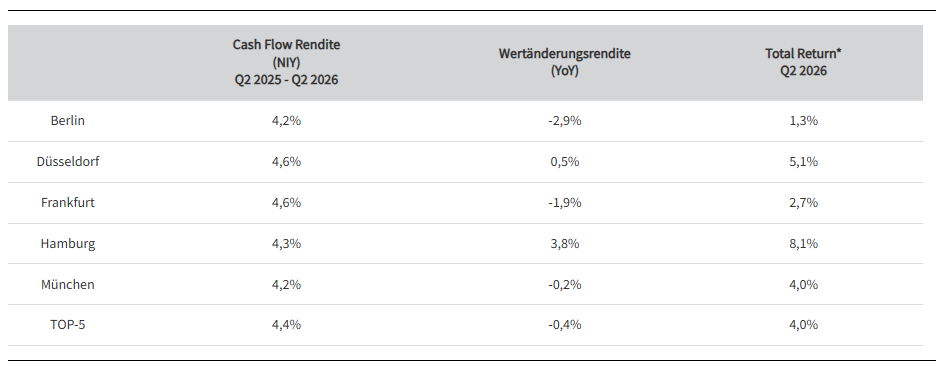
Munich stands out in the city comparison of the second quarter. The Bavarian capital recorded several major deals, including some in the three-digit million range, such as the sale of the Prinzregentenplatz property by a major German institutional investor. The transaction volume was thus above the quarterly average of the past 14 quarters (since the slump in transaction volume in the first quarter of 2023) and totals just under 550 million euros in the first half of 2026, putting Munich in first place among the five major German cities. The same applies to the office letting market: Munich, along with Berlin, accounts for the majority of take-up by a wide margin. “Munich seems to be able to keep the price level most stable, as could be seen from several purchases by very long-term investors,” Kemper summarizes. “The rental market here is also particularly dynamic in a positive sense, which further consolidates Munich’s position as the most consistent investment market among German A-cities.”
The economic environment in Germany will remain challenging in the second quarter of 2026. According to initial estimates by the Federal Statistical Office, GDP rose by only 0.2 percent. The real estate market is aggravated by the 25 basis point increase in key interest rates due to the recurring flare-up of the Iran war and increased energy prices.
The difference between the availability of debt capital and equity capital remains remarkable. “Liquidity among debt capital providers, i.e. banks and alternative financiers, remains very high. The high willingness to finance leads to competition for the few attractive financing opportunities. As a result, we see pressure on margins and an expansion of loan-to-value ratios, which indicates a higher risk appetite on the part of banks,” says Kemper. This observation is confirmed by the German Real Estate Financing Index for the second quarter of 2026, published quarterly by JLL and HWWI. Although the current financing situation for office investments is seen as critical, at the same time significantly improved future prospects are documented with regard to the willingness of credit institutions to finance.
The real stumbling block for the (office) investment market is still on the equity side: “Investors with strong equity are selectively looking for opportunities that take into account the current interest rate environment. The stumbling block for an expansion of transaction activity is still pricing, especially in Germany,” explains Kemper. “Whenever the seller is willing to accept or have to accept the changed market level, the transactions are also concluded. But as long as the market situation is not sufficiently acknowledged or there is other selling pressure, selective transaction activity is likely to remain.”