Purchase prices for new-build apartments rise again
Rents in Germany’s largest cities noticeably lost pace in the first half of 2026. Median rents rose by three percent on average, after growth in the same period last year was 6.8 percent. In contrast, the market for condominiums continues to gain momentum: With an increase of 2.9 percent, price growth is higher than a year ago.
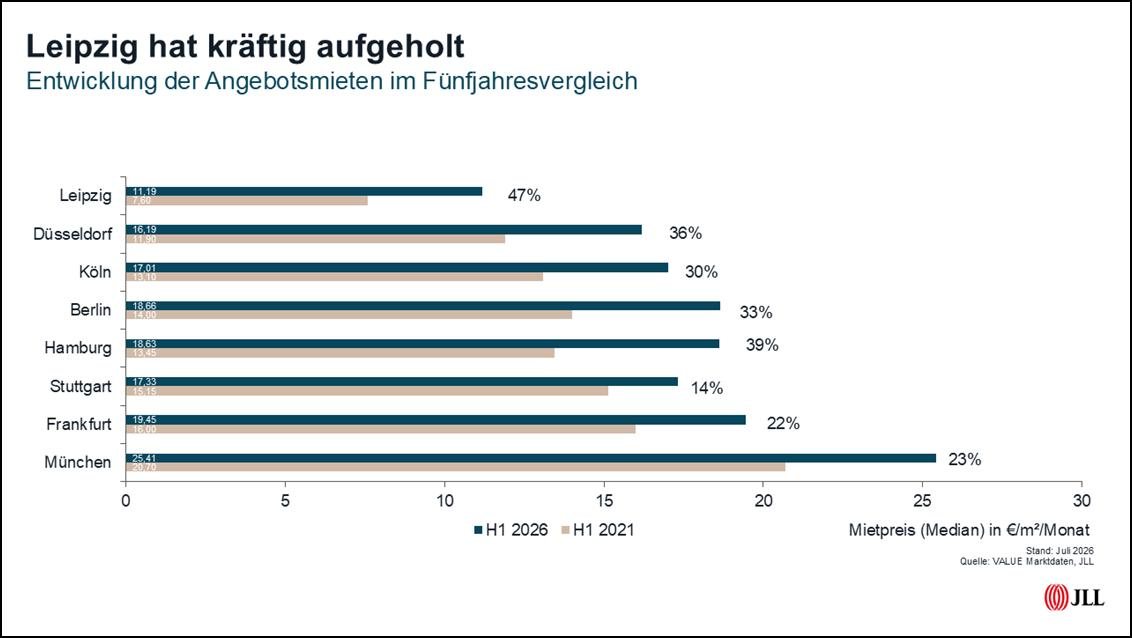
In the eight cities analysed – Berlin, Düsseldorf, Frankfurt, Hamburg, Cologne, Leipzig, Munich and Stuttgart – the median asking rent, which includes both existing and new-build apartments, was 17.98 euros/m² in the first half of 2026. The cheapest apartments are still found in Leipzig (11.19 euros/m²), while in Munich, prospective tenants have to pay more than twice as much at 25.41 euros/m².
Outside the metropolises, a differentiated picture emerges: In the independent cities, rent growth of 3.4 percent was almost at the previous year’s level (3.3 percent). The rural districts, on the other hand, recorded an accelerated development of 4.8 percent compared to the previous year (3.7 percent).
A total of around 32,000 rental offers and 27,000 purchase offers were evaluated for the analysis. Both new buildings and existing buildings were considered.
As was already observed in the second half of 2025, rents in the new construction segment are hardly growing. At 21.39 euros/m², average rents for new buildings in the eight metropolises in the first half of 2026 were only slightly above the previous year’s level (plus 0.5 percent). After rents for new buildings had risen by 8.6 percent in the previous year, the development has thus almost come to a standstill.
Dr. Sören Gröbel, Director of Living Research at JLL Germany, explains this development with the shrinking supply of new-build apartments in conjunction with a growing share of price-controlled units. As a result, individual completed projects have a disproportionately negative impact on the development of rents. “The changes measured therefore increasingly reflect the individual characteristics of the properties and less the fundamental market movement,” says Gröbel.
A quality-adjusted analysis, which excludes the influence of property characteristics and micro-location differences, is therefore better suited to analysing market developments in the new construction segment. According to this, there are strong rent increases in Leipzig (six percent) and Hamburg (4.8 percent). In Berlin, on the other hand, a downward correction still has to be made, but it is lower at one percent.
When looking at the absolute rent levels, Munich maintains its undisputed top position at 26.48 euros/m². This is followed by Hamburg with 23.75 euros/m², Stuttgart with 23.00 euros/m² and Berlin with 21.92 euros/m². At 15.00 euros/m², Leipzig remains the cheapest market for new-build apartments among the cities surveyed.
For existing apartments, the momentum is higher at an average of 3.3 percent, but much more flattened out than a year ago (6.6 percent). The average new contract rent for existing apartments in the first half of 2026 amounted to 17.54 euros/m². There are considerable regional differences: Hamburg leads with an increase of 6.2 percent, although there is also a slowdown compared to the previous year’s figure of 10.6 percent. In Leipzig, the previously exceptionally high growth of 10.2 percent to 2.5 percent has cooled significantly. Berlin is the only metropolis to show a decline: New contract rents for existing apartments fell by 4.2 percent in the federal capital.
Inexpensive apartments are becoming disproportionately more expensive
In the premium segment, the increase in rents in the first half of 2026 lagged behind the market as a whole. Prime rents (top decile) on average in the eight metropolises climbed by 2.3 percent, while rents in the lowest price segment rose by 5.5 percent. “The willingness to pay at the upper end of the market is increasingly reaching its limits. Affordability is becoming the determining factor for rental growth. This is particularly evident in the fact that high-priced apartments are growing less than low-cost properties,” Gröbel analyses.
Massive increase in prices in the long term is increasingly burdening households
Despite the current subdued momentum in both existing and new-build housing, new contract rents have risen at an above-average rate over a longer period of time. This is leading to a growing financial burden on households. Over the past five years, rents in the eight cities have risen by an annual average of five percent – with considerable regional differences. Berlin leads this development with an average annual increase of 8.4 percent, followed by Leipzig with eight percent. Stuttgart brings up the rear with 1.9 percent annually. The persistently tense situation on the rental housing markets in major German cities has prompted, among other things, the legislature to tighten tenancy law again.
The housing market is still imbalanced. Thus, an unchanged high demand meets too little supply. The number of completions continued to shrink in 2025: Stuttgart recorded the sharpest slump with a decline of half to just 661 units. This is followed by Munich (minus 33.5 percent) as well as Berlin and Hamburg (each minus 28.2 percent). Cologne is a positive exception with 4,371 completed apartments (up 144.5 percent).
Despite declining completions, there were signs of a turnaround in building permits, with Hamburg (up 44.6 percent), Berlin (up 40.7 percent) and Frankfurt (up 40.3 percent) registering significant increases. “Overall, the approvals remain well below previous annual values and will also only be reflected in actual completions with a considerable delay and probably also in lower numbers. The reason is that we observed a peak in the number of expired building permits last year,” says Gröbel. In addition, the conditions for new residential construction remain challenging, with a still difficult financing environment and rising construction costs.
Condominium market continues recovery
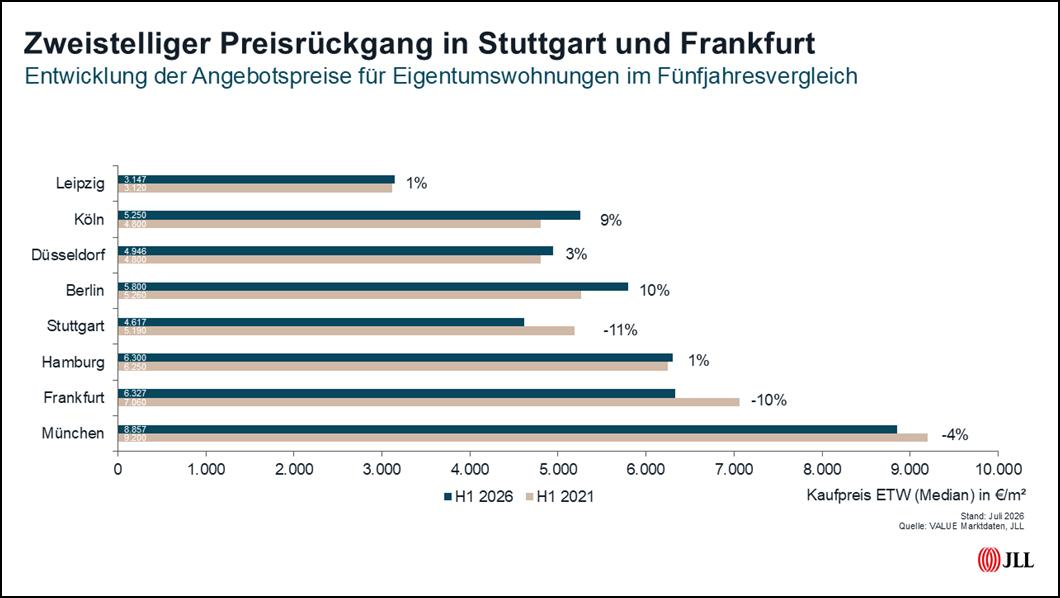
The market for condominiums continued its recovery course in the first half of 2026. The average purchase price for condominiums in the eight metropolises reached 5,656 euros/m² – an increase of 2.9 percent compared to the previous year. At that time, price growth was only 0.4 percent.
This development was driven by the existing segment, whose purchase prices rose by 2.4 percent in the first half of 2026, thus showing a stronger recovery. In the previous year, growth had been 1.6 percent.
While prices for existing apartments had fallen more sharply in recent years than those for new buildings, which react less flexibly due to the link to construction costs, the existing segment is now somewhat more dynamic with growth of 2.4 percent. But new construction purchase prices are also currently returning to the growth zone. On average for the eight cities, the increase is 1.1 percent, after a minus of 1.6 percent in the previous year. The average new building purchase price is 7,935 euros/m². At 10,813 euros/m², Munich maintains the highest price level for new construction, ahead of Hamburg at 8,411 euros/m² and Berlin at 8,135 euros/m².
Roman Heidrich, Lead Director Residential Valuation JLL Germany, assesses the development: “Price growth increased compared to the second half of 2025, although the general conditions deteriorated in the course of 2026, in particular due to rising mortgage rates. While the price development has so far remained unaffected by this, the changed situation is reflected in the speed of sales. This slowed down again in the first half of the year.”
Regional differences shape the development of purchase prices
The regional analysis reveals considerable divergences in development dynamics. Cologne leads with growth of 5.6 percent after 4.3 percent in the previous year, thus confirming the stable growth path. Düsseldorf is making a U-turn with 6.2 percent growth after minus 1.7 percent in the previous year, and Munich is showing solid growth at 2.1 percent, albeit slightly below the previous year’s figure (2.6 percent).
In the new construction segment, Berlin leads the recovery with a strong jump of 5.4 percent after minus one percent in the previous year, while Leipzig ends its phase of stagnation with 0.9 percent growth after 0.0 percent in the previous year. Düsseldorf recorded a sustained decline of minus 1.1 percent after minus 0.2 percent in the previous year, while Frankfurt showed a noticeable slowdown with only 0.3 percent growth compared to the previous year’s figure (five percent).
Asking rents and asking purchase prices are evaluated from value market data, which are characterized by particularly broad market coverage. In doing so, JLL analyses all rent and purchase price offers of the free housing market concluded at the respective time of consideration and presents them as median values. The respective twelve-month periods are considered. The presentation of the analysed data sets extends to the district level, differentiated into building age classes and apartment sizes. Further detailed evaluations are available on request.
* In the quality-adjusted consideration of price developments, the changes in the data sets of the half-years with regard to the condition and equipment of the properties as well as with regard to the micro-locations are excluded using a hedonic approach. All trends are checked for validity, even if this is not explicitly mentioned in the text.