

Space let totalling 123,000 m² exceeds the long-term quarterly average
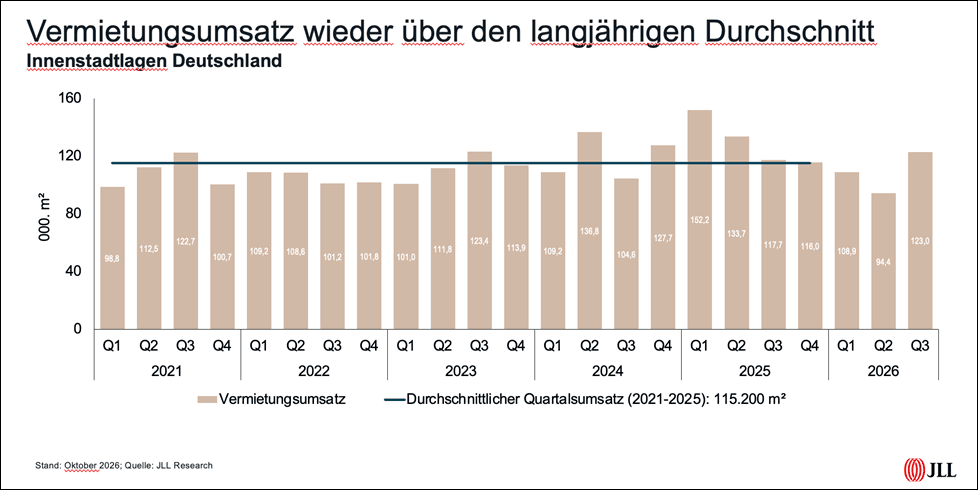
The German retail property lettings market gained significant momentum in the third quarter of 2026. The take-up of 123,000 m² significantly exceeds the weak figure for the previous quarter (94,400 m²) and is also slightly above the average quarterly take-up for the years 2021 to 2025 of 115,200 m².
The market picture remains solid when viewed over the year as a whole. After the first three quarters of 2026, take-up totalled 326,300 m². Market activity thus remains below the record level of the previous year, although letting momentum picked up again in the third quarter. The number of recorded transactions remained stable at 167 compared with the previous quarter (168), whilst the average leased area per transaction rose by around 31 per cent compared with the previous quarter. The ten leading German retail hubs accounted for 50 per cent of all transactions. Their share of space take-up rose from 41 per cent in the second quarter to 48 per cent in the third quarter. This confirms the continuing concentration of letting activity in these locations.
International retail chains are driving demand
International retail chains continue to have a strong presence in the German retail lettings market. In the third quarter, international retailers accounted for 67 per cent of the space let and 57 per cent of the deals concluded.
Aniko Korsos, Head of Retail Leasing at JLL Germany, explains: “International brands continue to form the backbone of the lettings market. The layout of the space plays a significant role here: global retailers are specifically seeking larger flagship units in order to fully showcase their brand experience. This demonstrates that Germany remains a key market for global expansion strategies.”
Berlin leads the way, whilst Leipzig sees a significant increase
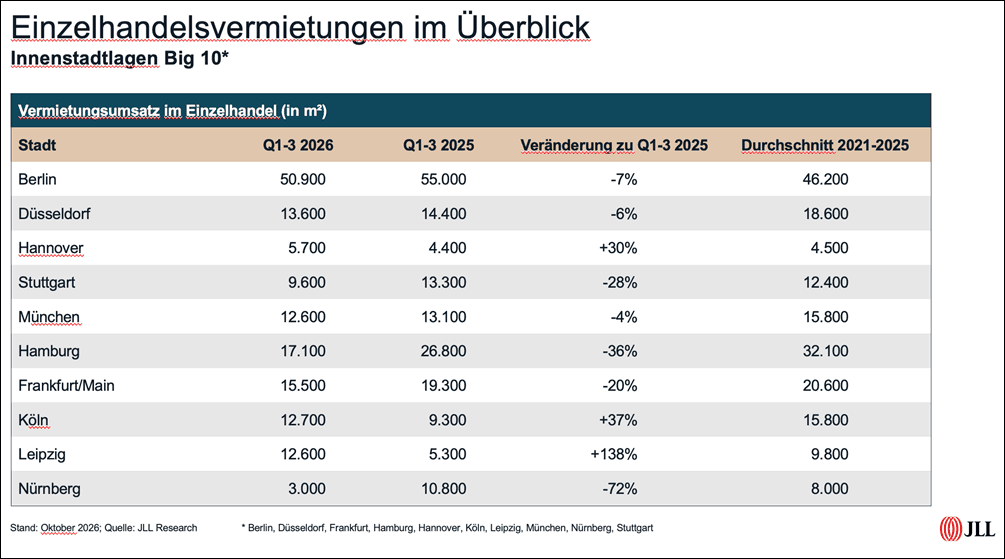
Berlin remains by far the strongest retail location in the first three quarters of 2026. With a take-up of around 50,900 m², the capital accounts for approximately one-third of the total letting volume across the ten major cities. Although this represents a seven per cent decline compared with the same period last year, Berlin still remains above the average for the years 2021 to 2025 (46,200 m²), which underlines the location’s high appeal.
Further down the list are Hamburg with 17,100 m² and Frankfurt am Main with 15,500 m², followed by Düsseldorf with 13,600 m² and Cologne with 12,700 m². Leipzig also achieved a strong result with 12,600 m². The city is well above the previous year’s figure and clearly exceeds its long-term average. Munich also reached 12,600 m², which is only slightly below the previous year’s level.
Whilst several markets are recording a decline in take-up, Leipzig (+138 per cent), Cologne (+37 per cent) and Hanover (+30 per cent) in particular are showing strong growth compared with the same period last year. By contrast, the figures for Nuremberg are significantly weaker, with take-up of 3,000 m² (-72 per cent) well below the previous year’s level. Hamburg (-36 per cent) and
Stuttgart (-28 per cent) are also recording noticeable declines.
“The marked divergence between locations highlights just how volatile the markets are outside the three largest cities. In cities such as Leipzig, even a single large-scale let can significantly boost the overall result for a quarter. Conversely, the absence of such deals during the reporting period has an immediate impact. The current picture is therefore less a widespread trend than the result of very targeted individual deals,” explains Aniko Korsos.
Clothing retailers and food concepts are the main drivers of demand
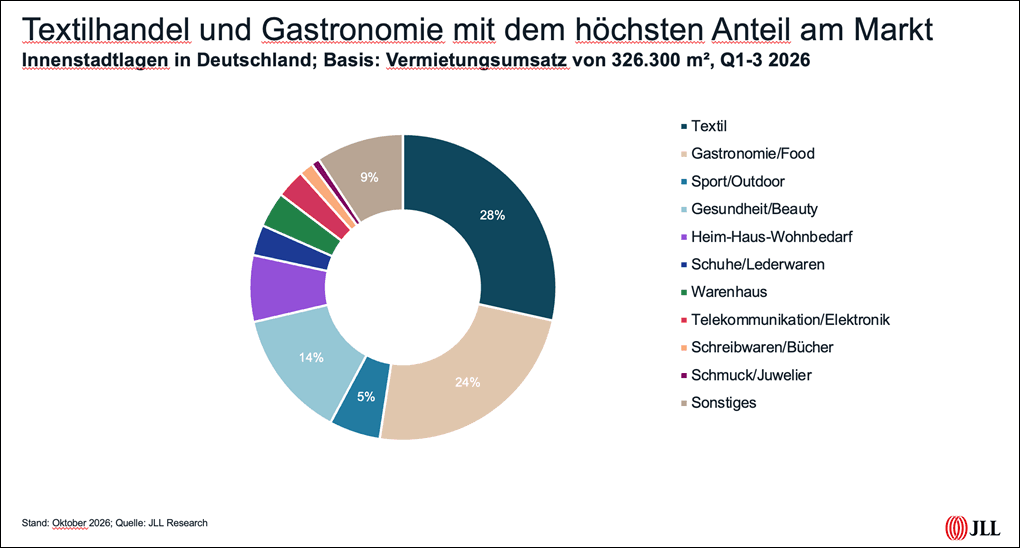
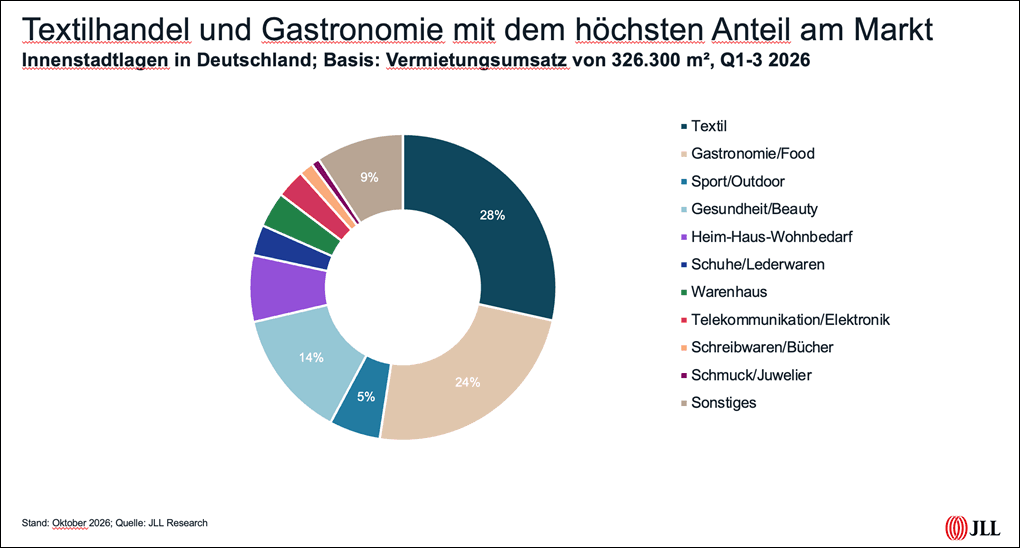
With a take-up of around 92,900 m², the clothing retail sector accounted for more than 28 per cent of the total letting volume in the first three quarters of 2026. Particularly active players included Inditex, New Yorker and Jack & Jones, which contributed to the strong market momentum with several new leases. The clothing sector has thus once again confirmed its leading role in driving demand for retail space.
In second place is the catering/food sector, with a floor area of around 78,200 m² (just under 24 per cent). A large proportion of this is accounted for by catering-related uses. Among the fastest-growing brands so far this year are Go Asia, Rewe and Edeka, which have further expanded their presence with new outlets.
Prime rents largely stable – significant correction only in Nuremberg
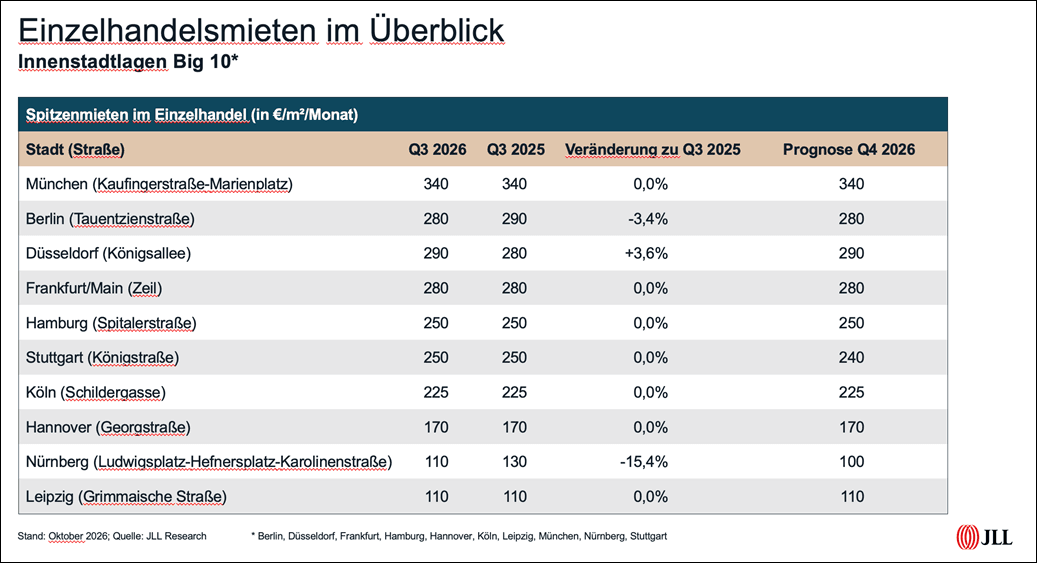
Munich retains its position as Germany’s most expensive retail location, at 340 euros per square metre per month. Frankfurt am Main remains at 280 euros, whilst Hamburg and Stuttgart are both at 250 euros. Cologne remains at 225 euros, Hanover at 170 euros and Leipzig at 110 euros. This means that rental levels in the third quarter of 2026 remained unchanged in the majority of the ten leading retail locations.
Year-on-year, changes can be seen at three locations. In Berlin, the prime rent fell by 3.4 per cent to 280 euros per square metre per month, whilst Düsseldorf saw an increase of 3.6 per cent to 290 euros. Nuremberg recorded the sharpest decline, falling by 15.4 per cent to 110 euros. Together with Leipzig, the city thus has the lowest prime rent among the ten major cities.
In the other 56 cities analysed by JLL, prime rents also remained unchanged. This applies to all four city size categories examined: cities with at least 500,000 inhabitants, those with 250,000 to under 500,000, those with 100,000 to under 250,000, and those with fewer than 100,000 inhabitants. On average across Germany, across all 66 cities surveyed, rent levels remained virtually constant.
The outlook for the fourth quarter of 2026 suggests that conditions will remain largely stable. Eight of the ten leading retail locations are expected to maintain their current prime rents. Only in Stuttgart could the rent level fall slightly to 240 euros, whilst a further decline to 100 euros is expected in Nuremberg.
Aniko Korsos sums it up: “The noticeable upturn in the third quarter underlines the solid demand base in the German retail market. However, it is still too early for euphoria: tenants remain very price-sensitive and weigh up their leasing decisions carefully – a process that can sometimes be very protracted. Landlords must therefore capitalise on the current market dynamics to secure successful lease agreements, whilst ensuring they do not lose sight of the needs of both parties. The outlook for the final quarter gives us confidence regarding the continued momentum in lettings, so we expect a solid result for the year.”