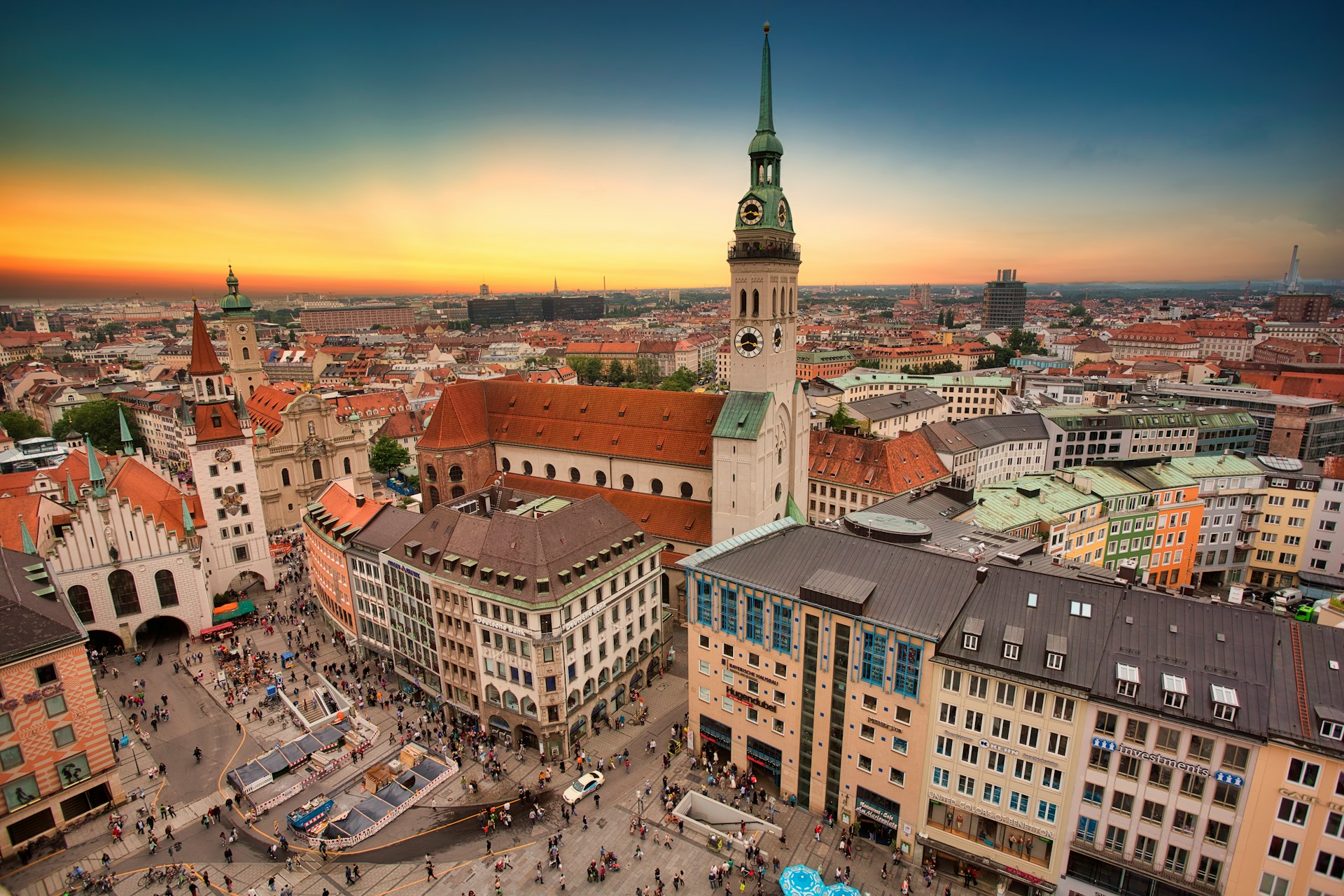
In the second quarter, Munich’s investment market continued where it left off in the first quarter – namely as the leading investment location in the turnover ranking of A-cities. With a transaction volume of around €1.24 billion, only the Bavarian capital was able to crack the billion euro mark in the middle of the year. This is the result of the analysis by BNP Paribas Real Estate.
“The fact that larger revenue drivers were also involved, but not exclusively, is underlined by the number of registered deals, which was last higher in 2022. For example, the market environment that continues to be challenging means that the number of deals has fallen by almost 38% in a long-term comparison, but the increase in revenue of almost 35% compared to the previous year sends a positive signal,” explains Michael Morgan, Munich Branch Manager of BNP Paribas Real Estate GmbH.
Notable transactions in the first six months include investments in the three-digit million range. Of particular note is the Alte Akademie, formerly part of the Signa portfolio, which is one of the largest retail deals in Germany this year. In addition, two of the five largest office investments in Germany were registered with the inner-city office assets at Prinzregentenplatz 7 to 9 and Sonnenstraße 15 (formerly Lindberg-Haus).
In terms of prime yields, there have been no market-relevant changes in both the retail highstreet (3.45%) and office sectors (4.20%) so far this year, while the upward pressure in the logistics segment has led to a slight adjustment of ten basis points to 4.60%.
City and office deals in the investment focus, 50% above and below € 100 million each
In the distribution of take-up in the half-year balance sheet by property types and sub-locations within the Munich market area, two clear winners stood out in the form of office investments and central locations. In this context, office properties account for just under 47% of the total volume and almost 57% of the result can be located in the centre of the Bavarian capital.
In addition to the above-mentioned large-volume office buildings and the high-street property “Alte Akademie”, the Excelsior Hotel and serviced apartment properties (currently operated by Numa and Limehome) have also changed hands in inner-city locations, which has contributed to an overall diversified investment activity in Munich’s most important submarket. The transaction activities outside the city can also be described in a small-scale but varied way, with some office properties as well as logistics and retail and food retail sales being observed. Taken together, a good 43% of the volume was generated outside the city centre.
In the size classes, around as much has been invested in top properties above the €100 million mark as in medium-sized and smaller commercial properties up to this threshold. This results in an average volume per deal of around €39 million.
Outlook: good foundation for the second half of the year has been laid – continued cautious optimism due to global uncertainties
“At the middle of the year, the Munich investment market created a very good starting position to be able to record an increase in turnover at the end of the third and fourth quarters compared to the same period last year. The Bavarian metropolis underlines its continued excellent competitive position in a comparison of cities not only by leading the location ranking, but also by the top office and retail deals, which are once again among the largest nationwide investments in their respective asset classes,” says Michael Morgan.
The fact that Munich’s office leasing market was also in good shape in the first six months of the year and reported above-average take-up with further rising rents should further strengthen the return of confidence in the office sector. In addition, the investment location has repeatedly recorded larger high-street transactions and hotel sales above the €50 million mark, which is a clear indication of the equally positive conditions in these two sectors.
Nevertheless, the market-dominating uncertainties about the geopolitical situation, financing conditions and economic developments have the potential to fundamentally change the investment environment overnight and drive it in a different direction. However, the Munich Metropolitan Region has the basic prerequisites for a continuously increasing investment volume. Munich is an economic powerhouse that is future-proof and fast-growing with its technology sector and innovative industries. This is the key investment argument for investors.