BNP Paribas Real Estate publishes logistics market data for the 1st half of 2026
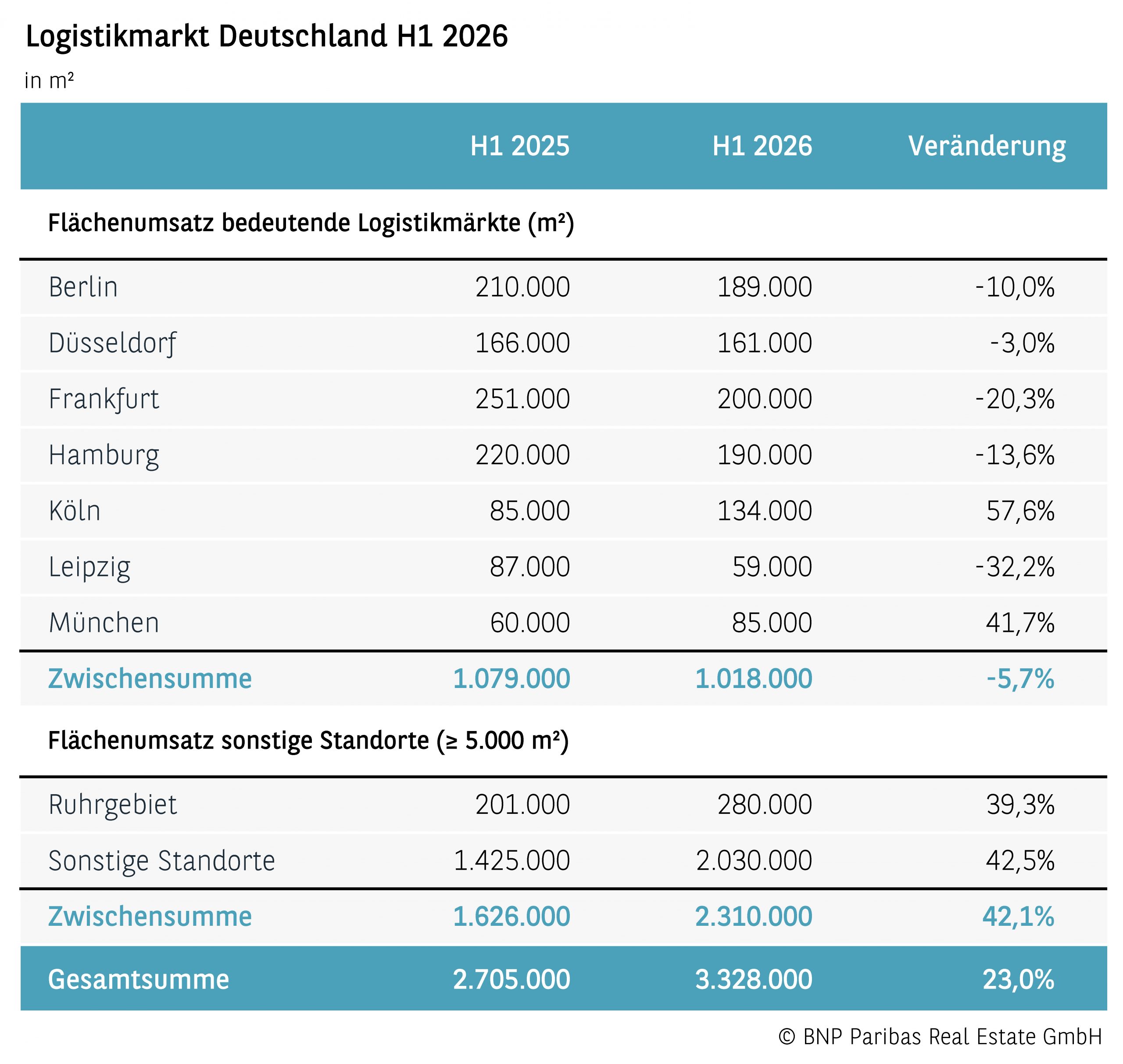
The nationwide warehouse and logistics space market continues its impressive growth trajectory and closes the 1st half of the year with take-up of a good 3.3 million m². This result is around 23% higher than in the previous year and also slightly above the ten-year average (+4%). The second quarter was able to increase by almost 16% compared to the first three months of the year. This result is all the more remarkable in view of the economic and geopolitical conditions, which were further burdened in particular by the Iran war and the conflict over the Strait of Hormuz. This is the result of the analysis by BNP Paribas Real Estate.
“Overall, there is brisk market activity with a high number of contracts, with significantly more large deals of 20,000 m² or more being concluded than in previous years. This segment alone is responsible for around half of the total turnover and is thus at the second-highest level of the past ten years. Only in 2022 was a significantly higher volume sold in this category. Logistics service providers remain by far the largest demand group, with a market share of 44% and numerous large-scale contracts. The trend that has been going on for some time now that companies in the e-commerce sector are increasingly commissioning logistics service providers to handle their business is continuing. This applies above all to companies from the Asian region, especially from China, but also to other online retailers such as Amazon, which are expanding more strongly again,” explains Christopher Raabe, Managing Director and Head of Logistics & Industrial at BNP Paribas Real Estate GmbH.
The top logistics markets (Berlin, Düsseldorf, Frankfurt, Hamburg, Cologne, Leipzig and Munich) achieved a combined take-up of 1,018,000 m² by the middle of the year, which corresponds to a decline of almost 6% after the high result of the previous year. Frankfurt achieves 200,000 m²
(-20%), followed by the markets of Hamburg (190,000 m²; -14 %) and Berlin (189,000 m²; -10 %), which are almost on a par. While Düsseldorf with 161,000 m² was only slightly below the previous year (-3%), Cologne achieved the highest increase with 134,000 m² (+58%). Munich also increased take-up by almost 42% to 85,000 m², while demand in Leipzig has so far been relatively moderate (59,000 m²; -32%). In contrast, the polycentric Ruhr region recorded very high market momentum and closed the 1st half of the year with a volume of 280,000 m² (+39%). Outside the major logistics hubs, take-up totals 2.3 million m², which corresponds to a significant increase compared to the same period last year (+42%) and exceeds the ten-year average by 12%.
When it comes to the distribution of nationwide take-up by sector, it is particularly noteworthy that all three main segments increased in absolute terms compared to the previous year. Logistics service providers are clearly at the top of the ranking with a market share of almost 44%, but manufacturing companies also account for more than 1 million m² of take-up (30%) and thus also achieve an above-average value. With around 19%, retail companies are in third place. Although they are again taking up more space than in the weak previous year, they are still below their long-term average. However, this rather low value does not adequately reflect the generally high demand from retailers, as e-commerce companies in particular are increasingly mapping their space requirements by means of logistics service providers.
The rent level remained largely stable in the 2nd quarter. While prime rents in the individual markets remained at a constant level in the middle of the year, there was an increase in almost all locations compared to the previous year. At €11.25/m², Munich has by far the highest rent for top properties in excellent locations (+7% compared to H1 2025). This is followed by Frankfurt and Hamburg with €8.80/m² each (+7% and +4%) and Düsseldorf with €8.70/m² (+2%). In Berlin (€8.30/m²; +1%), Cologne (€8.20/m²; +6%) and the Ruhr region (€8.00/m²; +1%), the prime rent is also at least €8/m². In Leipzig, the price level is significantly lower at €5.70/m². Compared to the previous year, prime rents rose by an average of a good 4% to around €8.50/m² across the top markets, while average rents recorded an average increase of 5% (€7.20/m²).
Prospects
Despite moderate economic growth and geopolitical uncertainties, the warehousing and logistics market achieved excellent take-up, which was significantly higher than in previous years and was able to increase even more in the second quarter. Uncertainty factors and risks persist, especially with the ongoing Iran war and the conflict over the Strait of Hormuz and the erratic US tariff policy, and are having an impact on international trade flows and supply chains in addition to increased energy prices and a new interest rate level. The Federal Government’s planned reform package, on the other hand, is expected to provide impetus for higher economic growth in Germany.
In the further course of the year, the existing trends on the demand side of the German logistics leasing market are likely to continue. In order to be able to react quickly to changing conditions, supply chains are stabilized and local inventories are increased. While the automotive sector is still in the process of transformation, some deals are already being registered in the defense sector. Above all, however, e-commerce companies are demanding extensive space, especially through logistics service providers.
In some top markets, the issue of short-term space availability is likely to come to the fore again. In the large-scale segment in particular, extensive space has been absorbed by the market in many locations in high demand, and accordingly there are signs of a noticeable excess demand in the short to medium term. The continued rather restrained speculative construction activity does not compensate for this development to the necessary extent. In the course of this, it can be assumed that prime and average rents will rise.
“Due to the continuing momentum on the rental market, we expect a take-up result for the year as a whole that should be well above 6 million m² and thus higher than in previous years,” says Bastian Hafner, Head of Logistics & Industrial Advisory at BNP Paribas Real Estate GmbH, summarising the outlook.