The renewed price shock for oil and gas is increasing global inflationary pressures and bringing dependence on fossil energy imports back into focus. The European Central Bank (ECB) raised its key interest rates by 0.25 percentage points on 10 September 2026, explicitly referring to the ongoing inflationary pressures caused by the conflict in the Middle East.
The prices for oil and gas are determined on international markets. Germany cannot escape this price risk on the world markets solely by changing supplier countries or supply routes. Domestic renewable energies reduce this dependence and act as a price brake. “The price drivers have a name: fossil energies. The best protection against inflation is the transformation of oil and gas to electricity from domestic renewable energies in combination with energy storage,” says IWR Managing Director Dr. Norbert Allnoch.
Cheaper electricity prices: How solar power is already pushing expensive gas-fired power plants out of the price formation
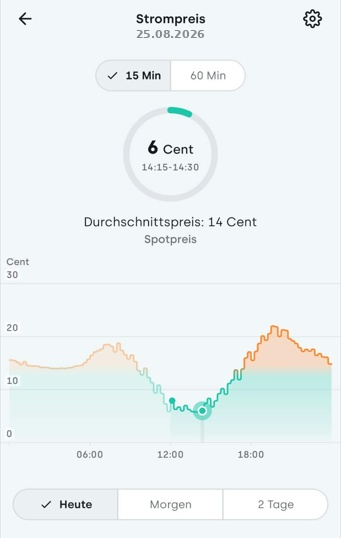
How the decoupling of expensive fossil fuels works in the electricity market is already becoming apparent. On particularly sunny days, exchange electricity prices often fall significantly during the day as solar power generation increases by noon and rise again in the evening with declining PV generation.
In the public debate, this typical price trend is often presented with a false causal chain: too much solar power penetrates the grid at noon, leads to an “oversupply”, is worthless, overloads the electricity grids and has to be “dumped” abroad at low prices. This misleading presentation mixes the pricing on the electricity exchange with the physical and grid processes in the electricity system.
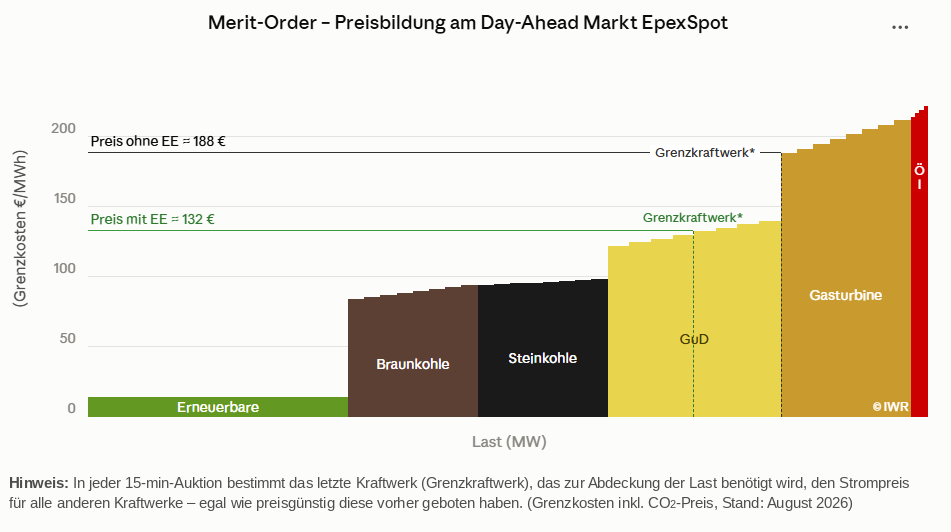
In fact, the merit order principle or marginal cost model applies to pricing on the electricity exchange. Power plants are ranked according to their bids. The last power plant that is still needed to meet demand determines the electricity price for all power plants considered in the auction – regardless of how cheap they have previously bid. Solar systems offer their electricity at low marginal costs and push power plants with higher marginal costs, e.g. gas-fired power plants, back in the merit order. As a result, electricity prices on the stock exchange fall. The low midday price is therefore a price signal from the electricity market and not evidence of an overload of the electricity grids.
The principle becomes clear with the current high gas prices. With a gas price of currently around 80 euros/MWh at the trend-setting European TTF hub, a gas-fired power plant with an assumed electrical efficiency of 50 percent alone incurs fuel costs of around 160 euros/MWh of electricity or 16 ct/kWh. CO2 costs and other variable costs are added to this. If such a gas-fired power plant is not needed to meet demand and is instead displaced from the merit order by cheaper generation, it can no longer set the high exchange electricity price. The result: a cheaper power plant or bid determines the price. The further renewable energies push expensive power plants back in the merit order, the lower the exchange price of electricity.
Stock market price and grid bottleneck are two different things
Regardless of the pricing on the electricity exchange, there are regional grid bottlenecks and curtailments of renewable plants. Nevertheless, according to the Federal Network Agency, more than 96 percent of the renewable electricity generated could be fed into the grid and transported to end consumers in 2025. A low or negative exchange electricity price is therefore not automatically an indication of a grid bottleneck.
With the commissioning of the large north-south power connections Ultranet (2,000 MW), A-North (2,000 MW), SuedLink (4,000 MW) and SuedOstLink (2,000 MW) by 2028, the transport options between the renewable generation centres and the consumption centres will continue to increase.
Battery storage systems shift cheap electricity into expensive hours
It is precisely the low electricity prices in the midday hours that create the economic incentive for battery storage systems. They buy electricity at low prices, store it and sell it again in the more expensive morning and evening hours. In this way, battery storage systems shift electricity volumes over the course of the day and follow the price signals of the electricity market.
The effect on electricity prices is in both directions: When charging, demand increases in the favorable midday hours. When unloading, the electricity supply increases in the more expensive morning and evening hours. As a result, exchange electricity prices fall there and expensive gas-fired power plants are pushed back in the merit order.
The combination of renewable energies and battery storage systems thus extends the price-lowering effect of wind and solar power over the course of the day. The more cheap renewable electricity can be postponed, the less often expensive gas-fired power plants have to determine the electricity price. At the same time, the influence of high international gas prices on the German exchange electricity price decreases.
IWR criticizes federal government: State-subsidized fossil gas power plants are the wrong price policy signal
Against this background, the IWR takes a critical view of the current design of the Federal Government’s strategy. State-subsidized gas-fired power plants on the planned scale, which are not only kept in reserve but can also participate in the electricity market, are an additional electricity price risk in the event of high gas prices. If they are needed to generate electricity, their high fuel costs can have a direct impact on the exchange price of electricity via the merit order.
“A permanently competitive electricity price level is of central importance for the German economy. This goal contradicts an electricity market design of the federal government, in which expensive fossil fuel power plants often determine the exchange price of electricity. It is therefore crucial that the fossil price risk of these power plants takes effect as rarely as possible,” says Allnoch.
In order to strengthen Germany as a business location, the focus should therefore be on the further expansion of wind and solar energy in combination with privately operated battery storage systems. Domestic renewable energies reduce dependence on fossil fuels, the prices of which are formed on international markets and are therefore not subject to nationally controllable price risks. Storage systems shift cheap electricity volumes to the more expensive hours and thus contribute to the fact that expensive gas-fired power plants are less likely to determine the exchange price of electricity.