


Private Markets discover structured finance as a growth technology. Fund risks are rated, carved and tailored to different balance sheets. This mobilizes new capital – and raises an old question anew: Where does risk distribution end and where does risk renaming begin?
Private markets have been growing for years, with more and more capital flowing into private equity, private credit, infrastructure or secondaries. But in the meantime, a second growth strategy is emerging.
The next stage of growth in private markets is not only created by new asset classes. It is created by the industrial breakdown of existing risks into balance-sheet building blocks.
The speed at which this market is growing is already shown by the figures of a single rating agency: KBRA. Between 2018 and 2024, it valued CFO issues with a total volume of 37.7 billion dollars. By September 2025 alone, another 16 billion dollars had been added. In the case of direct lending rated-note feeders, the issues rated by KBRA had also reached a new high of 9 billion dollars by then. And it’s not just the volume that is growing: Rated note feeders are increasingly structured with three or more tranches; in 2025, KBRA rated several structures with four tranches for the first time. (KBRA)
First Mechanism: Regulatory Translation
An insurer can directly hold a share in a private market fund. However, it can also structure its exposure via a rated note feeder and thus hold at least part of a rated bond instead of directly LP equity.
This can make a significant difference. The US investment consultant NEPC now describes rated note feeders as increasingly widespread. The practical reason: Depending on the company, a classic fund component can be associated with a regulatory capital burden of around 30 to 45 percent for US insurers. A rated note feeder can reduce the mixed burden to around 10 to 20 percent, depending on the structure. The same private market exposure thus requires significantly less regulatory capital. (NEPC)
The risk has not disappeared. But it has taken a form that is better suited to a regulated balance sheet.
Second mechanism: portioning of risk
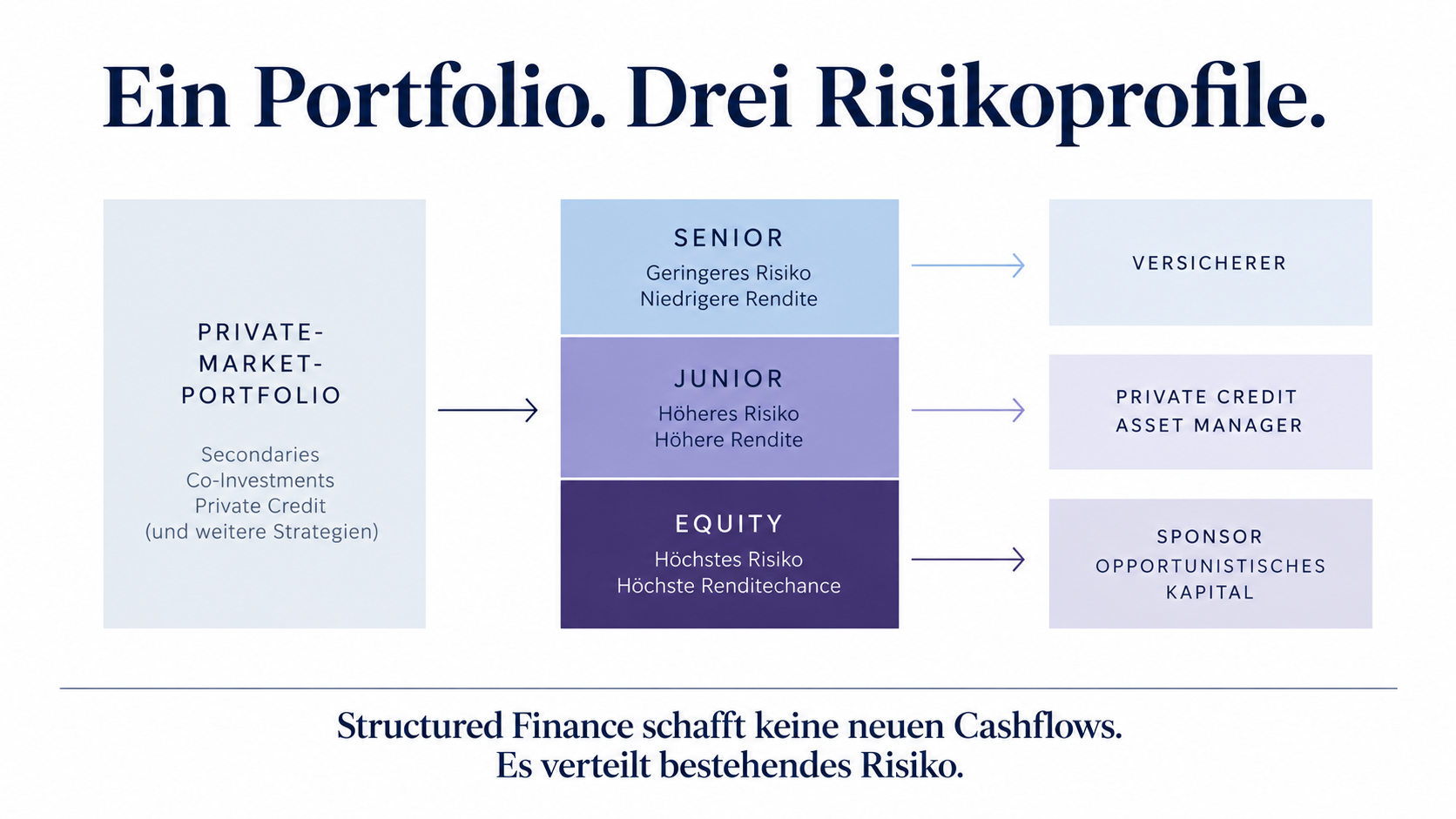
A CFO (Collateralized Fund Obligation) bundles private market exposures and finances this portfolio through different tranches. At the top are rated senior notes, below them are subordinated tranches and finally equity. Each layer bears a different share of the risk – and finds different buyers.
Carlyle AlpInvest shows how concrete this is now becoming. The $1.25 billion CFO, launched in 2025, bundles broadly diversified private equity exposure across different strategies, regions and vintages – including secondaries, portfolio finance and co-investments. This already diversified portfolio is then broken down a second time: by risk. Insurers, asset managers, banks and family offices participated in the transaction. (Carlyle)
And AlpInvest is not an isolated case. Franklin Templeton closed its first $1.5 billion CFO in August 2026 – with a portfolio of private equity secondaries and continuation vehicles as well as US middle-market direct lending. Franklin explicitly refers to the structure as a new capital raising channel for its private markets platform. (Franklin Templeton)
Typically, an insurer, for example, can buy the rated senior risk. Subordinated tranches and equity appeal to investors who consciously take on more risk in exchange for higher return opportunities.
The same private market portfolio thus gives rise to different investment products for different balance sheets.
And the technology is already moving on. Secondaries funds are also starting to break down their NAV loans into senior and junior tranches. The senior part can go to insurers, while the riskier junior part can go to private credit funds, for example. According to the Financial Times, the structuring is intended to reduce the cost of capital of secondaries funds and can allow them to acquire more fund shares or return capital to their own investors. CFO issuance of secondaries funds rose from just over $400 million in 2021 to $6.5 billion in 2025, according to KBRA data.
This is changing the growth logic of private markets. Until now, scaling has mainly consisted of finding more investors for an asset.
Structured finance is increasingly enabling the opposite:
The risk is broken down until its individual parts suit different investors.
This not only increases the buyer universe. If lower-risk insurance capital can take over parts of the financing more cheaply, capital costs fall. If additional financing capacity is created, secondaries funds can buy more assets.
Risk structuring is thus itself becoming the growth engine of private markets.
Where does risk distribution end – and where does risk renaming begin?
But this is exactly where the second side of the story begins.
This is because under these structures there are often already highly indebted buyout companies. Private equity funds lie above them. Secondaries funds buy their shares. These in turn are financed by NAV loans or CFOs. And in the meantime, this financing is also being broken down into different risk layers.
Leverage on leverage – and on top of that once again a capital structure.
This is not problematic per se. On the contrary, if an investor takes over first loss, the senior tranche actually becomes safer. Different risks end up on the balance sheets that they want and can bear.
This is risk distribution.
But the more layers are created between investor and underlying, the more important the question of where risk distribution ends – and where risk renaming begins – becomes.
An impressive reminder of the limits of this technology is provided by one of its older sisters: the securitization of real estate loans.
At the Centre Square office complex in Philadelphia, a $368 million real estate loan was securitized in 2020 in the form of Commercial Mortgage-Backed Securities (CMBS) and broken down into different risk tranches. The property had been valued at $471 million in 2019. After the collapse of the office market and the occupancy rate, the complex has now been sold with court approval for only $70 million – around 85 percent below the valuation at the time. All seven subordinated tranches are expected to be wiped out; the loss even reaches a tranche originally rated AAA. (CRE Daily)
This does not refute the logic of carving. As long as subordinate layers absorb losses, it works exactly as intended. But it shows its limit.
📌 Result
- The next frontier to growth is not just about freeing up more capital for private markets to win. It lies in putting every risk on the balance sheet that can bear it most efficiently.
- However, financial technology can only do cash flows . prioritize, distribute risks and reduce capital costs. It cannot multiply the cash flow, which in the end has to serve all shifts.