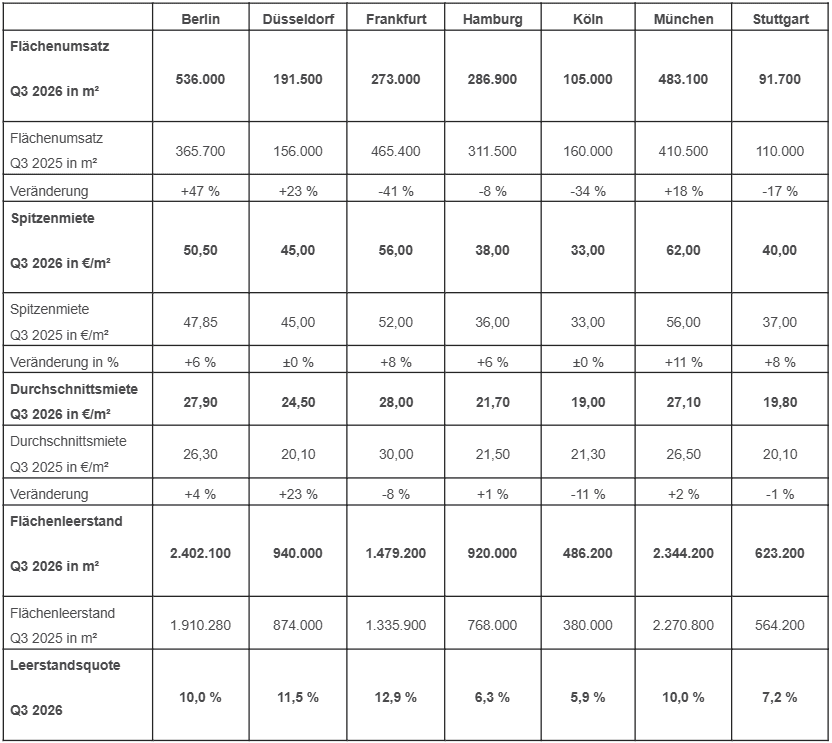
In the seven largest German office lettings markets, around 1.97 million square metres of office space were let in the first three quarters of 2026. This figure is just 2 per cent below the previous year’s figure and 6 per cent below the average for the past five years. However, behind this generally stable market performance lies a mixed picture across the individual locations. Whilst Berlin (+47 per cent), Düsseldorf (+23 per cent) and Munich (+18 per cent) recorded significant growth, Frankfurt (-41 per cent), Cologne (-34 per cent), Stuttgart (-17 per cent) and Hamburg (-8 per cent) fell short of their figures from the previous year.
“Given the challenging economic climate, a broad-based upturn in the office lettings market was not to be expected. This makes the generally robust market activity all the more encouraging, as it once again confirms that the market has already bottomed out. The number of lease agreements signed has risen slightly compared with the previous year, and even for large-scale deals exceeding 5,000 square metres, the figure of 55 agreements signed was almost on a par with the previous year’s level. Deals such as that involving BVG, covering almost 40,000 square metres in Berlin, or Uniper, covering almost 37,000 square metres in Düsseldorf, show that companies and institutions continue to make long-term location decisions,” says Cem Ergüney, Head of Office Letting Germany.
New-build activity is losing momentum
Whilst letting activity in the existing stock remains stable, market activity regarding lettings in property developments prior to the start of construction is proving significantly more subdued. The role of owner-occupiers is particularly striking: they account for 14 of the 30 recorded transactions, but at the same time, with around 117,600 square metres, they represent 57 per cent of the space taken up in this segment. Eight of these transactions were recorded in Munich and the surrounding area, with a further four in Hamburg.
Rising construction and financing costs, as well as more challenging marketing conditions, are making it more difficult to bring new projects to fruition. Owner-occupiers, on the other hand, are often able to act independently of pre-letting rates, marketing risks or future exit strategies, and usually pursue a long-term utilisation strategy.
“Whilst institutional investors are adopting a more cautious approach, owner-occupiers are becoming increasingly important. Under the current circumstances, they can make projects possible that might otherwise not have been realised. Given the shrinking project pipeline, owner-occupiers are therefore likely to continue to play an important role in the realisation of new projects in the coming years,” explains Ergüney.
Demand is being driven by various user groups
With a market share of 14 per cent each, the information and telecommunications sector and the manufacturing sector were the user groups generating the highest turnover in the first three quarters of 2026. The trend in the manufacturing sector is particularly striking, as it is now well above its five-year average of 11 per cent. The user structure points to the beginnings of a shift in the German economy. Technology-oriented, research-intensive and defence-related companies are increasingly emerging as key demand drivers in the office markets. The contribution of companies from the defence sector to the top seven’s take-up remains comparatively low overall, at less than five per cent. In Munich, however, their share has already reached around ten per cent. The geographical concentration of lettings there points to the formation of a sustainable cluster.
The public sector also remains a significant driver of demand. A look back over the past ten years highlights the particular importance of public-sector tenants when it comes to large-scale space requirements: whilst, across the market as a whole, only one in 33 lease agreements concluded during this period covered an area of more than 5,000 square metres, this figure rises to one in four for the public administration sector. The public sector thus remains one of the key drivers of large-scale lettings. However, increasing pressure to consolidate public budgets and a greater focus on more efficient use of space are likely to make demand more selective in future and limit its momentum.
Prime rents continue to rise selectively
Prime rents continued to trend positively in 2026, as expected, although this was no longer the case across the board. The sharpest increases were recorded in Munich, up 11 per cent, and in Frankfurt and Stuttgart, both up 8 per cent on the previous year. This trend was driven in particular by high-value leases signed by consultancy firms, banks and financial services providers.
“It is no coincidence that these particular user groups are currently shaping the trend in rental prices. An analysis of the top three per cent of all office lettings in terms of price for the years 2021 to 2025 shows that banks and financial services providers account for around 30 per cent of these deals. A further 22 per cent is accounted for by consultancy firms. Together with the information and telecommunications sector, these three user groups account for around two-thirds of all high-value leases. Demand for premium space is therefore currently concentrated primarily in knowledge-intensive sectors, which make targeted use of high-quality office locations to recruit staff, position themselves and strengthen their corporate culture,” says Francesca Boucard, Head of Market Intelligence & Foresight Germany.
Rise in vacancy rates is losing momentum
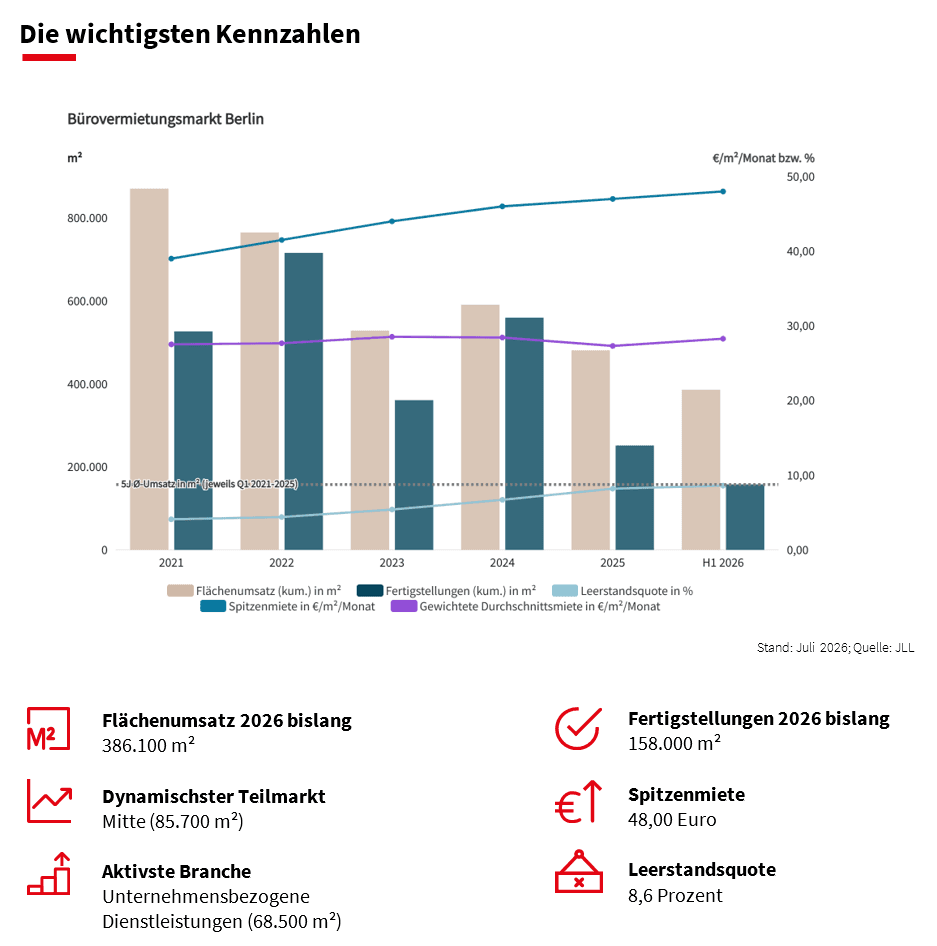
The vacancy rate in the top seven office markets rose to 9.4 per cent at the end of the third quarter and thus remains at its highest level for around two decades. Four of the seven locations now have a double-digit vacancy rate. Berlin has also reached 10.0 per cent. At the same time, there are signs that the rise in vacancy rates is slowing. The momentum seen in recent quarters has noticeably eased, suggesting a gradual approach towards the cyclical peak. In addition to more stable demand, this is also being driven by a significant decline in new developments, which is limiting the future supply of space. As a result, the existing stock is coming more into focus. This presents an opportunity for owners to adapt existing buildings to changing user requirements and position them to remain competitive in the long term.
A completion volume of around 1.1 million square metres is expected for 2026 as a whole. Around 52 per cent of this has already been pre-let. Just under half of the volume is in Berlin. At the same time, there are still signs of delays in individual projects.
Outlook: Stabilisation continues
For 2026 as a whole, Colliers expects take-up of around 2.6 million square metres in the top seven markets, which would be on a par with the previous year. “2026 is likely to be remembered above all as a year of stabilisation. Demand remains robust overall, and the operating environment for businesses has improved noticeably over the course of the year. The improved economic outlook is less a direct driver of demand than an important prerequisite for long-term business decisions. The declining risk of recession and the increased certainty for planning are creating a more stable environment for the occupier markets,” said Ergüney.