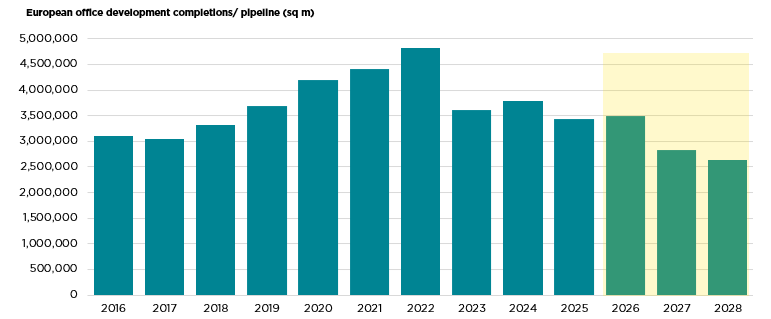
According to a recent study by Savills, European office completion volume in 2026 will remain stable year-on-year, at around 3.5 million square metres – a 28% drop from the peak in 2022. Labor shortages continue to affect the project developer market, delaying the completion of projects: 21% of the office space planned for 2025 has not been completed and postponed to 2026.
For 2027, the international real estate consultant expects a further decline in the volume of completions by 23% year-on-year to 2.7 million square meters, due to the lack of project starts since 2023.
According to Savills, only 1.5% of the office space in the development pipeline will be speculatively developed over the next two years, up from 3.0% four years ago. In terms of the total office space stock, Bucharest (3.6%), London West End (3.6%) and London City (3.2%) have the highest share of speculatively developed space in Europe with completion by the end of 2027.
“Some bold developers are pushing ahead with their projects in anticipation of an improving market – with higher rents and the hope of a normalized investment market with stronger price developments. Overall, however, equity remains more selective,” says Mike Barnes, Director, European Office Research at Savills.
Christina Sigliano, EMEA Head of Global Occupier Services at Savills, adds: “With the number of occupiers competing for prime centrally located office space, we expect vacancy rates for prime space in European cities to remain around 2-3% over the next few years. This will continue to put upward pressure on prime rents and provide opportunities for asset managers to convert secondary space into prime space.”
This development can also be observed on the German market: “In the top 6 German cities, too, the volume of completions in the next two years will be below the long-term average, with the availability of new construction space varying between cities: While there is still a comparatively large amount of new construction space available in Düsseldorf, short-term supply in Hamburg is already scarce. The development is reinforced by the low level of building permits for offices reached in 2025, which is likely to dampen the volume of new construction in the long term. If demand for high-quality space remains high, a further escalation of the shortage in the premium segment is foreseeable,” says Jan-Niklas Rotberg, Managing Director and Head of Office Agency Germany.