Improved material recycling reduces carbon footprint during demolition and subsequent new construction of office buildings – London, Amsterdam and Paris lead the way
The demolition and new construction of office buildings cause considerable grey emissions. One way to reduce this is to reuse materials in a circular manner. The framework conditions for this are increasingly developing in some European metropolises. According to a study by Savills, London, Amsterdam and Paris are leading the way in development – and a German city is also in the top 5.
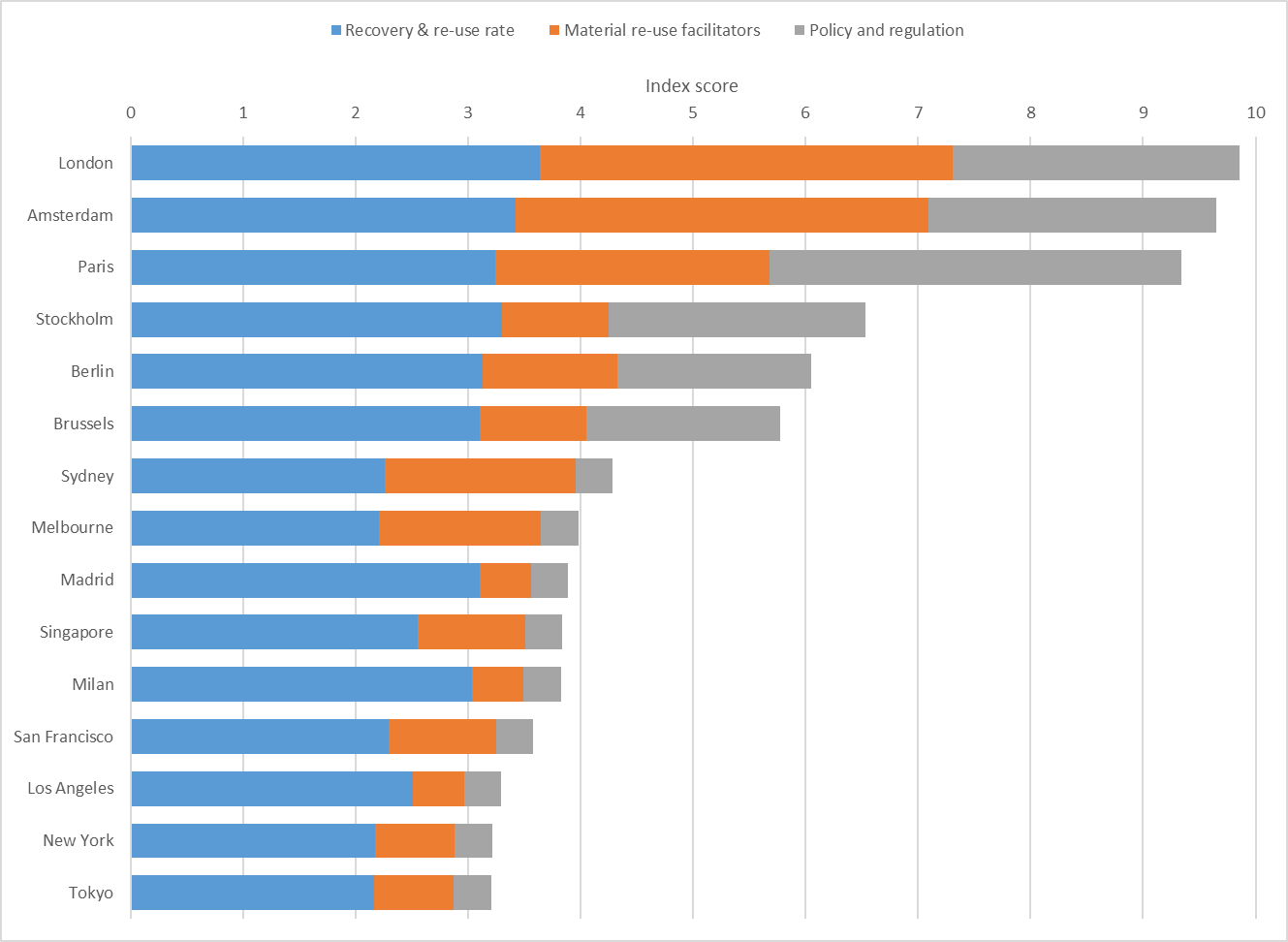
As part of its ‘Impacts’ series, Savills has developed the ‘Material Reuse Maturity Index’, which identifies which major office markets offer the most advanced material cycle frameworks. Recovery and reuse rates, the presence of specialized companies and service providers, and supporting local regulations are assessed. The result: More mature networks for recovery and trade in reused materials significantly improve the carbon footprint of demolition and new construction in these cities. Behind London, Amsterdam, Paris and Stockholm, Berlin ranks fifth in the index.
Savills emphasizes: In most cases, renovation remains the most effective measure for reducing embodied emissions in office buildings. However, both extensive renovations and demolition with subsequent new construction are cost-intensive – even if new buildings can enable long-term rent increases. According to Savills, the lack of high-quality office space in some markets means that high-quality and extensively renovated properties can also achieve significant rent increases. Successful projects, for example, exceeded average rent growth over a four-year period by 57% in Madrid and 67% in New York.
Sarah Brooks, Associate Director at Savills World Research, comments: “When weighing up between refurbishment and demolition followed by new construction, building owners consider numerous factors, including investment costs, length of potential vacancies, planning risks, exit yields and potential rent increases. While a building optimisation programme can cost less than 2% of the value of the building and a slight renovation 3-6% of the value of the building, the costs and risks of other measures – such as a deep renovation or complete demolition followed by a new building – are significantly higher. However, the potential returns can also be correspondingly larger.”
Joanna Conceicao, Director at Savills Earth, adds: “Office building owners face a huge modernisation task to adapt their portfolios to regulatory requirements and market expectations. In many markets, the majority of office space is threatened by possible non-compliance with upcoming or planned minimum standards for energy efficiency. Western European markets face particularly immediate challenges due to their comparatively older building stock and stricter future legislation. In other regions, these issues will also become more important as buildings age and policy requirements evolve. Even though renovations are still mostly the right solution for existing buildings from a lifecycle emissions perspective, it is positive that several large cities are making progress in establishing circular materials management. This will help reduce the emissions gap for projects where demolition and new construction are the most adaptable and long-term resilient solution.”
Daniel Gerdelmann, Managing Director Facility Management / Building & Project Consultancy at Savills in Germany, adds: “The reuse of materials opens up an additional opportunity for owners to strategically address sustainability goals in their portfolios. In the office segment, ESG has long since ceased to be defined solely in terms of energy consumption and operating costs, but increasingly also in terms of grey emissions, resource conservation and the question of how sustainable a building is over its entire life cycle. Especially when deciding between renovation and demolition with subsequent new construction, a functioning circular economy can therefore become an important building block in order to better reconcile regulatory requirements, market demands and ESG criteria. However, it remains crucial to evaluate each property individually – technically, economically and with a view to its long-term usability.”
Savills Material Reuse Maturity Index: