

The global secondaries market is reaching record volumes. But private markets do not simply become liquid as a result. Rather, an infrastructure is being created that increasingly organizes the handling of long-term capital in a professional manner.
Private markets are considered long-term. This is precisely one of its greatest advantages – and at the same time one of its greatest challenges. Anyone who invests in real estate, infrastructure or private equity often ties up capital for many years. However, this does not always fit the time horizons of investors. Strategies change, allocations are adjusted, and regulatory requirements evolve. The desire for an orderly entry or exit can therefore arise long before the end of a fund.
It is precisely at this point that it is worth taking a look at the market development at the moment.
Several market analyses paint a remarkably consistent picture. The global market for private market secondaries reached a new record level in 2025. Jefferies puts the transaction volume at around 240 billion US dollars, Lazard comes to around 233 billion US dollars with a different survey method. A record high was also reached in real estate secondaries, with Ares recording transactions completed or contracted in 2025 with a net asset value of around $20.3 billion.
The obvious conclusion seems clear: private markets are becoming more liquid.
But it is precisely this interpretation that falls short.
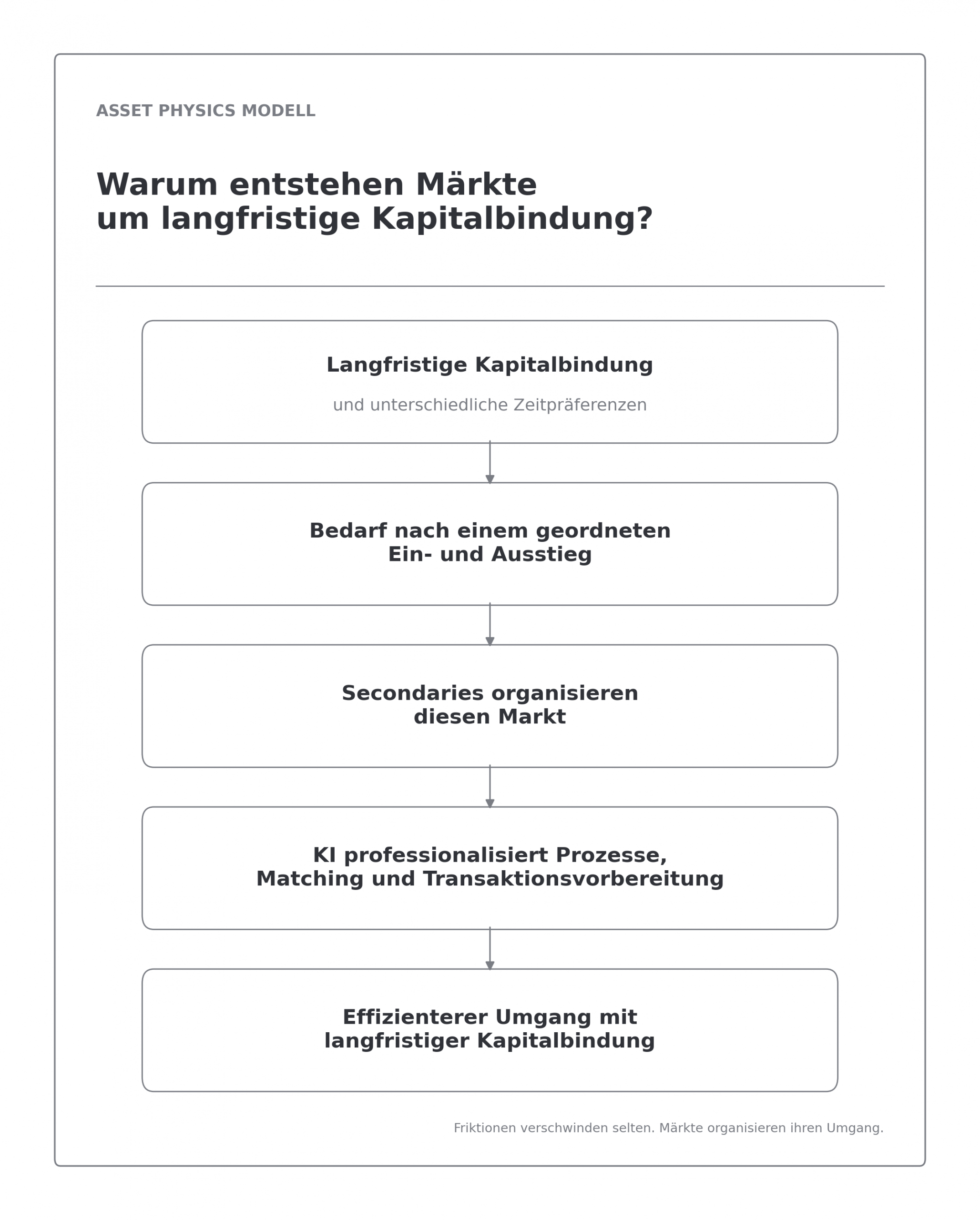
A secondary does not change the property or the fund. Both remain long-term. Long-term capital commitment – one of the defining characteristics of private markets – is therefore not disappearing.
What is changing is how it is handled.
While one investor wants to free up capital, adjust his allocation or meet regulatory requirements, another is looking for exactly this long-term exposure. The larger the private markets become and the more capital is tied up over many years, the more often investors with different time horizons meet each other.
This is exactly where the secondaries market comes in.
Secondaries do not create short-term trading in long-term assets. Rather, they coordinate the orderly entry and exit of investors with different time horizons.
They organise the handling of long-term capital commitments.
Long-term thinking and flexibility no longer have to be a contradiction.
This pattern is by no means exceptional. Mature markets often develop an infrastructure around their defining characteristics. Exchanges developed clearing houses. credit markets, rating agencies. Private markets develop secondaries. Not because the long-term capital commitment is disappearing, but because their handling is becoming more professional.
A look at Real Estate underlines this point. Despite the new high, the segment remains small at around 20 billion US dollars, both in absolute terms and in relation to the overall secondaries market. And if you zoom even deeper, you will see that trading in real estate fund units remains particularly challenging in Germany. Transfer restrictions, investor consents, valuation issues, and regulatory and tax peculiarities often make transactions complex and time-consuming. Therefore, there can be no talk of a consistently liquid market.
This is precisely why the development is remarkable. The record figures speak less for the end of long-term capital commitment than for the emergence of an increasingly professional infrastructure for dealing with them.
Artificial intelligence is likely to accelerate this process even further. Not because it eliminates capital commitment, but because it makes the market that develops around it more efficient. Documents can be automatically evaluated, data can be harmonized, potential buyers can be identified more quickly and transactions can be prepared in a more structured way. At the same time, individual activities that previously required considerable manual effort are becoming increasingly automatable. AI thus does not reduce the friction itself, but the costs of handling it – and changes where value creation will be created in this market in the future.
Perhaps that’s why the record numbers of 2025 tell a different story than it seems at first glance. It is not the private markets that change their character. Rather, they are developing an infrastructure that organizes the handling of their long-term capital commitment in an increasingly professional manner.
📌 Result:
Frictions rarely disappear. Markets find ways to organize them economically.
Further market studies:
Jefferies: 2025 Global Secondary Market Review – Another Record-Breaking Year
Lazard: 2025 Secondary Market Report
Ares: Real Estate Secondary Market Volume Hits Record $20 Billion in 2025