

This article is translated automatically.


First of all, a bit of classification
In November, the European Commission presented a proposal for a fundamental revision of the Disclosure Regulation (SFDR). This is not yet final, because now follow:
If all three institutions agree on a text, the reform will be adopted as an amending regulation and published in the Official Journal. Experience has shown, however, that proposals from the EU Commission provide the basic direction.
And the proposal clearly points in the right direction! And that's why let's finally get to the heart of the matter below!
Articles 8 and 9 of the previous SFDR are still categories of disclosure. Now, however, the industry will receive categories in the sense of real product classes .
So far, there has been wide room for interpretation without measure (used very differently, especially in the member states of the EU). There were sometimes ugly accusations of greenwashing, which unsettled the industry. And specifically, the real assets funds that are particularly close to the heart of this column move between data gaps on the one hand and reporting overkill on the other.
With the reform of SFDR, Europe is undergoing a change of perspective: The EU is defining product categories and thus a paradigm shift: Funds will have to position themselves in the future – not just report. In addition, a more uniform target level at EU Commission/regulation level is being established in order to reduce the previous national implementation variants ("patchwork"). This will give new impetus to product design, marketing and governance. This time combined with the hope that they will finally have a more constructive effect on investors and KVGs.
The SFDR reform would be half as effective if it did not correct one of its biggest errors: the PAI indicators are disappearing.
PAI were probably well-intentioned, but practically useless in real assets:
Its omission is therefore not a side note in the SFDR reform, but the actual prerequisite for the new product logic to work at all.
Instead of PAI, product logic comes into play
No longer a universal 18-point matrix,
but targeted minimum criteria for each product class:
The associated statement is: "No longer measure everything – only what fits the investment purpose." This results in less breadth, more depth and less data simulation, but more data relevance. For real assets in particular, this is a real liberation!
The real strength of the SFDR reform lies in the fact that Europe no longer thinks of sustainability in binary terms – but in terms of purposes.
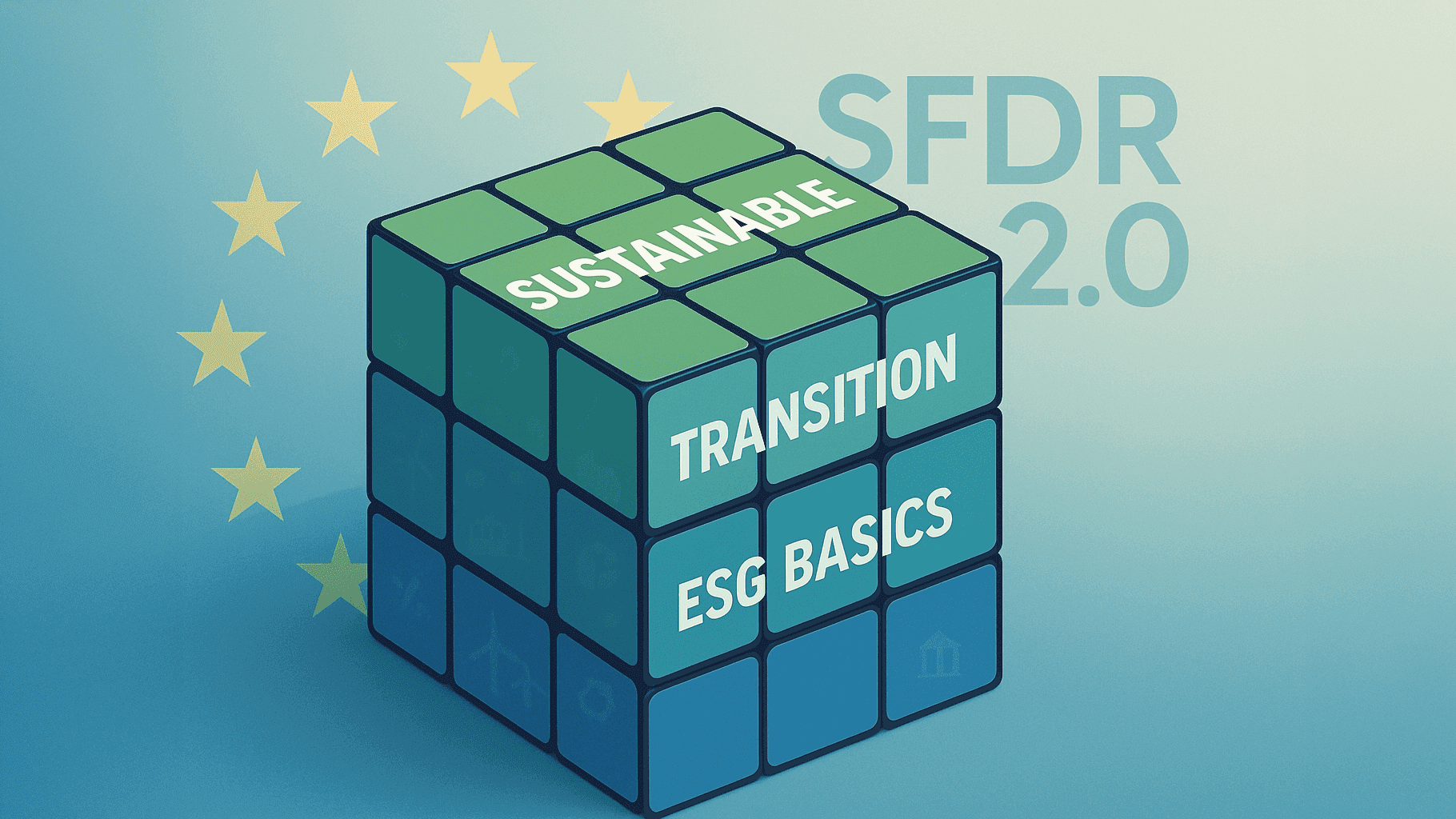
Class 1 – Sustainable
For products with true sustainability telos. For example, these could be: renewable energy plants, BESS plants, and impact assets in general. High minimum standards and clear metrics apply. And there is less room for interpretation. In the future, Europe will separate the real Greens from the marketing Greens.
Class 2 – Transition
This is a real gamechanger! This category recognizes that the path to sustainability is a path, not a state. It addresses investments that
Here, Europe is finally making a credible contribution to deepening the European Capital Markets Union in a relevant way. And for the first time, real assets and private markets will have a sufficiently large drawer in the system.
Class 3 – ESG Basics
For products that integrate ESG – without full sustainability claims. The new Article 8 Light category: broad and flexible.