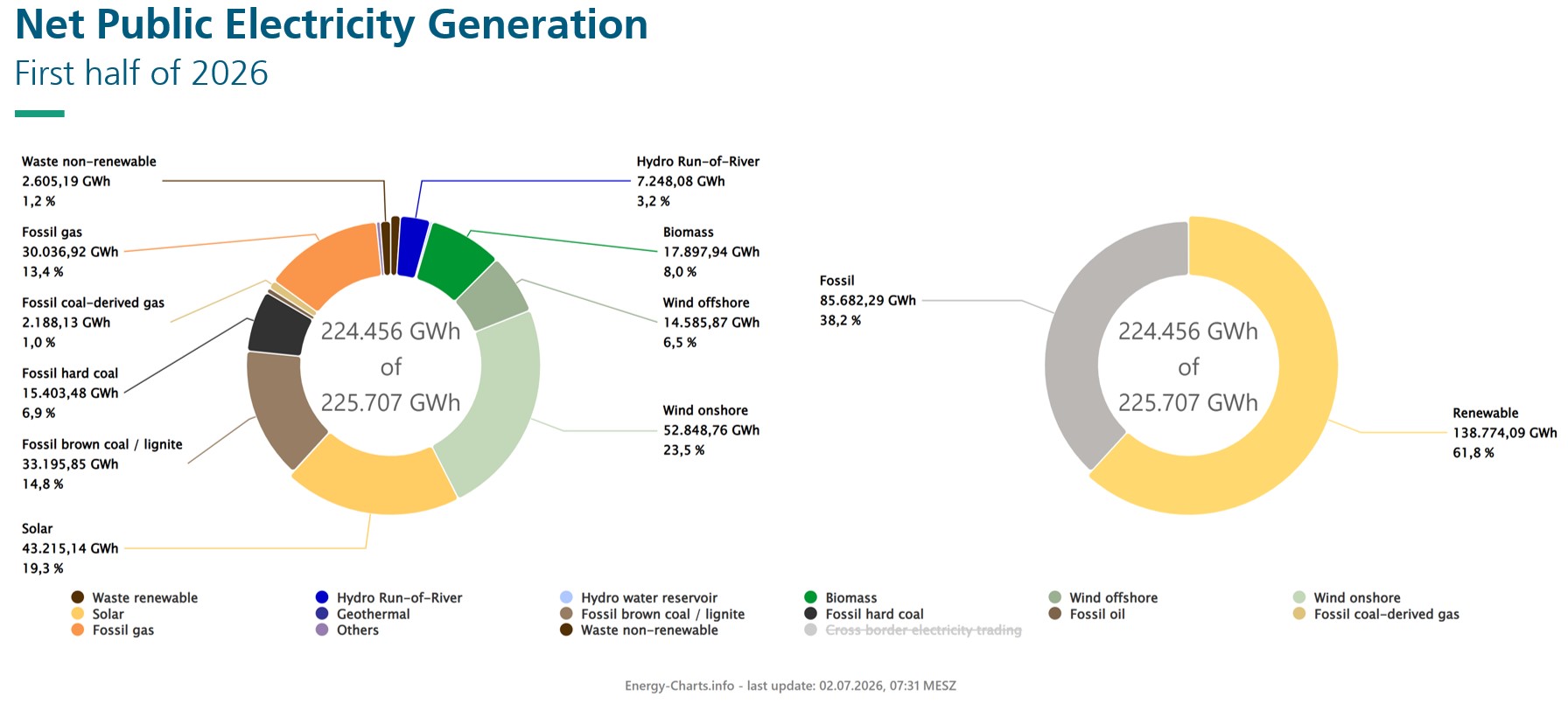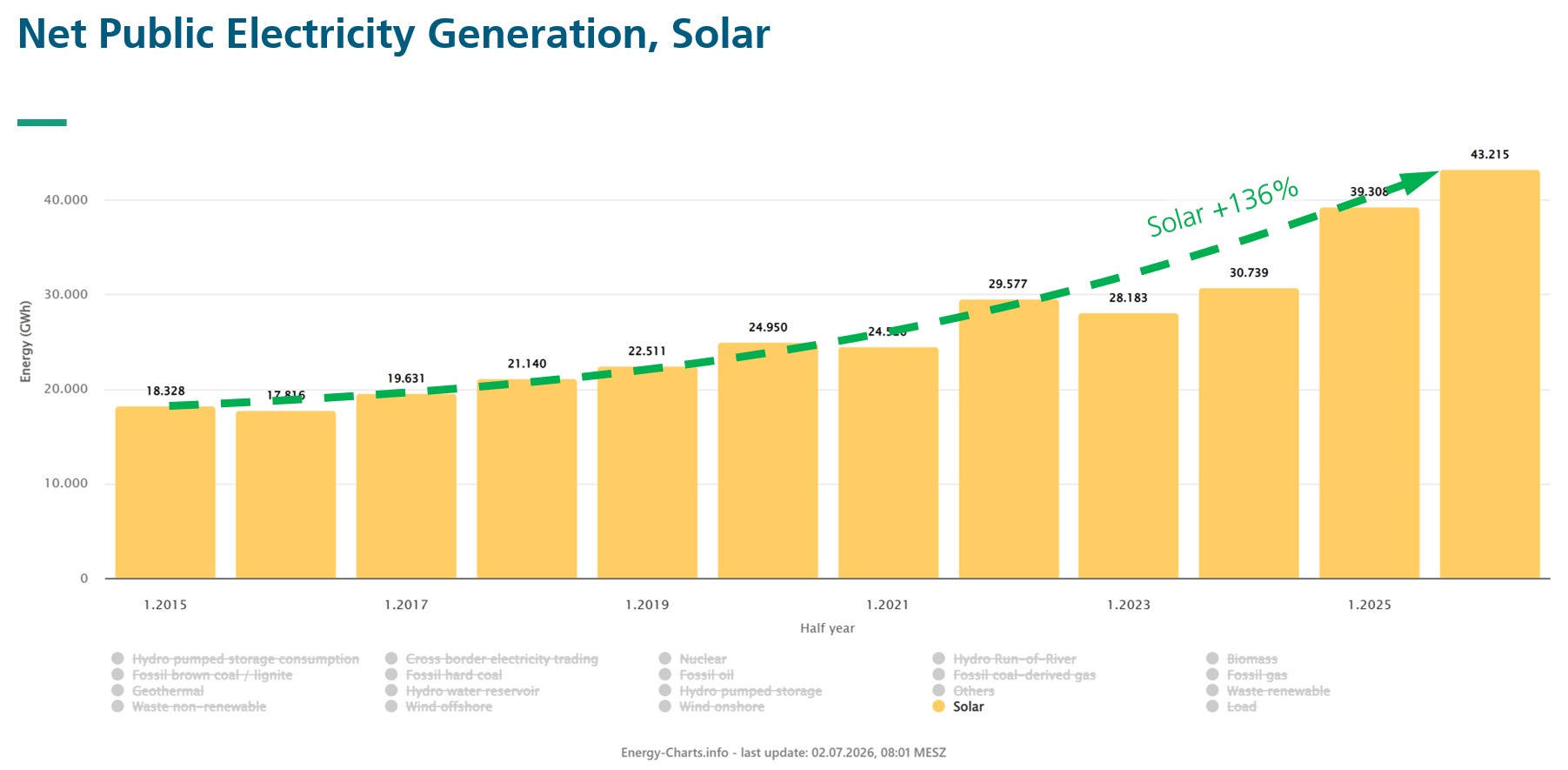
The share of renewable energy in Germany’s net public electricity generation—the actual mix of electricity coming from the outlet—stood at 61.8 percent in the first half of 2026. Wind power increased its generation by 12.2 percent compared to the previous year, while the electricity feed-in from photovoltaics reached a new record of 43.2 terawatt-hours. Strong generation from renewable sources ensured that electricity prices in the spring were largely decoupled from the rise in gas prices caused by the war in Iran. This is according to an analysis by the Fraunhofer Institute for Solar Energy Systems ISE based on data from the energy-charts.info platform.
Rising Generation from Wind and Solar Power Plants
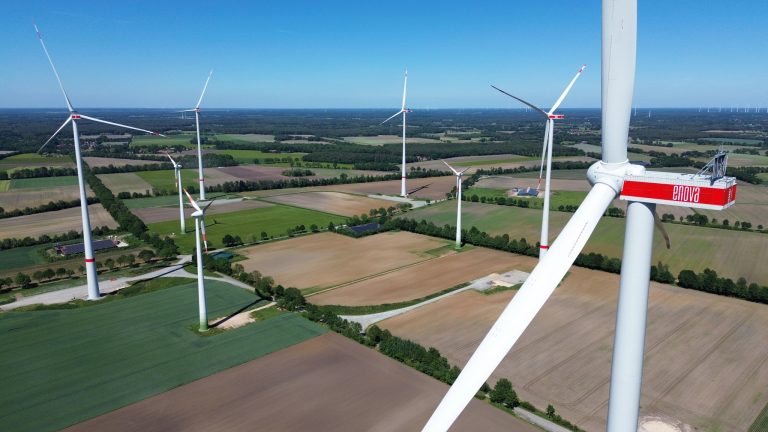
Compared to the first half of 2025, generation from wind power plants has increased: for offshore plants, from 11.4 TWh to a new record of 14.6 TWh; for onshore plants, from 48.7 TWh to 52.8 TWh. Wind power thus increased its share of net public electricity generation from 28.8 to 30 percent. At 43.2 TWh, the electricity feed-in from photovoltaics was ten percent higher than in the previous year (39.3 TWh), reaching an all-time high. Across the EU as well, photovoltaic generation reached record levels and has risen by 254 percent since 2015. In contrast, generation from hydropower declined slightly (7.8 TWh, down from 8.1 in 2025), reaching its lowest level since 2015. The feed-in from biomass also declined slightly (17.9 TWh, compared to 18.3 in 2025). Generation from fossil fuels—natural gas, lignite, and hard coal—rose by six percent compared to the previous year, reaching 78.6 TWh. At 61.8 percent, the share of renewable energy in net public electricity generation remained at a similar level to that of the first half of 2025 (61.3 percent). The share of renewable energy in the load (which includes electricity consumption and transmission losses) rose from 55 to 58.5 percent, setting a new record.
High levels of wind and solar power generation are leading to an increasing number of hours during which the day-ahead market price for electricity is negative. In the first half of 2026, there were a great many hours when the price was close to 0 euros per megawatt-hour, as more and more power plants have a financial incentive to curtail generation when market prices are negative. Generation peaks and load curves highlight the need for intraday storage and flexibility. Although the storage capacity increased from 25.4 to 29.3 GWh—meaning that more large-scale battery storage systems were commissioned in the first six months of the year than in the entire previous year— However, there remains a significant “storage gap” that needs to be closed to enable the shifting of surplus electricity to hours of low generation. Expanding battery storage for intraday storage could reduce negative electricity prices on the power exchange during the day and price spikes in the evening hours. The heat wave in June, which led to increased electricity demand for cooling while conventional power plants were operating at reduced capacity, resulted in particularly sharp price fluctuations during the evening hours.
Thanks to strong generation from renewable sources, only 1.3 TWh of electricity was imported on balance in the first half of the year (1st half of 2025: 9.6 TWh). Imports came from Denmark (8 TWh), the Netherlands (5.3 TWh), France (5.1 TWh), Belgium (3.1 TWh), and Norway (2.9 TWh). Exports went to Austria (5.7 TWh), Denmark (5.5 TWh), the Netherlands (4.8 TWh), the Czech Republic (3.3 TWh), and Poland (2.9 TWh).
Photovoltaic Generation Capacity Rises by 7 GW – Profitability of Small Rooftop Systems at Risk
In the first half of 2026, 2.1 gigawatts peak of new photovoltaic building-mounted systems with a capacity of up to 30 kilowatts peak were installed. In the 30–100 kilowatts peak segment, 1.1 GWp of new capacity was added. Ground-mounted systems contributed the most to the expansion, with 3.5 GWp. Overall, installed module capacity rose from 118 GWp to 124.9 GWp* (DC). Installed inverter capacity rose from 107.7 to 113.9 GW. According to a joint analysis by Agora Energiewende and Fraunhofer ISE, the changes currently under discussion as part of the renewable energy act amendment could make smaller rooftop PV systems, in particular, less economically viable under current conditions. This could create incentives to design systems on a smaller scale or not to fully utilize available rooftop space.
Electricity Prices Are Largely Decoupling from Gas Prices
A comparison of electricity and gas prices reveals the impact of the war in Iran, which began on February 28: The price of natural gas rose by 48 percent from February to March (from 35.61 euros to 52.71 euros/MWh). Following the start of the war, the marginal costs of electricity generation from natural gas—which consist of the costs of gas and CO2 emission allowances—rose by 39 percent to 132.87 euros per MWh. If gas-fired power plants had deter-mined the electricity price according to the merit-order principle, electricity costs would have risen significantly as a result. In contrast, the exchange electricity price fell to 95.58 euros/MWh after the war began, as renewable energy sources, with their low production costs, drove prices down starting in March. In April, it fell again significantly by 27.7 percent, while the natural gas price declined by only 12.6 percent. “If renewable energy sources hadn’t contributed so heavily to electricity generation, the electricity price on the exchange would have been 76 percent higher in April,” explains Energy Charts project manager Leonhard Gandhi.