
Yesterday, the independent analyst firm bulwiengesa presented the current spring forecasts for 2026 for the German real estate markets as part of its forecast webinar. The central finding: The time for blanket market movements is over. Location quality, usage concepts and property-specific factors are increasingly decisive for further development.
“The market remains challenging, but it is not without a chance,” says Alexander Fieback, Head of Research at bulwiengesa, classifying the current situation. “It remains crucial to observe developments closely and to make well-founded decisions on the basis of reliable data.”
The forecasts are based on economic analyses, extensive market observations and evaluations from the in-house real estate database RIWIS.
Economic policy uncertainty remains a negative factor
The macroeconomic environment remains difficult. Geopolitical crises, rising energy prices and uncertainties regarding inflation and interest rate policy continue to slow down economic momentum.
The Economic Policy Uncertainty Index for Germany was last at 976 points, one of the highest values ever measured. At the same time, markets are now pricing in several interest rate hikes by the European Central Bank in the course of 2026.
The mood in the real estate industry also remains tense. The Deutsche Hypo real estate climate fell to 83.8 points in May 2026, well below the previous year’s level. The investment climate remains particularly strained.
Investment market remains selective
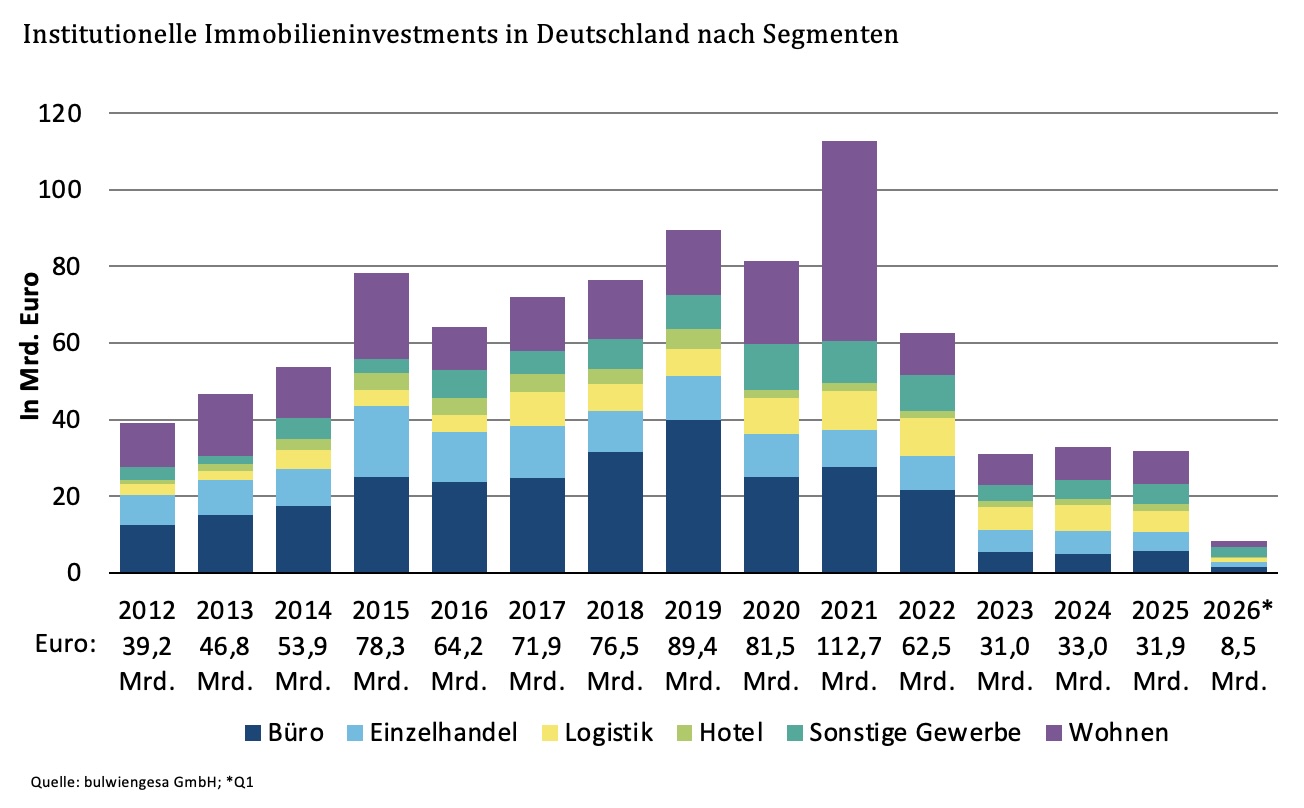
The institutional investment market has stabilised despite difficult conditions, but remains cautious. In the first quarter of 2026, institutional real estate investments of around EUR 8.5 billion were registered – an increase of around 5% compared to the previous year.
“The investment market remains very selective,” says Alexander Fieback. Smaller individual transactions in particular continue to dominate market activity. Investors with strong equity capital, family offices and investment and asset managers are currently shaping the buying side. Larger portfolio transactions, on the other hand, remain rare.
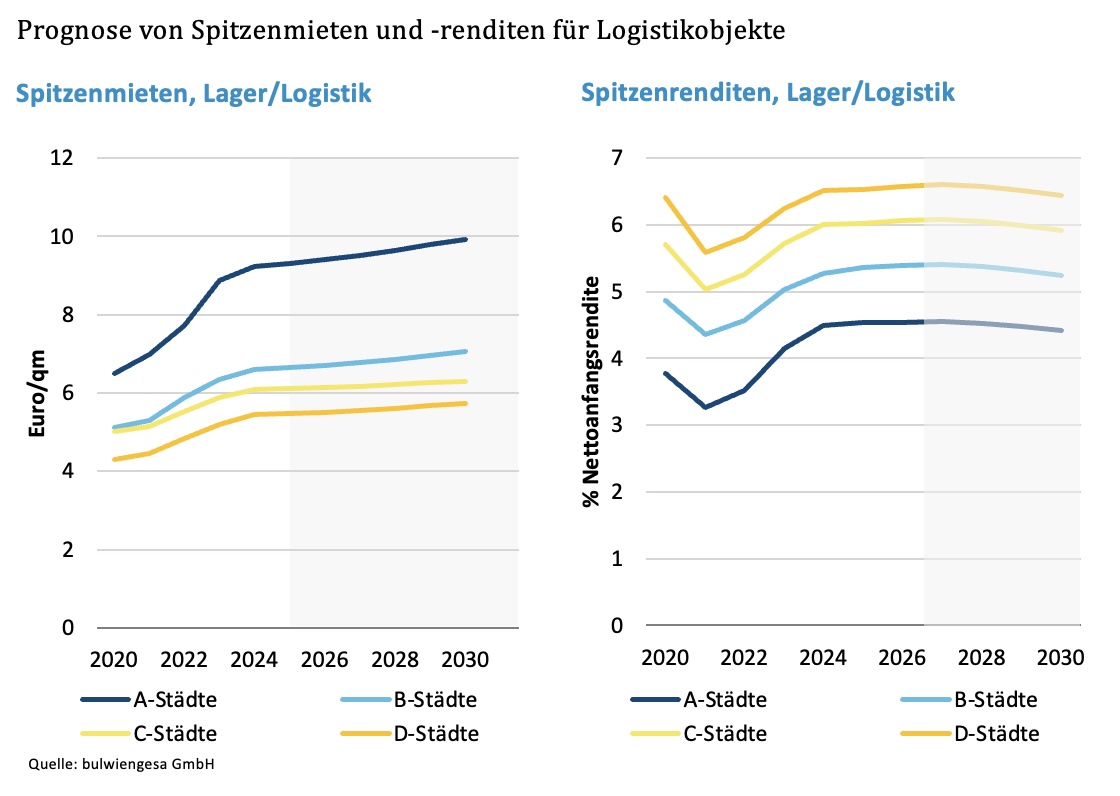
Net prime yields have stabilised across the board, but are showing a slight upward trend at the beginning of 2026. For the current year, prime yields of 4.6% on average are forecast for office properties in Class A cities, 4.5% for logistics properties, 4.0% for high-street properties and 3.6% for residential properties in prime locations.
Residential remains the strongest asset class
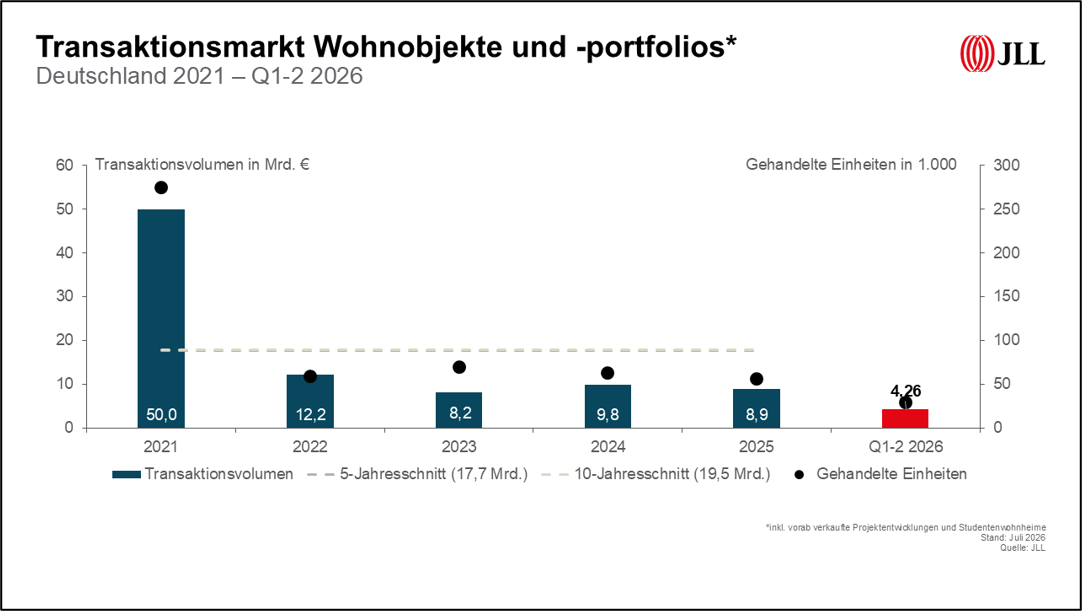
The housing market remains characterised by structural supply bottlenecks. High construction costs, restrained new construction activity and persistent excess demand continue to cause rents to rise.
“Anything that is not realised in the new building naturally puts pressure on the existing building,” explained André Adami, Head of Housing at bulwiengesa. For existing apartments in the Class A cities, bulwiengesa forecasts a further increase in average rents from 15.06 euros/sqm in 2025 to 15.52 euros/sqm in 2026. By 2030, an average of 17.44 euros/sqm is expected.
At the same time, the market is becoming increasingly differentiated – especially in terms of location quality, need for modernization and energy standards.
Office properties in structural change
“The office market is currently undergoing the greatest structural change,” says Fieback.
Remote work, changing space requirements and the increasing concentration on high-quality and central space are shaping the development.
While modern ESG-compliant space in prime locations continues to generate demand, peripheral and lower-quality locations are coming under increasing pressure. The vacancy rate in the Class A cities is now around 10% on average. At the same time, bulwiengesa expects prime rents to continue to rise in the prime locations of Class A cities. By 2030, the analysis firm forecasts prime rents of around 48 euros/sqm on average.
Logistics proves resilient
In the logistics segment, too, the momentum of recent years has weakened. Nevertheless, the asset class remains comparatively robust. bulwiengesa expects impetus in particular from the defense sector and the market entry of Asian online retailers. At the same time, demand is increasingly focused on high-quality logistics locations. According to the forecast, average prime rents in Class A cities will rise from the current 9.31 euros/sqm in 2025 to just under 10 euros/sqm in 2030.
Retail: Focus on top locations and local supply
In the retail sector, the polarisation between strong and weak locations continues. High-traffic high-street locations and local supply concepts remain particularly in demand. Food retailing, gastronomy and drugstore concepts continue to benefit from stable demand, while traditional retail locations are increasingly having to downsize and realign. For high-street locations, a slight upward trend is only expected in the A-cities. For the smaller locations, the trend is rather declining.
Forecasts more closely linked to practical examples for the first time
As part of this year’s webinar, bulwiengesa presented the forecasts for the first time on the basis of concrete real estate and neighbourhood developments. The focus was on mixed uses, regional demand developments and economic effects of different location and concept decisions.
The study showed that the importance of micro-layers and property-specific factors continues to increase. Location quality and usage concepts are increasingly decisive for the economic success or failure of projects.
The complete spring 2026 forecasts are available via the RIWIS real estate database. A recording of the webinar will be available on the bulwiengesa website: