Foreign investors are significantly expanding their holdings
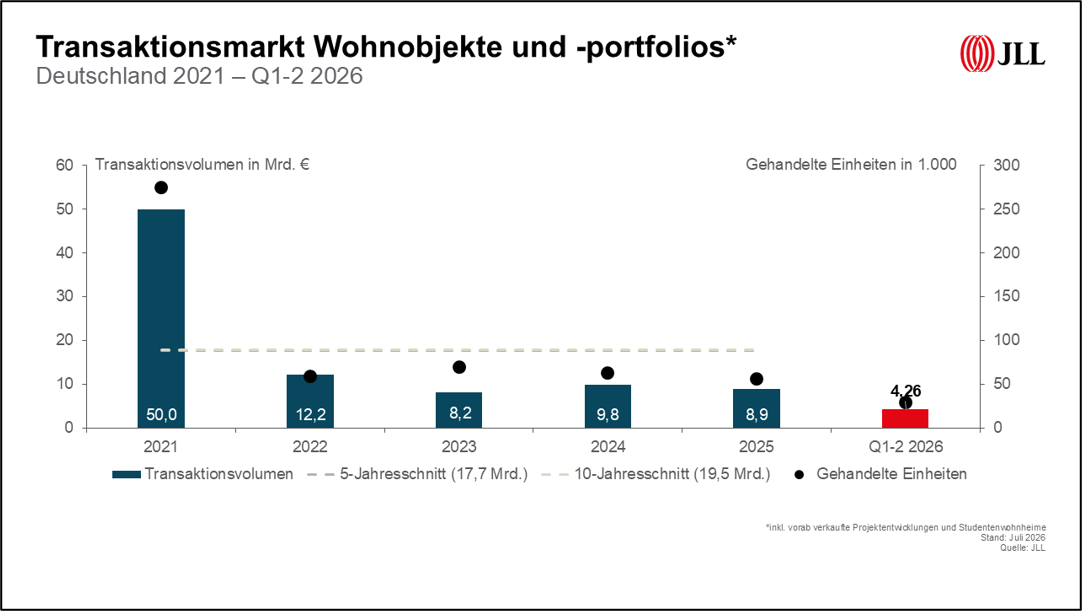
The commercial residential investment market in Germany closed the first half of 2026 with a transaction volume* of 4.3 billion euros, stabilising at the level of the same period last year (4.4 billion euros). In 129 transactions, 29,500 residential units were traded, slightly less than in the first half of 2025 (31,000).
At EUR 2.6 billion, the second quarter recorded a significant increase in investment volume of 58 percent compared to the previous quarter (EUR 1.65 billion). Sales in the same quarter of the previous year (2.1 billion euros) were exceeded by just over a quarter.
With 64 transactions registered in the second quarter, market activity was roughly on a par with the previous year, but still below the five-year average of 80 deals. “The volume development is remarkable in several respects – on the one hand, in view of the phase of heightened geopolitical uncertainty caused by the Iran crisis, and on the other hand, because this result is based on both an increase in volume and a stable number of transactions,” comments Michael Bender, Head of Residential JLL Germany.
Core transactions accounted for 44 percent of the total volume, compared to 54 percent in the same period last year. The core-plus risk class accounted for 36 percent, while value-add transactions recorded the strongest gains at around 20 percent (previous year: 13 percent).
The combination of an increased transaction volume with an almost constant number of deals resulted in an increase in the average transaction size in the second quarter to EUR 41 million (previous year: EUR 32 million). The increase in investments between EUR 50 million and EUR 100 million is particularly striking, accounting for 14 percent of registered transactions – the largest relative increase of all purchase price categories compared to the previous quarter (8.8 percent). In the three-digit million range, only eight transactions were registered in the first six months – in the previous year there were twice as many.
Metropolises remain underrepresented
In the second quarter of 2026, transaction activity remained concentrated in locations outside the seven real estate strongholds. The share of metropolitan areas in the total volume was only around 35 percent, compared to 41 percent in the previous quarter and 38 percent in the same quarter last year. Within the metropolises, Berlin leads with a total volume of 500 million euros, far ahead of Munich (150 million euros). “The ongoing trend towards markets away from the metropolises speaks on the one hand for a limited supply in the urban hotspots and on the other hand for the fact that capital is willing to invest in the right product outside the metropolises,” says Helge Scheunemann, Head of Research at JLL Germany.
Foreign investors were much more active in the second quarter of 2026. Their share on the buy-side was 45 per cent (1.91 billion euros), while on the sell-side they accounted for only around 14 per cent of the volume (580 million euros). On balance, foreign investors thus expanded their position in the German residential investment market by around 1.33 billion euros – the highest commitment in several quarters and, according to Scheunemann, “a clear indication of the increasing attractiveness of the German market for international investors”.
Larger transactions in the second quarter include the acquisition of the Dutch company Breevast, which acquired a portfolio of 1,920 residential units across Germany.
Forward deals with a high proportion of municipal buyers
Forward transactions accounted for 18 percent of the investment volume in the second quarter (EUR 460 million in eleven transactions). The average size of forward deals was around 42 million euros, almost on par with the overall market average. Of the forward transactions in the first half of the year (EUR 1.07 billion), around three quarters were attributable to projects with subsidies or in the price-controlled segment with an average share of around 90 percent subsidised units. On the buyer side, as in the previous year, municipal and state-owned housing companies were the dominant buyer group with a share of around 57 percent and a total purchase volume of 540 million euros.
Prime yields stable, but spread to weaker qualities widens
Prime yields in Germany’s seven largest cities remained stable at 3.51 percent and continued their sideways movement despite changing market fundamentals. “While prime properties in excellent micro-locations with outstanding quality continue to attract broad competition and ensure consistent returns, non-trophy assets show higher interest rate sensitivity,” analyses Dr. Sören Gröbel, Director of Living Research at JLL Germany. For example, the spread between properties with good versus moderate structural substance – both located in strong micro-locations within the seven largest cities – widened from 50 to 68 basis points in the second quarter of 2026.
“This growing difference underlines investors’ increased focus on quality and location fundamentals in a more challenging macroeconomic environment, as well as the different intensity of demand and competition across different asset classes,” explains Gröbel.
Geopolitical risks increase forecast uncertainty
The changing interest rate environment, driven by the Iran crisis with its associated supply chain disruptions and elevated inflation, poses some challenges for the market: The inflation rate in the euro area rose to 3.2 percent by June 2026, to which the ECB reacted hawkishly in June. Long-term interest rates remain elevated due to the uncertain inflation outlook. The 5-year swap rate has stabilized at around 2.7 percent – well below its highest level for the year, but far from the previous year’s level.
“The risks to the forecast of further interest rate developments have increased significantly with the Iran crisis. Despite initial reaffirmations of peace, the further course of the conflict remains an important factor influencing further economic development – and thus also the development of interest rates and yields on the residential investment market,” says Scheunemann.
No easing on the rental housing markets and in new residential construction
The situation on the rental housing markets in Germany’s major cities remains tense, even though growth in new contract rents flattened out at the beginning of 2026. Deteriorating affordability has become a limiting factor for rent development. In order to curb the sharp rise in rents, the federal government has launched a comprehensive amendment to tenancy law, which, among other things, provides for a tightening of the capping limit from 15 to eleven percent within three years as well as regulations on indexed rents.
There have recently been slight signs of recovery in residential construction. At least the number of building permits increased at the beginning of the year. However, this positive trend is put into perspective by historically high construction costs and geopolitical risks. “Despite the immense demand, construction activity remains at a historically low level, and the realization of urgently needed residential projects remains blocked,” Gröbel emphasizes.
Further large portfolio transactions expected
Despite existing geopolitical and economic uncertainties, there is still quite a lot of movement in the market. “In addition to a large number of individual transactions, we are also seeing large portfolios that are attracting strong investor interest,” reports Michael Bender. He expects further large-volume deals in the further course of the year.