
The dynamics of narrative capital markets have long been a phenomenon of liquid assets. It is now beginning to transform even the traditionally slowest areas of institutional investment.
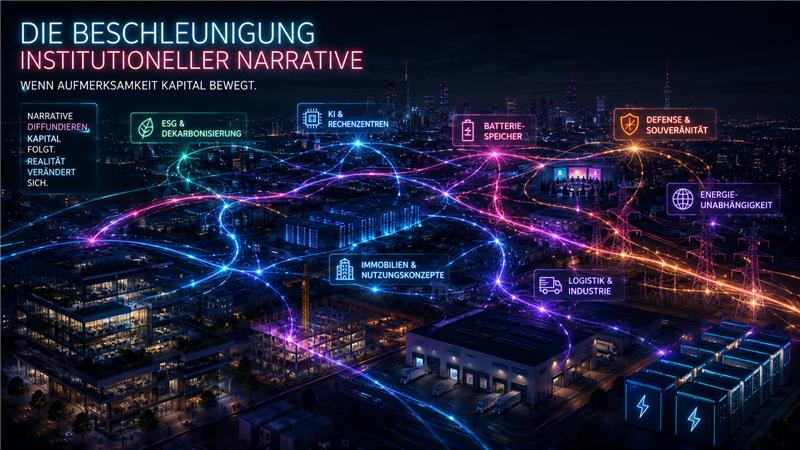
A few years ago, ESG dominated institutional capital markets. Then came inflation and interest rate turnaround. Then there is energy independence, data centers and the increasing electricity demand of artificial intelligence. Then battery storage, resilience, defense and strategic sovereignty.
With each new wave, own fund strategies, market studies, panels, consultants and sales languages were created within a very short time. Narratives have always existed in the capital markets. What is striking today, however, is the speed with which narratives organize institutional capital flows.
Anyone who currently follows the agendas of major industry events or conference panels will see this increasing pace of institutional narratives almost in real time. Within a few years, the dominant topics there are visibly shifting — from ESG and decarbonization to inflation and energy independence to data centers, battery storage, defense or strategic sovereignty.
Such dynamics have long been known from liquid markets. There, topic rotations, attention boosts and narrative synchronization have always been part of the market mechanics. Technology cycles, China, value versus growth, artificial intelligence, or most recently, defense and energy infrastructure: capital has often moved not only along fundamentals, but also along stories, expectations, and visibility.
What is new is not so much the existence of such narratives as their increasing diffusion into traditionally slower asset classes. The narrative dynamics of liquid markets are increasingly diffusing into physical asset classes.
Real estate, infrastructure and private markets in general have historically been considered stable precisely because they largely eluded the speed of liquid markets. Buildings do not change their use on a quarterly basis. Infrastructure cycles run over decades. Capital commitment creates inertia. The illiquidity of these asset classes was not only a liquidity feature, but also a temporal buffer against narrative acceleration.
The current frequency is all the more striking.
Hardly any asset class has historically stood more strongly for the long term than real estate. All the more remarkable is the speed with which new surface narratives are now emerging and rotating again: Coworking, urban logistics, ESG revitalization, life science, micro-apartments, data centers or, most recently, new industry- and sovereignty-related usage concepts. With each new wave, our own market studies, strategy papers, panels, renderings and product worlds are created almost immediately.
The situation is similar in the infrastructure. Just a few years ago, long-term contracted cash flows and regulatory stability often dominated the perception of the asset class. Today, the focus is increasingly on flexibility, electricity price volatility, grid bottlenecks, battery storage or the energy requirements of digital infrastructure. As a result, the asset class is changing not only economically, but also narratively. Capital now organizes attention visibly faster than before.
What is less interesting is that narratives exist. Capital markets have never been completely free of them. What is remarkable is the increasing speed of their dissemination — and the synchronization of institutional actors that results from it. Today, research, conferences, consultants, LinkedIn, podcasts and digital market communication create a permanent visibility of new topics. Today, narratives diffuse globally and almost in real time.
This is changing not only the perception of markets, but increasingly also their physical reality. Where capital becomes visible more quickly, capital costs, development dynamics, space concepts and strategic allocations change. Attention thus becomes an economic factor itself.
Institutional markets continue to speak the language of long-term fundamental analysis, strategic allocation and stable cash flows. In fact, even traditionally slow asset classes seem to be increasingly operating in attention loops.
Perhaps this is why digitization is not only changing information markets, but increasingly also the speed of physical capital allocation.
📌 Result:
If you want to understand long-term capital markets, you may not only have to analyze fundamentals in the future — but also understand how attention arises, rotates and disappears again.