

In the first three quarters of 2026, Germany’s top five office lettings markets recorded a total take-up of around 1.74 million square metres. This result was almost on a par with that of the corresponding period in the previous year. Market performance varied across the individual locations. Whilst Berlin, Düsseldorf and Munich achieved significant growth in take-up, figures in Frankfurt and Hamburg were below the previous year’s levels. In the third quarter, the lettings market gained momentum overall: at around 605,900 square metres, take-up was 11.6 per cent higher than in the third quarter of 2025. These are the findings of a recent analysis by the global property services firm CBRE.
“The stronger third quarter underscores the fundamentally stable demand in Germany’s top five office lettings markets, despite the economic challenges. However, trends continue to vary both between locations and within individual markets,” says Carsten Ape, Head of Office Leasing Germany at CBRE. “Companies continue to focus on modern, sustainable and flexible office space in central or very well-connected locations.”
Alongside the quality of the premises, energy efficiency, the quality of the working environment and its appeal are becoming increasingly important. Quality-conscious tenants remain willing to accept higher rents for modern premises in prime locations. Cost-conscious companies, on the other hand, are increasingly looking at existing premises and decentralised alternatives.
“The differentiation based on location and quality is becoming increasingly apparent. Rising vacancy rates therefore do not automatically mean that companies have a wider choice of suitable premium space,” adds Dr Jan Linsin, Head of Research Germany at CBRE. “Whilst modern and ESG-compliant space remains in short supply in the best premium locations, older properties and less well-connected locations offer tenants a wider choice and greater negotiating power.”
Berlin, Düsseldorf and Munich are driving revenue growth
Revenue trends continued to vary from location to location and were partly influenced by major individual deals and differing figures from the previous year. Major deals made a significant contribution, whilst the small and medium-sized lettings business continued to form the broad market base.
In the first nine months, Berlin recorded a take-up of 567,400 square metres, which was around 38 per cent higher than the previous year’s figure. The market benefited from a broad base of demand and numerous large-scale transactions. A total of 19 transactions exceeding 5,000 square metres were recorded. IT companies and the public sector were virtually neck and neck at the top of the list of sectors with the strongest demand. Both the central business district (CBD) and locations on the city’s outskirts recorded growth in take-up.
In Munich, take-up rose by just under 19 per cent to 467,600 square metres. The positive nine-month result was driven primarily by a strong first half of the year. The market recorded 13 transactions exceeding 5,000 square metres. The manufacturing sector and IT companies together accounted for more than half of the take-up. Around half of the total take-up was accounted for by sites within the Mittlerer Ring.
Düsseldorf recorded an increase of around 27 per cent to 201,500 square metres. Major lettings in the third quarter provided further impetus. The strong focus on quality amongst tenants was reflected in the 65 per cent share of Grade A space in total take-up.
In Frankfurt, take-up fell by 42 per cent compared with the same period last year to 267,700 square metres. Nevertheless, larger lettings provided a positive boost in the third quarter: three deals were in the size category above 5,000 square metres. A number of large lettings by public-sector organisations, including BaFin in Frankfurt and BVG in Berlin, had a significant impact on the results for those respective locations.
Hamburg recorded a take-up of 237,200 square metres, which was 24 per cent below the previous year’s figure. Market activity remained predominantly fragmented: more than four out of five registered tenancy agreements were for spaces of up to 1,000 square metres. The five strongest sub-markets accounted for around two-thirds of the total take-up.
Alongside established sectors such as financial services, consultancy, manufacturing and the public sector, technology- and innovation-driven sectors are driving demand. These include, particularly in Berlin and Munich, IT, artificial intelligence, robotics, new energy and defence.
Vacancy rates rose
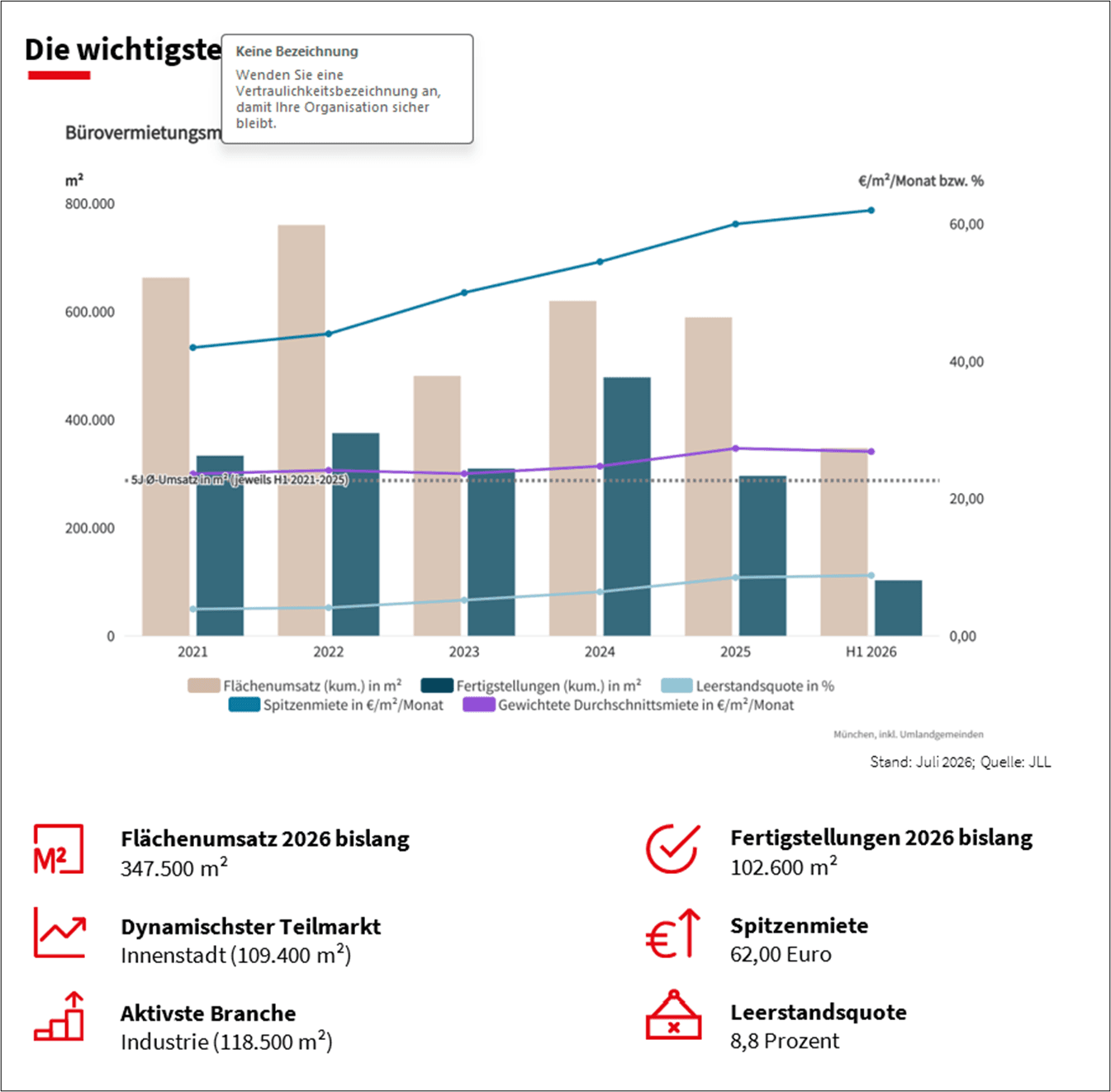
The supply side continued to be characterised by a further rise in vacancy rates. By the end of the third quarter, the vacancy rate in the top five markets had risen by 0.8 percentage points year-on-year to 8.8 per cent. Vacancy rates also rose overall in prime locations: the average vacancy rate across the top five CBDs rose by 1.1 percentage points to 7.1 per cent. At the same time, prime rents remained stable or continued to rise due to demand for limited supplies of premium space.
In many places, additional space is becoming available primarily through the release of space in older and out-of-the-way properties. By contrast, modern space in central and well-connected locations remains in short supply. At the same time, completion activity slowed significantly in the third quarter: 99,900 square metres were completed in the top five markets – around 55 per cent less than in the same quarter of the previous year.
Prime rents remained stable or continued to rise
In Berlin, the prime rent rose by 3.3 per cent year-on-year to 46.50 euros per square metre per month. The weighted average rent increased by 5.2 per cent to 27.17 euros. The vacancy rate stood at 8.6 per cent.
In Düsseldorf, prime rents remained stable at 46.00 euros per square metre per month compared with the previous year. The weighted average rent recorded the sharpest rise among the top five locations, increasing by 21.5 per cent to 23.93 euros. At the same time, Düsseldorf had the highest vacancy rate at 13.0 per cent.
The prime rent in Frankfurt rose by 2.8 per cent to 56.00 euros per square metre per month. By contrast, the weighted average rent fell by 14.1 per cent to 26.88 euros. This contrasting trend highlights the growing price differentiation between a small number of high-quality premium spaces and the wider range of available space. The vacancy rate stood at 11.4 per cent.
Hamburg recorded the sharpest percentage rise in prime rents, with an increase of 7.9 per cent to 41.00 euros per square metre per month. The weighted average rent rose by 1.7 per cent to 22.42 euros. At 4.6 per cent, the vacancy rate remained the lowest amongst the top five markets.
Munich continued to record the highest figure of the five locations, with a prime rent of 62.50 euros per square metre per month. This represented an increase of 5.0 per cent compared with the previous year. The weighted average rent rose by 2.1 per cent to €27.48. Whilst the vacancy rate for the market as a whole stood at 8.6 per cent, it was just 1.8 per cent in Munich’s CBD.
Outlook for the full year
“The stronger third quarter points to fundamentally stable demand for the rest of the year. However, companies will continue to scrutinise their space decisions carefully, which means that the processes leading up to the signing of a lease may take longer,” says Ape. “The availability of space that meets users’ requirements in terms of quality, sustainability and accessibility will be crucial to the market’s future development.”
The decline in construction activity and the thinning of project pipelines in several markets are likely to further restrict the availability of modern office space in the long term. Of the space scheduled for completion in 2027, around 37.6 per cent had been pre-let across the top five markets by the end of the third quarter. For 2028, the pre-let rate stood at 51.2 per cent, although there were significant differences between markets.
Modern, sustainable and well-connected office space is likely to remain in short supply – and consequently expensive – particularly in central locations. In contrast, further downward pressure on rents is expected for older properties and out-of-centre locations.
“Opportunities arise for owners of existing buildings when they adapt their properties to changing tenant requirements through targeted modernisation,” explains Linsin. “The increasing differentiation of the market makes the quality of the individual building and its location a key factor in its lettability.”