Growing climate risks could exacerbate the financial consequences of a lack of insurance cover for property owners in Germany. In a scenario involving high greenhouse gas emissions, the number of buildings exposed to natural hazards and lacking insurance cover against them could rise by 70 per cent to around 2.5 million by 2080. This is shown by a new study by Wüest Partner in collaboration with CLIMADA Technologies. The calculation assumes that regional insurance penetration remains constant at 2023 levels.
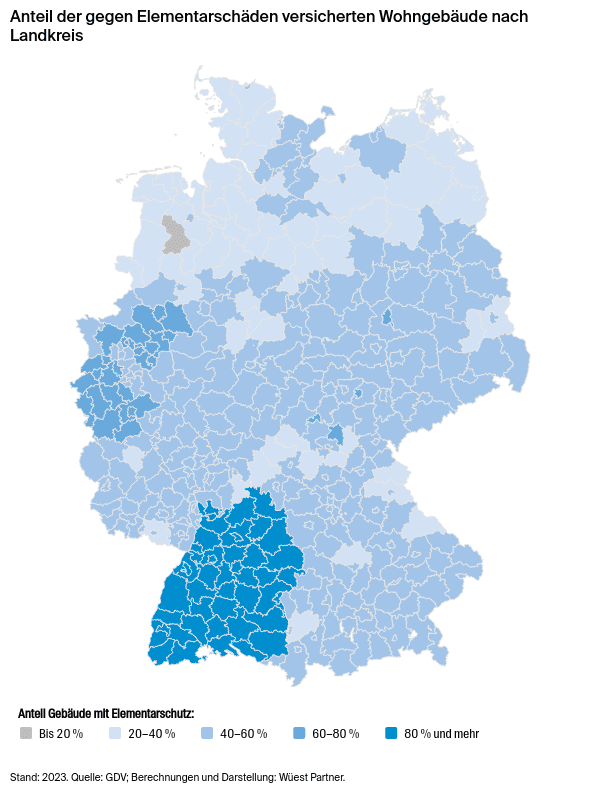
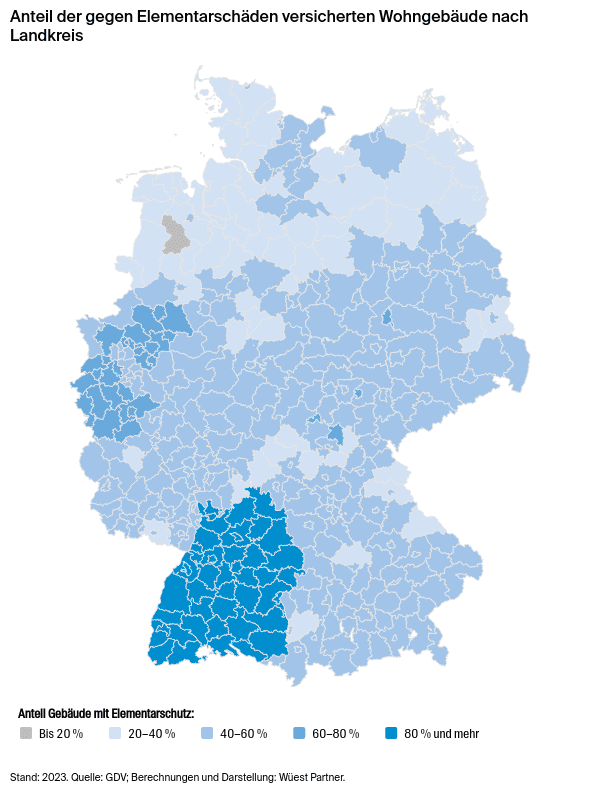
Whilst around 96 per cent of residential properties are insured against storms and hail, only 59 per cent have supplementary natural hazard cover. This covers, amongst other things, flooding caused by heavy rain and rivers bursting their banks, as well as landslides. Damage caused by storm surges, however, is usually excluded even from these supplementary policies.
Heavy rainfall widens the insurance gap
The study examines four natural hazards: heavy rainfall, river flooding, coastal flooding and landslides. For the historical reference period, the model estimates that around 1.47 million buildings are at risk without adequate insurance cover. By 2080, this figure could rise to between 1.90 and 2.50 million, depending on the emissions scenario. The main driver is the increasing risk posed by heavy rainfall.
Particularly large insurance gaps are evident along the North Sea coast. For Wilhelmshaven, the modelling in the scenario with high greenhouse gas emissions by 2050 yields an insurance gap score of 99.8 per cent; for the Wesermarsch district, the figure is 98.9 per cent. This means that almost the entire building stock in these areas would be exposed to at least one of the natural hazards examined, without having adequate insurance cover. The main factor here is the increasing risk of coastal flooding, coupled with a near-total lack of storm surge cover.
The insurance gap is also widening on the edge of the Bavarian Alps. There, increasing risks from heavy rainfall and landslides are compounded by the relatively low uptake of natural hazard insurance. The modelling predicts an insurance gap score of 59 per cent for Altötting by 2050, and 54 per cent for Kempten (Allgäu).
However, the increase is not limited to individual regions. Under the high greenhouse gas emissions scenario, the number of districts with an insurance gap score of at least ten per cent will rise from 68 to 120 by 2080.
Insurance cover is becoming a factor in property value
This development is of considerable significance to property owners, investors and lending banks. If damage caused by natural hazards remains uninsured, property owners must bear the costs themselves. This can undermine a property’s profitability, make financing more difficult and reduce its market value. At the same time, rising claims costs can lead to insurance becoming more expensive or cover becoming harder to obtain in particularly high-risk areas.
Insurance cover is becoming a factor in property value
“Insurance cover is part of a property’s value. Anyone assessing its climate risk – whether as part of a valuation or when granting a loan – must therefore also check whether there is adequate insurance cover and whether the property will remain insurable in the long term. If this cover is lacking, the owner bears the financial risk of any damage themselves,” says Ronny Haase, a long-standing partner at Wüest Partner.
Protective measures can limit risks
To limit the growing insurance gap, effective protective measures are needed alongside broader cover against natural hazards. Structural modifications and public precautionary measures can limit damage and help to ensure that buildings remain insurable in the long term. For particularly high claims, solutions are also required that spread the risks across insurers, reinsurers and the state.
You can find the full study here: Climate risks in Germany: insurance gaps and insurability