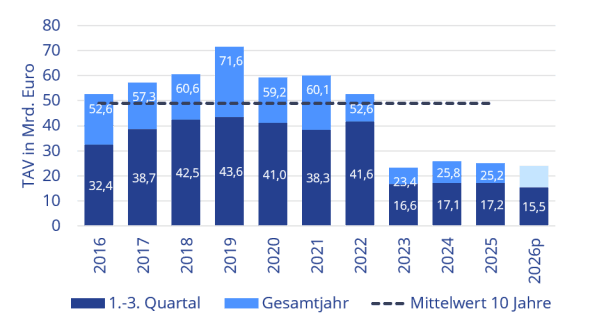
The increased pressure on interest rates over the last three months has finally ensured that 2026 will not be the year of the hoped-for upturn in the property investment market. According to Colliers, property worth 21.6 billion euros was traded in Germany in the first nine months. This meant that the transaction volume in the investment market (residential and commercial) was 9 per cent below the previous year’s figure. The institutional residential segment – comprising properties with ten or more residential units – accounted for around €6.1 billion, which is 7 per cent less than in the same period last year. Commercial property generated €15.5 billion in turnover, around 10 per cent less than in the corresponding period of 2025.
After eleven quarters of stable transaction volumes, each totalling around 6 billion euros, the three-month figure fell below the 4.5 billion euro mark for the second consecutive quarter, reaching just 4.4 billion euros in the third quarter. The number of transactions, at 226, was also below the quarterly average, which has stood at 265 since the drastic market correction in mid-2023. The average deal size remains just below the €20 million mark. Overall, for the first time since the market stabilised in mid-2023, there is again a noticeable slowdown in transaction activity.
Interest rates and financing conditions have tightened significantly over the summer
Geopolitical tensions and the associated uncertainties regarding inflation, government spending and capital market returns are currently making it more difficult to assess long-term investment decisions. The consequences are longer decision-making processes and higher requirements in terms of returns and risk premiums.
Michael R. Baumann, Head of Capital Markets Germany at Colliers, commented on the implications: “Purchase prices for assets already in the transaction process are being recalculated. This is causing further delays to deal closures. At the same time, we are observing that, particularly amongst institutional property owners, there is a growing realisation that they must accept price reductions and value adjustments in order to carry out necessary portfolio restructuring to generate liquidity. Some lending banks are prepared to accept haircuts. The market generally has sufficient investable capital. The key bottleneck at present remains the pricing negotiations between buyers and sellers.” Baumann sees this as a key prerequisite for strengthening the willingness to invest among currently active buyer groups. Prospective foreign buyers, in particular, often adopt a wait-and-see approach given that purchase prices remain high by international standards.