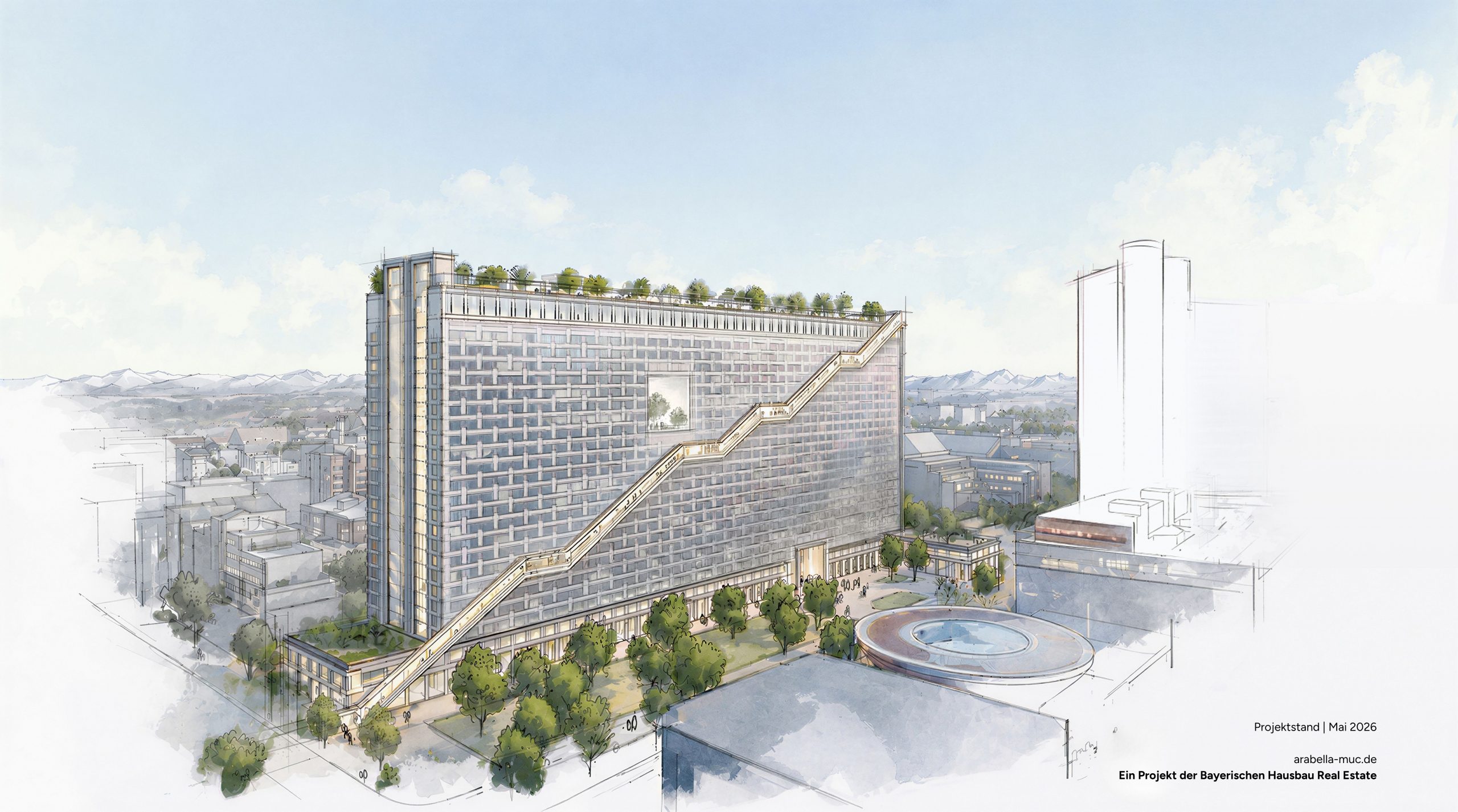
Bayerische Hausbau Real Estate has found a way to comprehensively revitalise the Arabellahaus. Instead of demolition, which was long considered unavoidable, the property in Arabellapark is to be fundamentally rebuilt, renovated and expanded. At the same time, the formative architectural identity is retained. The further development of the open, mixed-use building is intended to set new standards for the revitalisation of large existing buildings. The preservation of the building was made possible by simplifications in the Bavarian Building Ordinance and innovative structural solutions. The construction phase is expected to last from spring 2030 to the end of 2034.
Opening up to the city and new uses
The new concept for the landmark in Munich-Bogenhausen envisages a greater opening of the building to the city with space for recreation, encounters and leisure. The roof will be made accessible to the public for the first time: green and recreational areas with gastronomy, culture, sports and free recreation facilities are planned. Part of the architectural planning is the external escalator system along the façade, which leads from the ground floor to the roof. A terrace in a breakthrough at the level of the 15th-19th floors (“Skygarden”) also offers new possibilities of use for tenants. The concept is complemented by a ground-level, multi-storey passage, which creates a generous connection for pedestrians and a visual axis to Rosenkavalierplatz. The previous “city-in-the-city” principle of the Arabellahaus will be further developed: Inside, the proven mix of different uses will remain – with commerce, health, hotel and apartments of different sizes under one roof. The plan is to create price-controlled housing.
Sustainable preservation instead of demolition
The existing structure is to be supplemented and upgraded by the addition of a new building layer, so-called shelves. With this innovative approach and the preservation of the supporting structure, a significant part of the resources tied up in the building can be preserved at the same time. Around 20,000 tonnes of CO₂ equivalents of grey energy remain bound in the building fabric – an order of magnitude that only a few major projects in Germany achieve. At the same time, the Arabellahaus is to be comprehensively revitalised technically, energetically and functionally. The plan is to renew the technical building equipment, improve the insulation and measures to optimise the energy and digital operation of the building. In addition, new solutions for energy generation are being examined, including photovoltaics on roof surfaces. The project management is being carried out by SBP Bau- und Projektentwicklung GmbH. The architectural firm Hild und K, under the direction of Prof. Andreas Hild, is responsible for the architectural design and the extension concept.
“We are pleased to have found a solution for the Arabellahaus that is economically viable, technically feasible and architecturally groundbreaking,” says Marcel Wnendt, Managing Director of Bayerische Hausbau Real Estate. We are creating additional living space for the city of Munich and making a contribution to sustainability. This innovative revitalisation could serve as a model for the future handling of existing properties in major cities around the world.”
“The Arabellahaus is a piece of Munich city history. After around six decades, however, the property has reached the end of its life cycle technically and functionally,” says Stefan Bögl, Managing Director of Bayerische Hausbau Real Estate. “Instead of demolition and new construction, we are deliberately focusing on the preservation of the existing structure as far as possible. Our goal is to bring the Arabellahaus into a new era – attractive for residents and users, innovative in technology and architecture, and shaping Munich’s cityscape in the best sense of the word.”
Permanent apartment tenants receive individual support
As early as 2018, the tenants of the apartments and commercial space in the Arabellahaus were informed that the use of the previous building could not be continued after six decades. According to the planning status at the time, demolition seemed unavoidable, especially because there was no known possibility of renewing the outdated building services in the existing building.
The tenants were informed in advance about the new plans for revitalization this week. For tenants, this means that they will have to move out before construction starts in 2030 at the latest. BHRE fulfils its responsibility as a landlord beyond what is required by law: it provides apartments that can be occupied at short notice in an alternative BHRE property for residents of the Arabellahaus with open-ended leases, and the possibility of further apartments in a planned new construction project is also planned.
The Arabellahaus was built between 1966 and 1969 and is still one of the most famous buildings in Munich today. In addition to the 23-storey high-rise building on Arabellastraße, the Arabellapark ensemble also includes the flanking office and commercial buildings on Rosenkavalierplatz. Today, the Arabellahaus comprises a total of around 87,000 square metres of gross floor space including residential, hotel, clinic, office, retail and catering uses. The usage concept, originally conceived as a “city within the city”, still characterises the location today.
More information at: arabella-muc.de