Transaction volume in the German market grows by 13 percent
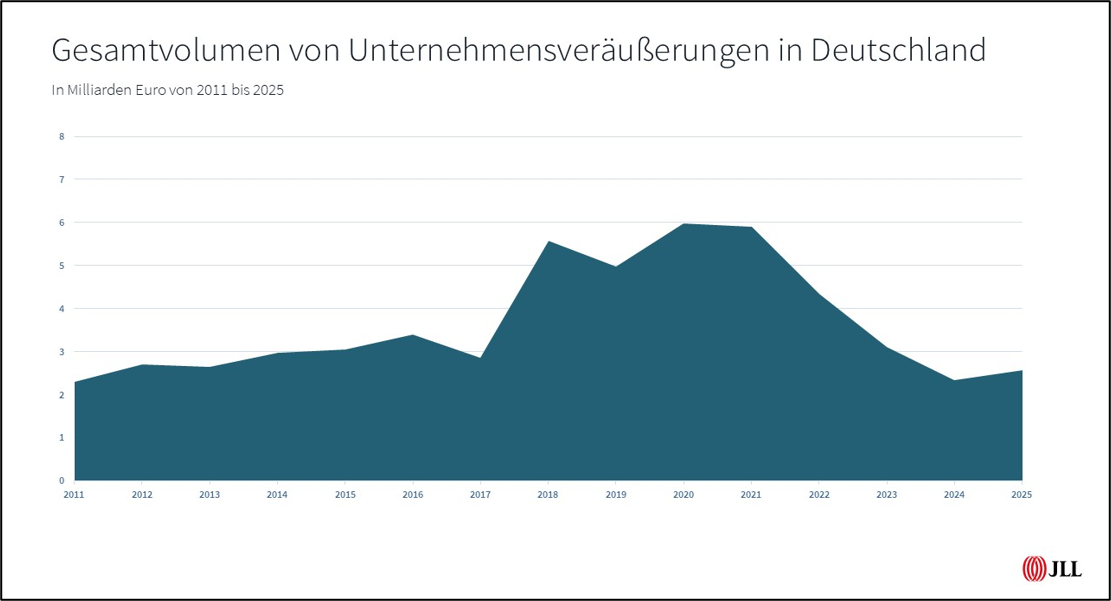
On the German real estate market, companies sold properties worth 2.6 billion euros last year. In the previous year, these “corporate disposals” had amounted to 2.3 billion euros. This corresponds to growth of 13 percent and signals a cautious recovery, in which price expectations of buyers and sellers gradually converged, analyzes the JLL study “Raising Capital from Corporate Real Estate”. “However, companies are very selective in this regard and mainly sell properties that have no strategic significance or are particularly operationally intensive. Properties that are important for the respective core business, on the other hand, remain on the balance sheet,” says Martina Williams, Head of JLL Work Dynamics Northern Europe.
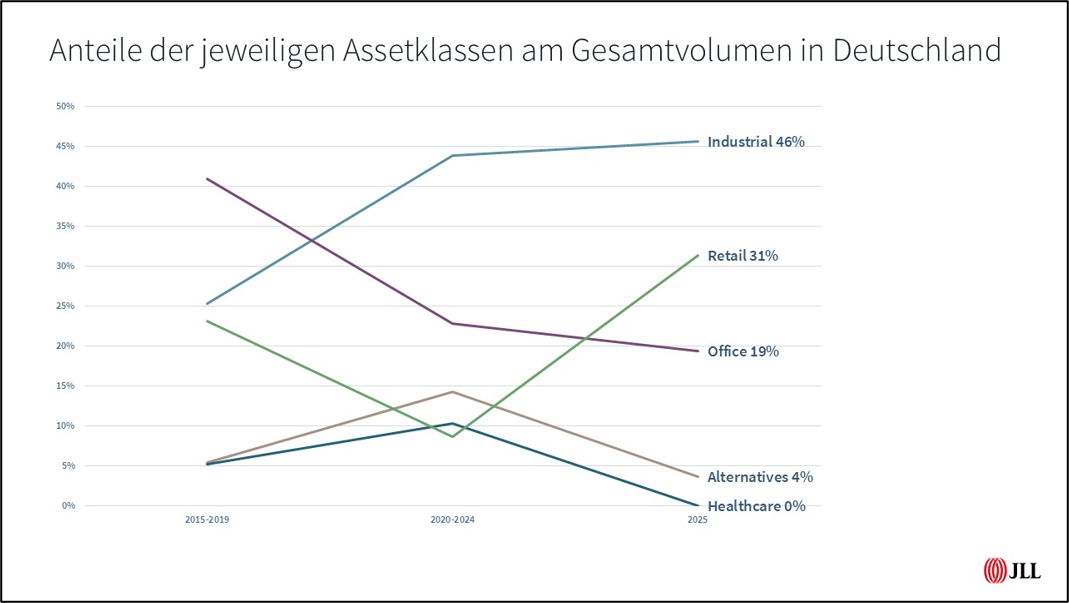
The transactions focused primarily on real estate of manufacturing companies. Their share rose from 25 percent in 2015 to 2019 to 46 percent in 2025. “This development reflects the continued demand for logistics space and its operational relevance,” Williams classifies the growth. At the same time, the share of office properties fell from 41 percent to 19 percent – the reason for this is the consequences of hybrid work, high renovation costs and stricter sustainability requirements. Retail properties had a relatively stable share at 31 percent, while companies held all healthcare properties in their portfolios last year.
Sale-and-leaseback structures once again dominated the transaction landscape in 2025. “Parting with the property and at the same time continuing to use it as a tenant enables German companies to free up capital – for research – for example – while maintaining business continuity. This is a key aspect, especially in an environment of consistently higher interest rates,” explains Williams. On the other hand, investors focused on prime properties with long-term leases and stable cash flows.
Across Europe, the volume grew even faster than in Germany
Meanwhile, across EMEA, companies sold properties for 19.4 billion euros in 2025. They thus contributed nine percent of the total transaction volume in the region. At 25 percent, growth was once again stronger than in Germany, while the number of transactions rose by 18 percent year-on-year to 553 deals. Growth was mainly driven by small and medium-sized transactions.
In terms of sector distribution, industrial real estate dominated with a market share of 35 percent, followed by retail with 25 percent and office real estate with 24 percent. Healthcare reached seven percent, alternative asset classes nine percent. The outlook for 2026 is positive, with experts expecting further stabilisation and selective growth, especially in long-term leases and high-quality properties.
Retail properties dominate EMEA market
In a comparison of the real estate sectors, the retail sector recorded the strongest development in the EMEA region. The transaction volume in the retail sector rose by 50 percent to 4.9 billion euros. This increase was driven by large-volume strategic transactions, with food retailers playing a key role. At 1.9 billion euros, they recorded a stable transaction volume. In France and Great Britain, this division led the field with 23 percent and 21 percent market share, respectively.
The technology, media and telecommunications sectors, meanwhile, saw a significant increase of 245 percent to €709 million, with companies in the industry restructuring their real estate portfolios to support changing business models and related capital requirements. Here, the markets in Switzerland and Germany dominated with 262 million euros and 111 million euros respectively.
“Against the backdrop of the energy transition and the associated capital requirements, activity in the energy sector accelerated massively. Sales of corporate real estate rose from 138 million euros to 421 million euros – a threefold increase within one year. Germany led with 140 million euros, followed by Sweden with 115 million euros,” Williams gives an overview of one of the most important industries of the future.
The automotive sector also recorded significantly more momentum, doubling its volume last year from 290 million euros to 588 million euros. Poland and the Czech Republic gained in importance as transaction locations, while Germany maintained its leading position with 218 million euros. At the same time, the education sector grew by 249 million euros to 634 million euros, with the United Kingdom remaining dominant.