The network expansion of the energy infrastructure of Germany’s data centers is growing steadily. The extent to which a location uses network capacity is determined not only by the pure energy consumption of a data center but also by the electrical connected load. However, this is very unevenly distributed regionally in Germany, as the new analysis by IFA Berlin (www.ifa-berlin.com) shows. To this end, the world’s leading event for consumer electronics, home appliances and future tech examined the connected load of existing data centers in the German federal states and the country’s 20 largest cities. The topic will also be discussed at this year’s IFA Berlin: Edge & Cloud Computing as well as Connectivity and Secure Digital Infrastructures are among the trend topics in the “Computing & Gaming” and “Communication & Connectivity” show areas.
Hesse in 1st place with the highest connected load
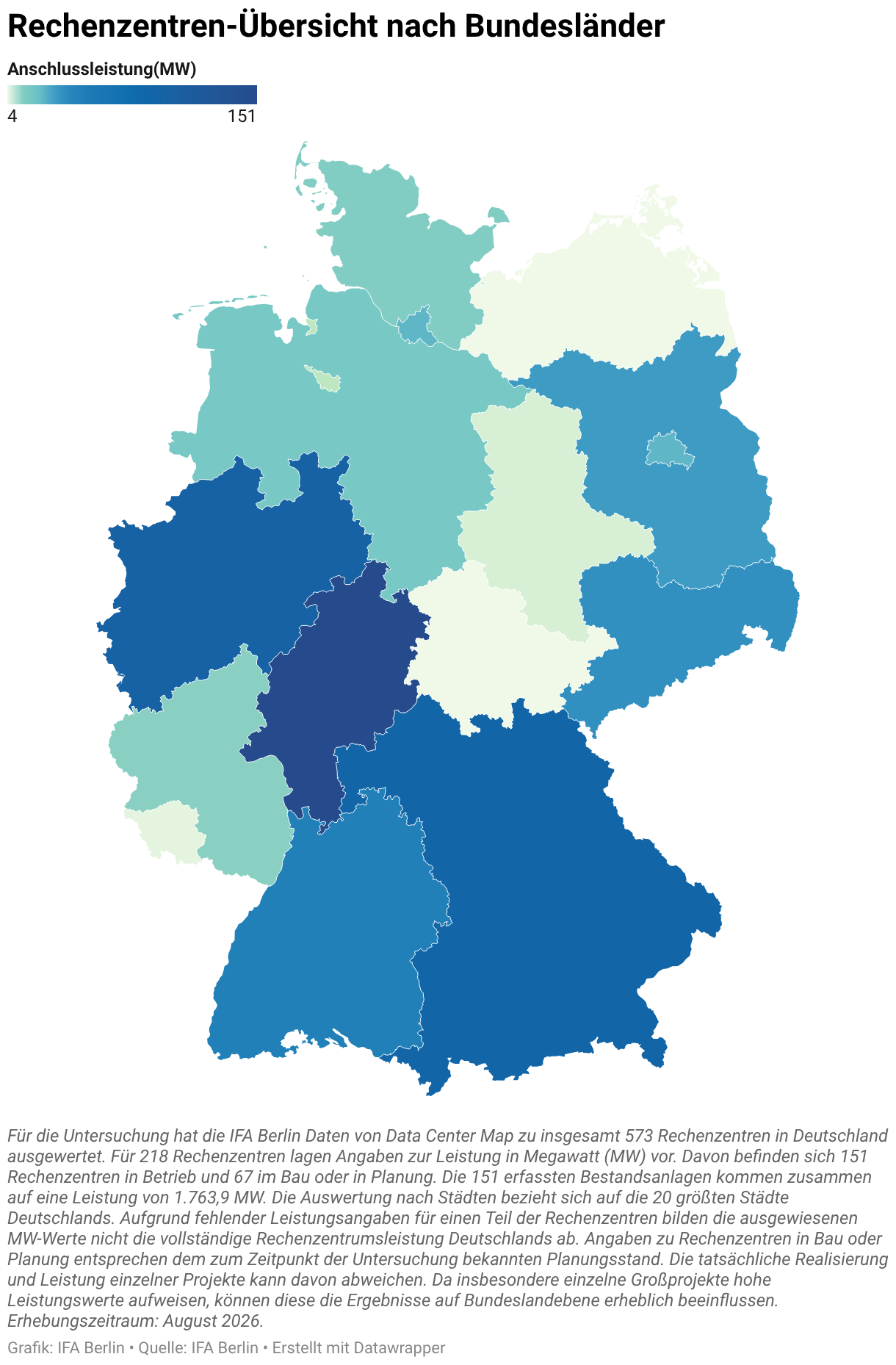
For the study, IFA Berlin evaluated data from Data Center Map on a total of 573 data centers in Germany. For 218 data centers, information on the connected load in megawatts (MW) was available. Of these, 151 data centers are in operation, which together account for 1,763.9 MW. Of these, Hesse contributes almost 70 percent of the recorded connected load with 1,229.8 MW and is by far in first place. There are currently 63 data centers in operation in the state for which a MW figure is available. This is followed by Brandenburg with 123.5 MW. North Rhine-Westphalia ranks third with 107.7 MW.
Lower Saxony is in last place in the ranking with 2.2 MW. Saarland occupies the penultimate place with 3.0 MW and Rhineland-Palatinate has the third lowest recorded connected load (3.6 MW).
In a comparison of cities, Frankfurt am Main is the frontrunner
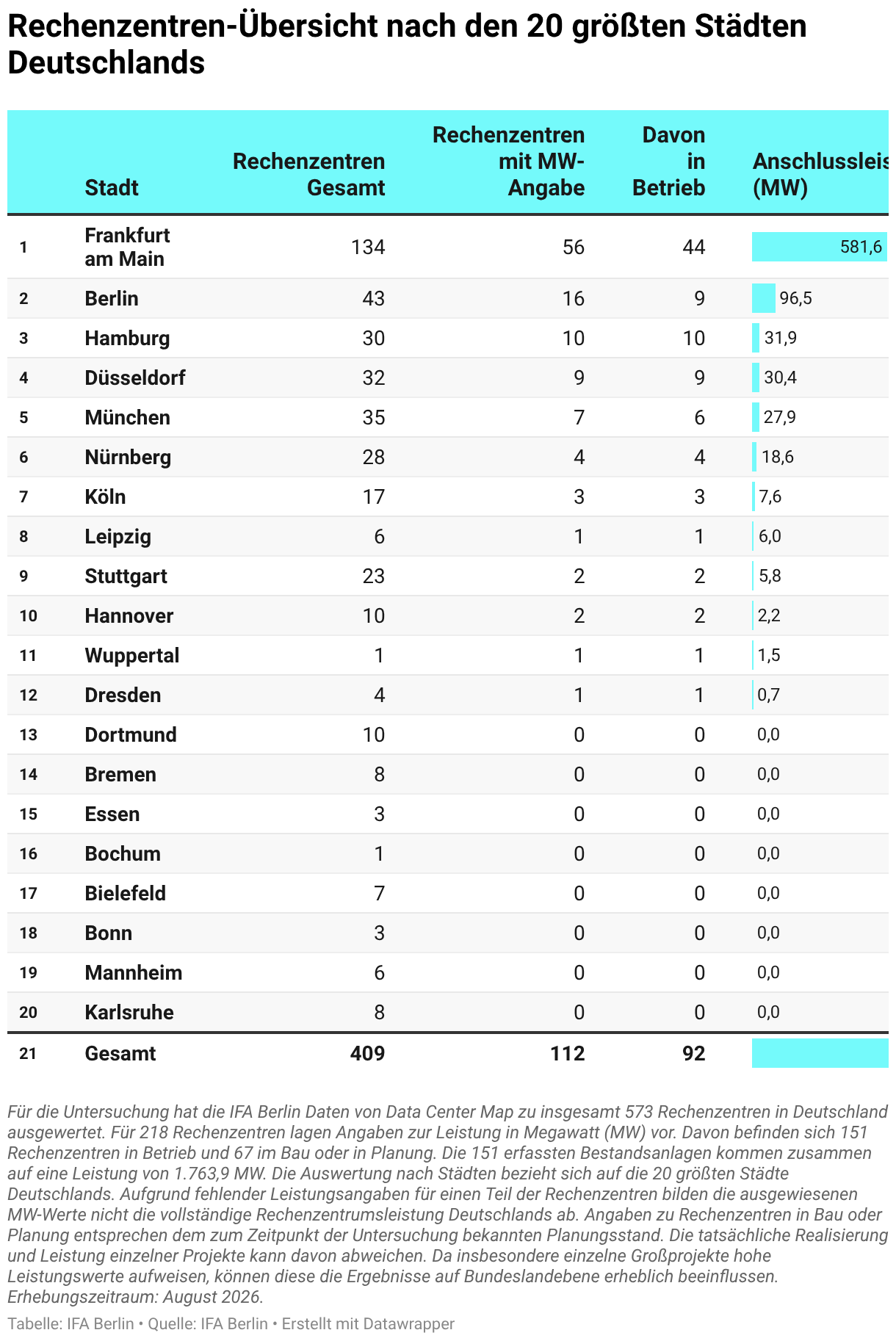
Among the 20 largest cities in Germany, Frankfurt am Main leads the ranking with 581.6 MW of recorded electrical connected load, followed by Berlin (96.5 MW) and Hamburg in third place with 31.9 MW.
In the negative ranking of cities, Dresden is in last place with 0.7 MW. It is followed by Wuppertal (1.5 MW) and Hanover (2.2 MW).
67 new data center projects under construction and planning
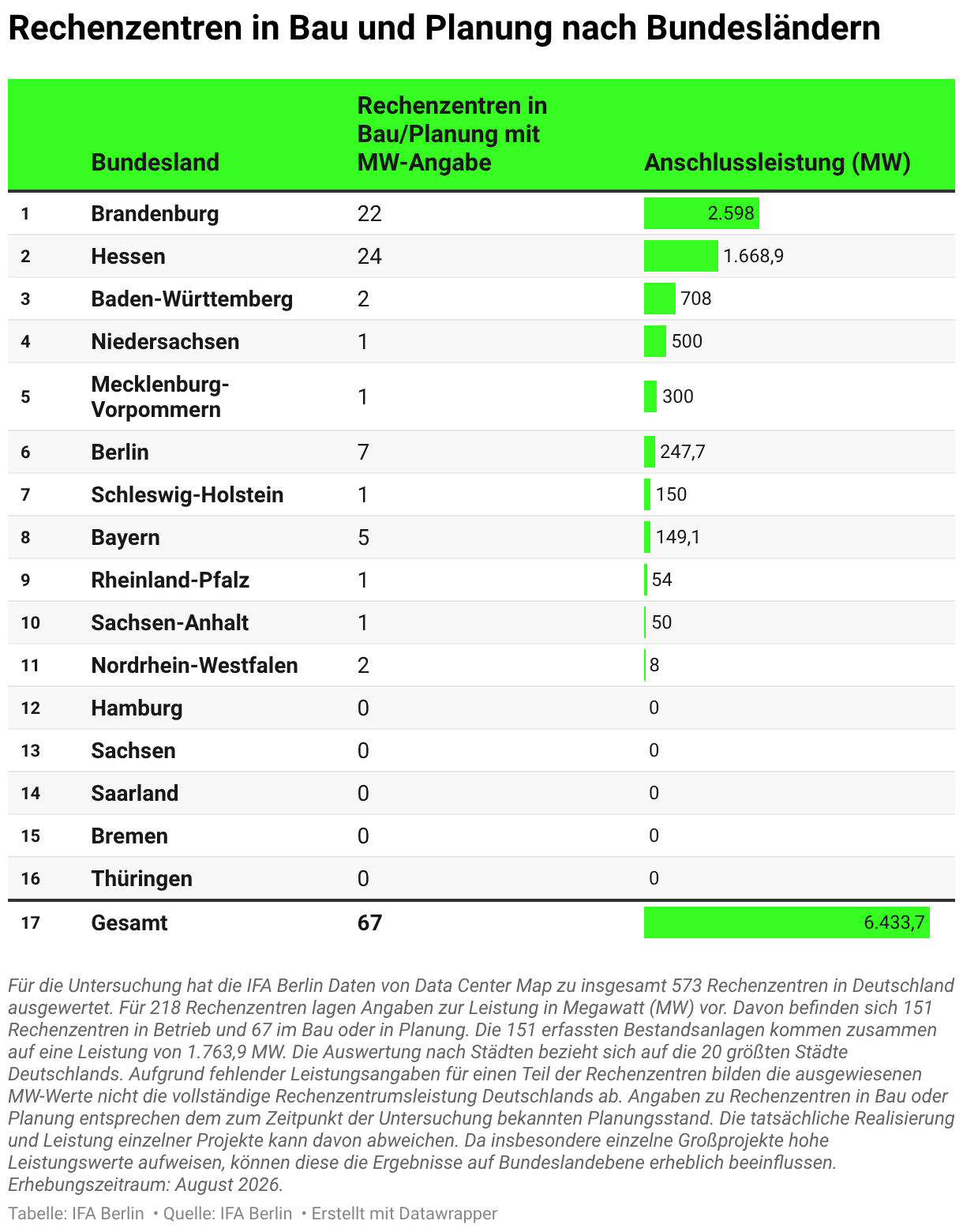
For the analysis, the future projects that have already been communicated were also collected. There are currently a total of 67 planned or under construction data centers, for which a potential available power output of 6,433.7 megawatts is indicated. The largest announced connected load is accounted for by the state of Brandenburg (2,598 MW). This is followed by Hesse (1,688.9 MW) and Baden-Württemberg with 708 MW.
In terms of the number of new projects, however, Hesse is ahead. With 24 planned or under construction data centers, more new facilities are being built there than in any other federal state. Brandenburg follows closely behind with 22 data centers. All other federal states have very few newly planned projects: For example, nine new data centers are currently planned in Berlin and five in Bavaria. In five federal states (Hamburg, Saxony, Saarland, Bremen, Thuringia), on the other hand, there is currently no known construction or planning of a data center.
Leif Lindner, CEO of IFA Berlin, comments: “At around 19.5 megawatts per system, the average connected load in Hesse is two-thirds above the national average of 11.7 megawatts. The reason for this is the Frankfurt-Offenbach region, which offers a locational advantage for particularly large systems with the DE-CIX Internet Exchange. Almost three-quarters of the connected load recorded nationwide is thus accounted for by a single federal state. This is proof of how regionally concentrated the digital infrastructure in Germany is. After all, without sufficient connected load, neither new data centers nor the capacities required for high-performance, edge and cloud computing can be built.”
About the study
For the study, IFA Berlin evaluated data from Data Center Map on a total of 573 data centers in Germany. For 218 data centers, information on capacity in megawatts (MW) was available. Of these, 151 data centers are in operation and 67 are under construction or in planning. The evaluation by city refers to the 20 largest cities in Germany. Due to a lack of performance data for some of the data centers, the reported MW values do not reflect the complete data center capacity of Germany. For example, for four federal states (Thuringia, Bremen, Saxony-Anhalt, Mecklenburg-Western Pomerania) and for eight cities (Karlsruhe, Mannheim, Bonn, Bielefeld, Bochum, Essen, Bremen, Dortmund), there was no information on connected load according to the source. The information on data centers under construction or planning corresponds to the planning status known at the time of the study. The actual implementation and performance of individual projects may differ. Since individual large-scale projects in particular have high performance values, these can have a significant impact on the results at the state level. Survey period: August 2026.