From 2027, the feed-in tariff for new solar installations is set to be abolished. This is provided for in the draft amendment to the Renewable Energy Sources Act. The debate surrounding this raises the question of under what conditions tenant electricity schemes can continue to be run profitably by landlords.
Julius Pahmeier, founder and managing director of VREY, a Berlin-based company specialising in communal building services, says:
“The current debate on the cost-effectiveness of photovoltaic systems on blocks of flats raises an important point: installing solar power in this sector is still significantly more complex than in detached houses, and the removal or reduction of feed-in tariffs certainly does not improve the overall conditions. However, I believe it is too simplistic to conclude from this that photovoltaics on smaller blocks of flats are, in principle, hardly ever cost-effective any more.”
The key factor is the assumptions on which such a cost-benefit analysis is based. For a building with up to 15 residential units, our calculations show that the loss of income resulting from a lower feed-in tariff for electricity fed into the grid is often in the region of around 120 to 400 euros per year. Whilst this is economically significant, it does not fundamentally call into question the profitability of a PV system. Factors such as the actual installation and operating costs – and, in particular, the level of self-consumption – carry much greater weight.
In my view, this is precisely where the key lever lies. The aim of such energy supply concepts must be to use as much of the electricity generated as possible directly within the building, rather than feeding it into the public grid. If, for example, the self-consumption rate rises from 40 to 70 per cent – perhaps through a suitably sized storage system, a heat pump or other controllable loads within the building – the economic analysis changes significantly. At the same time, the level of the feed-in tariff becomes less important.
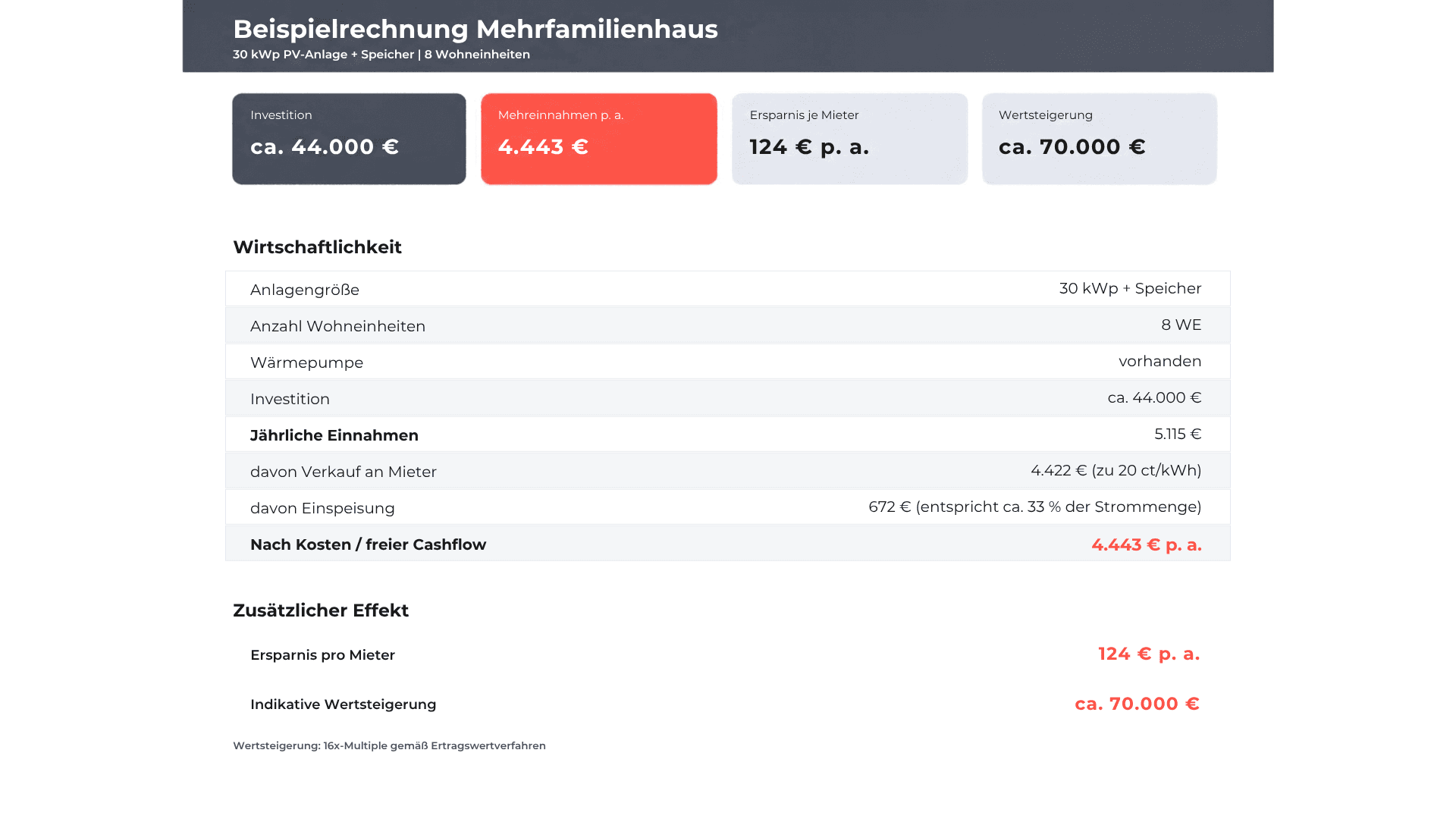
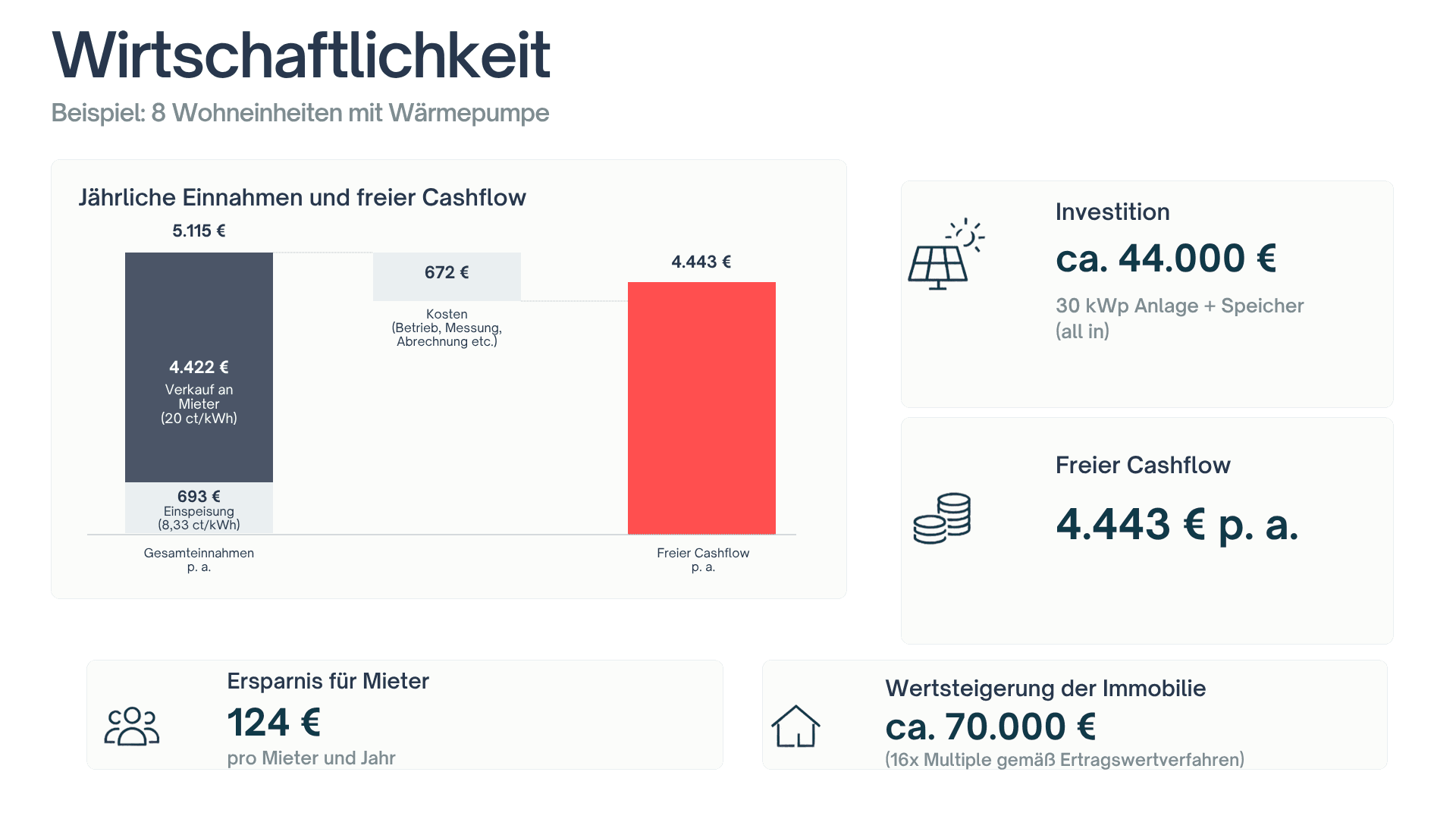
Even with smaller blocks of flats, annual cash flows of 5,000 to 6,000 euros or more can be achieved in this way. If, for example, a system costs around 60,000 euros, this can result in a payback period of around ten years – whilst the technical service life is significantly longer and may well reach 30 years. Under such conditions, we are not looking at returns of two or three per cent, but – depending on investment costs, self-consumption and performance over the entire term – returns can also be in the high single-digit or low double-digit range.
"In my view, the crucial question is therefore not whether installing a photovoltaic system on a block of flats is generally worthwhile. What matters is how the system and the energy supply plan are designed."