The European logistics real estate markets continue to stabilise in mid-2026, despite geopolitical risks such as the Iran conflict and the ECB’s key interest rate hike. At the same time, it is clear that take-up in 2026 will also be generated in markets with stable rent levels. One of the most important new developments is the growing demand from Asian companies for logistics space in Europe. It is increasingly shaping take-up in numerous sub-markets. These are the results of GARBE Industrial in the current GARBE PYRAMID MAP, an overview of prime rents and net initial yields in the 122 most important European sub-markets for logistics real estate in 25 countries.
Asian companies as a growing demand group
“Chinese companies are becoming an independent driver of demand for space in more and more European markets,” says Tobias Kassner, Head of Research and Member of the Executive Board at GARBE Industrial. “Behind this is a fundamental structural change in the e-commerce supply chains. Instead of bringing goods to Europe mainly by air freight or direct shipping, many companies are now building up their own inventories and logistics structures in Europe. The former ‘parcel drop’ via individual transshipment points is thus giving way to a more regionalised inventory management.”
The additional demand is no longer driven solely by e-commerce. Depending on the market, the focus will also be on the battery storage industry and the relocation of production and supply chains of the electric vehicle and semiconductor industries to Europe – among other things, to reduce trade and customs risks. “The intensity and characteristics of demand from Chinese and other Asian companies differ from market to market,” says Yingnan Yao, Head of Business Development Asia Desk at GARBE Industrial. “In Poland, the demand for logistics space is strongly driven by e-commerce. After comparatively little letting activity was observed there last year, e-commerce is supporting the result this year, with Asian companies playing a not insignificant role in this.”
In addition to Poland, Germany, France and Great Britain are also among the relevant target markets for e-commerce-driven enquiries, according to GARBE Industrial’s observations. In this segment in particular, short-term availability often counts, which is why many requests are aimed directly at existing space. For e-commerce distribution to Germany and other European markets, the logistics axis from Rotterdam via Duisburg to North Rhine-Westphalia is particularly relevant. In the Netherlands, the port locations also favor projects in the field of lithium and battery storage. In the UK, battery storage as well as production relocations and the establishment of local supply chains are further drivers in individual requests; a market-wide trend cannot be derived from this at present.
It is true that the additional demand increases the space dynamics. So far, however, it has not led to rising rents across the board. Meanwhile, the vacancy trend has stabilised throughout Europe. The vacancy rate, which has built up over the past few years due to full development pipelines and restrained leasing behaviour, is declining in many areas. This is attributable both to the increased letting of existing buildings and to a noticeably reduced speculative new construction activity.
The defence sector is also increasingly becoming a demand driver. However, the long-term investment programmes will only increase the demand for space in the coming years. It should be noted that a significant part of the demand runs under the radar due to confidentiality requirements or assignment to other sectors of the economy.
Stable rents, slightly rising yields
The development of prime rents underlines the ongoing stabilisation of the European logistics real estate markets. In the first half of 2026, rents remained stable in 79 of the 122 regions analysed, with 14 regions recording declines and 29 regions recording slight increases. Rent increases were concentrated in individual narrow markets in northern, western and southern Europe, while rents in many Eastern European locations moved sideways or declined slightly. At the end of June, the average prime rent was 7.52 euros per square metre per month.
In contrast, there is a change in sentiment in net initial yields. For the first time, rising yields prevailed again in the first half of 2026. Of the 122 regions analysed, 62 regions experienced slight decompression, 51 regions saw yields remain stable and only nine regions experienced further compression. This reversed the picture compared to the second half of 2025. Net initial yields rose by eight basis points on average over the first half of the year. At the end of June, the prime yield averaged 5.6 percent.
“The slight decompression of yields primarily reflects increased geopolitical and macroeconomic uncertainty – especially as a result of higher energy prices and changes in interest rate expectations. It is not evidence of a structural decline in demand on the European logistics real estate markets,” explains Tobias Kassner. “The value correction of recent years is well advanced or completed in many markets.”
Attractive market opportunities in Spain and UK secondary regions
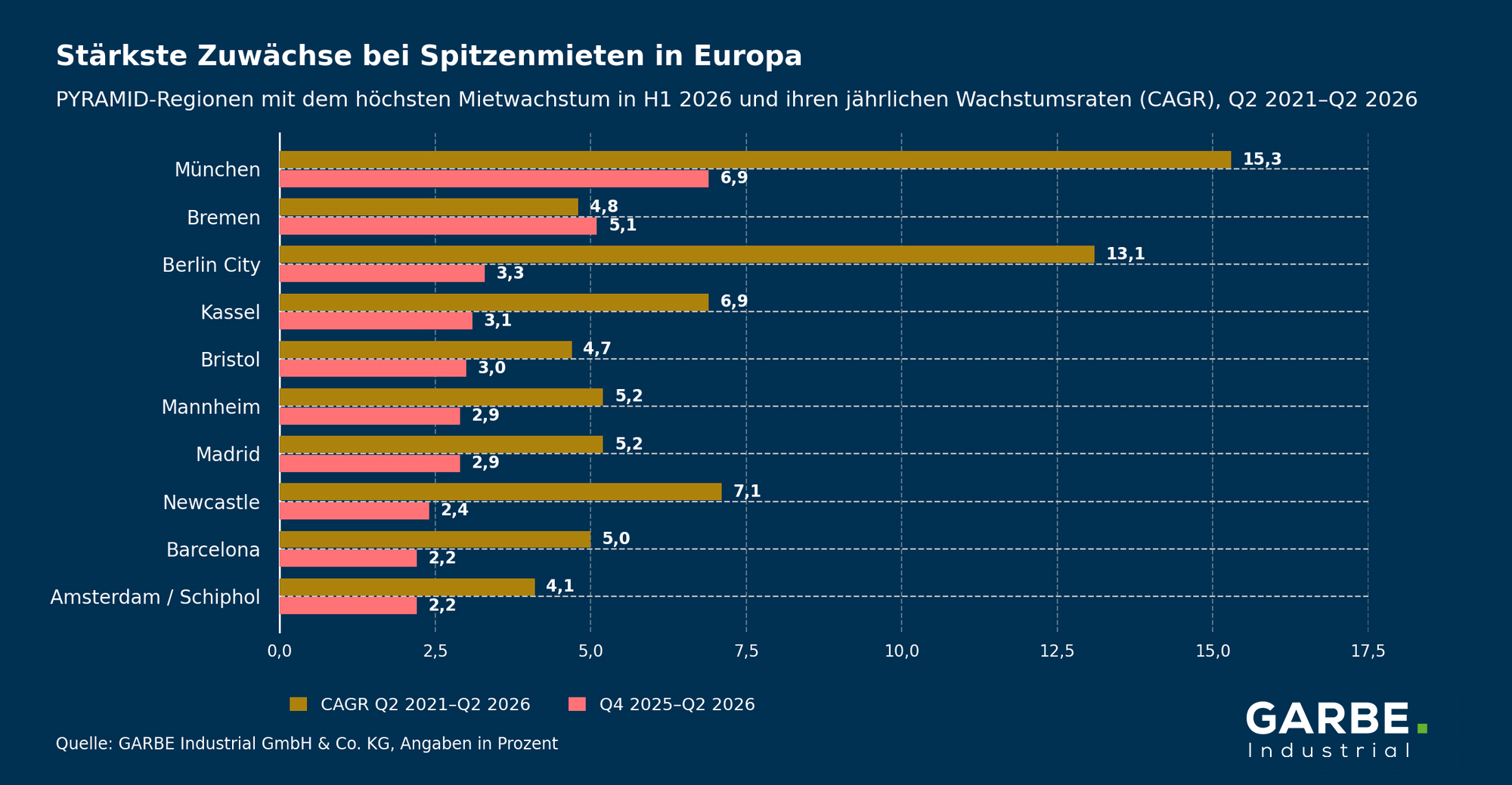
The most favourable combination of rental growth and yield compression will be seen in Spain and selected British secondary markets in the first half of 2026. In Barcelona, prime rents rose by EUR 0.20 in the first half of the year, while the net initial yield fell by ten basis points. In Zaragoza, the rent increase was EUR 0.10 and the yield compression was 20 basis points. Newcastle recorded a compression of ten basis points with rent growth of EUR 0.20. The top German markets of Munich and Berlin City remain the leaders in prime rents: Since the end of 2025, they have risen by 6.9 percent and 3.3 percent, respectively; over a five-year period, the average annual growth is 15.3 percent and 13.1 percent, respectively. In Berlin’s outer area, on the other hand, rent development remains more restrained due to a larger supply of space. In terms of yields, however, Munich and Berlin City are following the general trend of slight decompression and stable development, respectively. This means that the most favourable combination of rental growth and yield compression is shifting from Germany’s top markets to Spain and selected British secondary regions compared to 2025.
Detailed figures and methodological information can be found in the interactive GARBE PYRAMID MAP, the updated version of which will be available from 01.09.2026. The data referred to in the press release come from the PYRAMID project.