JLL study sees transparency as a key factor for growing real estate investments
Advancing digitalization, the increased use of artificial intelligence (AI) and targeted government reforms have led to an increase in transparency and investment turnover in the world’s leading real estate markets. This is according to the Global Real Estate Transparency Index (Greti) by JLL and LaSalle, which is published every two years.
Europe is still the most transparent region in the world with Great Britain and France in the first two places and the Netherlands in fifth place. As in the previous study, Germany ranks tenth. The top ten is completed by Australia (third place), the USA (fourth place), Canada (sixth place), New Zealand (seventh place), Ireland (eighth place) and Sweden (ninth place). In the “Highly transparent” category, Japan, Belgium and Singapore are also represented, as was the case most recently.
Germany has consolidated its position through progress in reporting on the debt capital market and the implementation of the Corporate Sustainability Reporting Directive (CSRD). The legal situation and transaction processes in Germany are rated positively. “However, there is still room for improvement, such as in the availability of market data for alternative real estate segments,” emphasizes Konstantin Kortmann, CEO and Head of Capital Markets at JLL Germany. “We see that Germany is attracting international real estate capital. In order to further increase its attractiveness and catch up with the absolute top group of highly transparent countries, it is necessary to consistently digitize public data stocks and create central, publicly accessible data platforms.”
The current study evaluates market transparency in 88 countries and 146 cities worldwide on the basis of 260 individual characteristics. These include, for example, the availability of information on rents, occupancy rates and pricing, key figures on transaction processes, the regulatory/legal environment and sustainability, for example with regard to building standards, energy consumption and climate risks. According to the study, two-thirds of the countries surveyed have improved their transparency in the past two years.
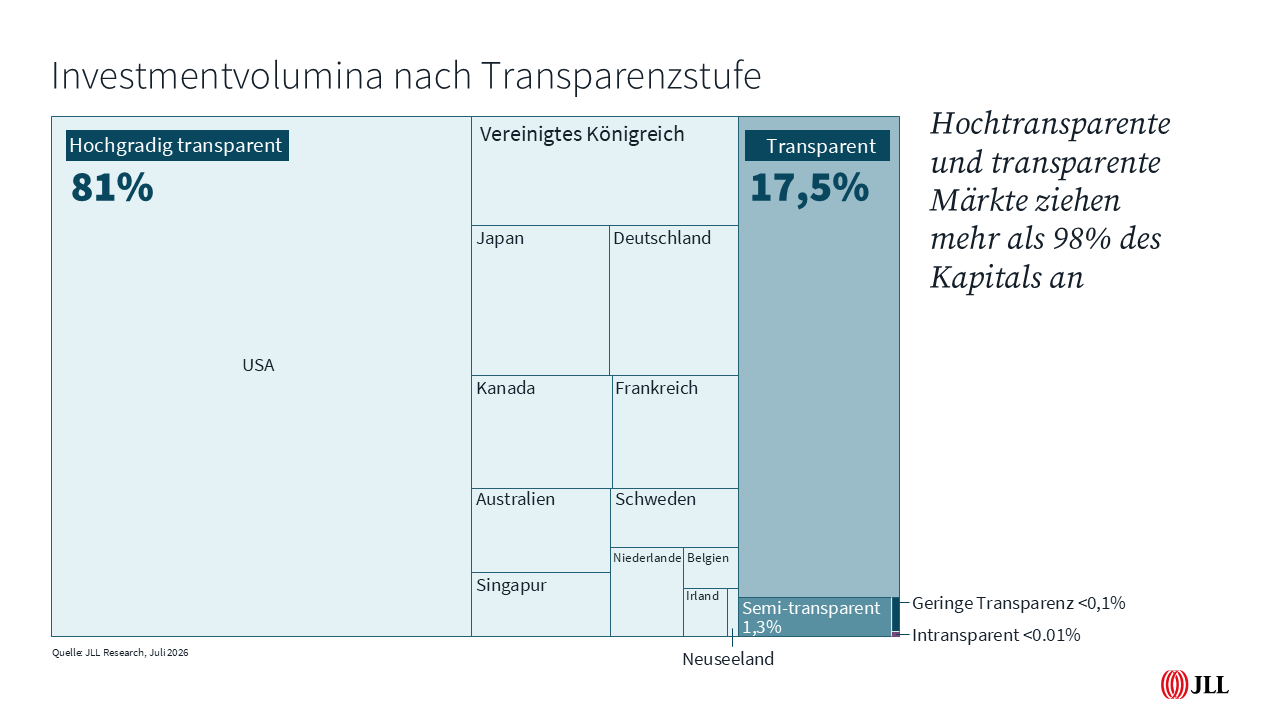
The main drivers of global transparency gains are countries in the Asia-Pacific region and the MENA region (Middle East, North Africa), including four Gulf states (Saudi Arabia, Dubai, Abu Dhabi, Qatar). The 13 countries classified as “highly transparent” have attracted 81 percent of global real estate investments in the past two years. The transaction volume in this group has increased by 64 percent, outpacing the rest of the world by 20 percentage points.
“The focus on transparency for investors has never been greater in global real estate markets, as external challenges such as geopolitical tensions attract increasing attention in the near future,” explains Richard Bloxam, CEO JLL Capital Markets. “Additional factors such as artificial intelligence, higher standards of sustainability obligations and reporting, and the growing importance of alternative real estate sectors are driving investors to seek and demand more transparency.”
AI accelerates transparency gains – and creates new challenges
A key driver of transparency improvements is the rapid spread of AI in the real estate industry. More than 90 percent of users and investors now use AI tools that analyze large amounts of data, evaluate market fundamentals and forecast opportunities in the capital markets, for example. Governments are increasingly digitizing their services and integrating AI to increase efficiency, attract investment and enable growth.
At the same time, the industry and its users are facing new challenges. For example, three of the four biggest challenges for corporate real estate portfolios are technology-related: cybersecurity and data protection, AI disruption, and uncertainty about the impact of AI on space demand. This uncertainty makes transparency all the more important to track the impact on demand, market fundamentals, and pricing across markets.