Broad-based market is less dependent on individual large deals
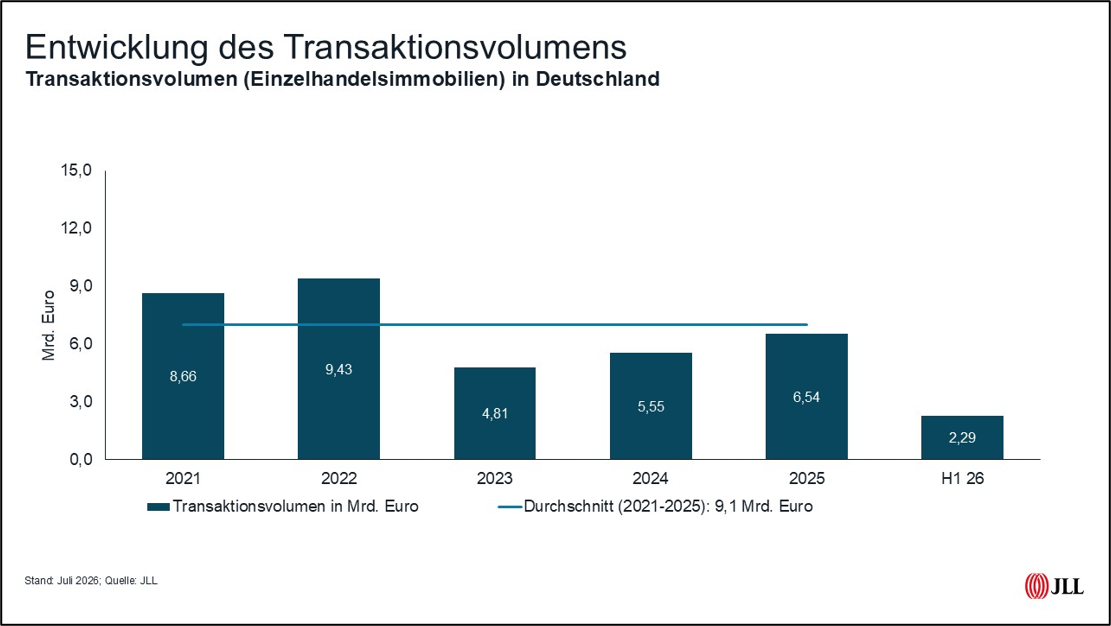
After the good start to the year, the German investment market for retail real estate suffered a noticeable setback in the second quarter. With a transaction volume of around 850 million euros, the market not only fell short of its own expectations, but also fell short of the first quarter of the year (1.44 billion euros) by around 40 percent. At the middle of the year, the market now stands at 2.29 billion euros, around 21 percent less than in the same period last year. The number of transactions fell from 83 to 41 in the second quarter, which shows that although significantly fewer transactions were concluded, they were on average significantly larger than in the previous year.
Meanwhile, Sarah Hoffmann, Head of Retail Investment at JLL Germany, sees great potential for increasing movement in the market: “We currently see a large number of specialist retail portfolios as well as individual products in the market. Shopping centers are also offered in both the prime and secondary segments. A high level of dynamism can already be seen. However, this only arises where prices in line with the market are expected.”
At the same time, Hoffmann observes that investors are clearly differentiating between the properties on offer: “Although the demand situation is robust, the sharp increase in available product means that investors have a wide choice and only become active if the product really fits the purchase profile. Recent bidding processes have shown many times oversubscription. From this, the actual potential of the market can be derived. This applies in particular to flawless core products as well as higher-yielding value-add to core-plus assets – but only if the yield actually meets the requirements of the buyer.” There are also a number of investors who are interested in properties that are rented out on a long-term and sustainable basis.
The top five transactions account for almost a third of the total volume at the end of the first half of the year and add up to 725 million euros. This shows a lower concentration on large deals than in the previous year, when the five largest deals still accounted for 57 percent of the half-year volume. “This observation is also underlined by a look at major deals. As in the same period of the previous year, we registered three transactions worth more than EUR 100 million in the first half of the year. But while these amounted to around 1.5 billion euros last year, this year they are just over 560 million euros,” Hoffmann analyses.
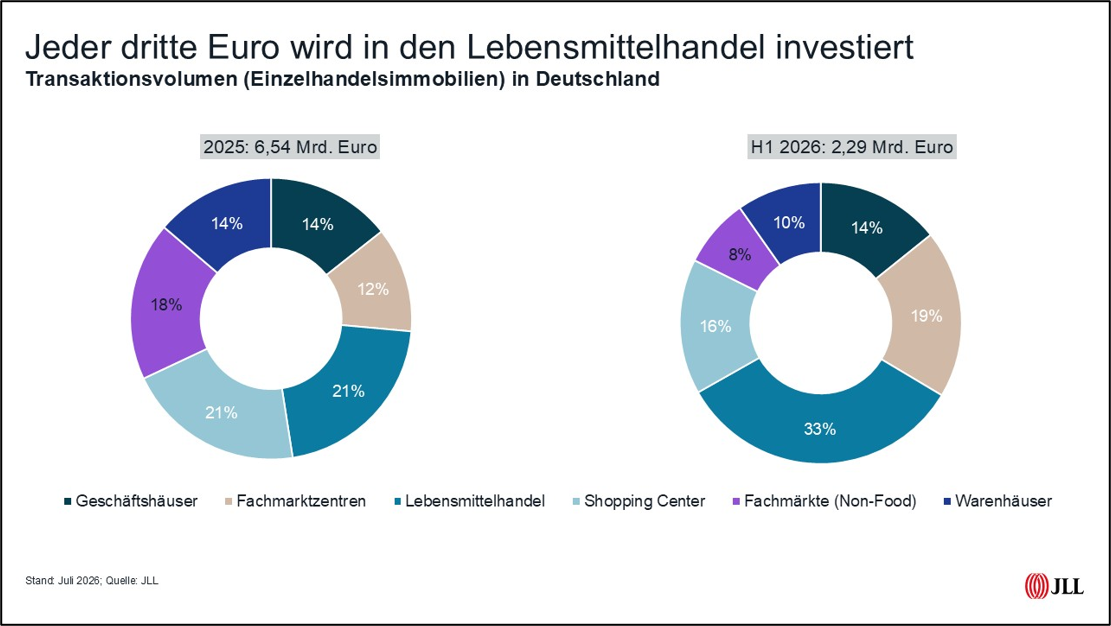
Once again, specialty store products dominated the action and together achieved 60 percent of the total volume. Food retailing accounted for 33 percent, retail parks for 19 percent and a further eight percent for non-food stores. In addition, shopping centers accounted for 16 percent of the volume, ahead of commercial buildings with 14 percent. Department stores contributed ten percent to the total volume.
It is worth taking a closer look, especially when it comes to high-street products: “Commercial building locations continue to be acquired primarily by family offices and private investors. We are noticing a stronger dynamism of international family offices here and, recently, an increase in the activity of institutional investors – as long as they are in terms of sustainable prime locations,” Hoffmann analyses.
In general, investors focused on security and invested 53 percent in core real estate and a further 38 percent in core-plus. Opportunistic objects (five percent) and value-add (four percent) played only a minor role.
On the buyer side, asset and fund managers again accounted for the largest share with 43 percent of the transaction volume, followed by real estate companies with 17 percent and private investors with 15 percent. On the seller side, the gap between asset and fund managers (25 percent) and real estate companies (21 percent) was much smaller.
Meanwhile, German investors dominated the market in the first half of the year with a 72 percent share on the buyer side and 67 percent on the seller side. On balance, they expanded their holdings by 111 million euros.
Prime yields remained constant compared to the previous quarter. In a year-on-year comparison, only individual specialist stores rose by ten basis points to six percent. Shopping centers remained at 5.9 percent and retail parks at 4.6 percent. On the main shopping streets, Munich leads the field with 3.2 percent, followed by Hamburg and Berlin with 3.4 percent. “For the moment, we expect prime yields to stabilize. A number of core transactions are currently underway in the market. It can be clearly deduced from the ongoing processes that institutional liquidity is available if the product meets the criteria in quality, sustainability and returns,” says Hoffmann, classifying the prime yields.
“For the second half of the year, we expect a significant recovery compared to the subdued second quarter. There are currently some promising properties on the market and, despite the economic and geopolitical risks, we see a high willingness among many market participants to invest in good products,” says Sarah Hoffmann. “It is not uncommon for us to currently manage marketing processes in which 50 players or more sign confidentiality agreements. Double-digit bidding situations are also possible again and show the liquidity for the retail sector.”