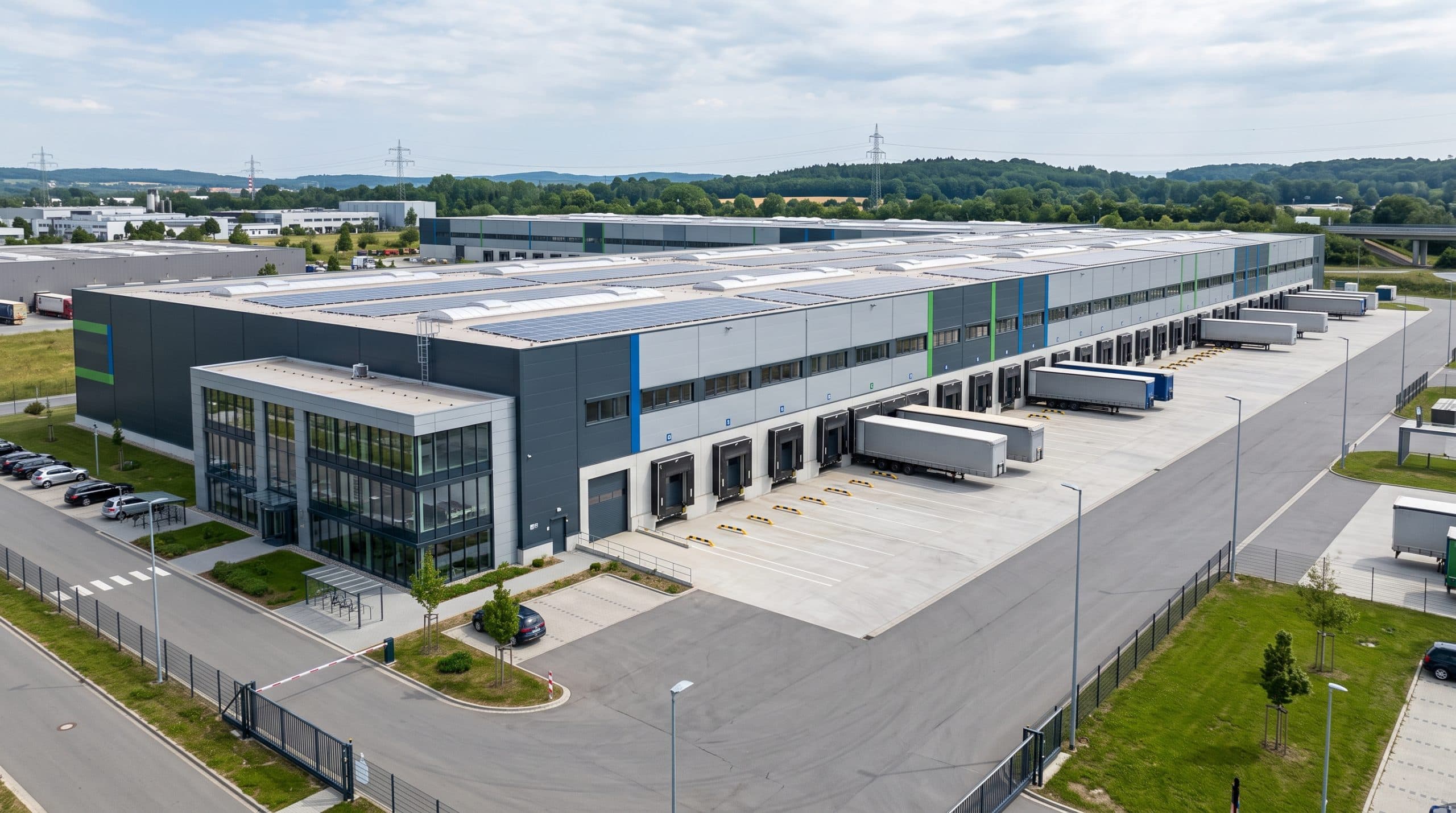
BNP Paribas Real Estate publishes market figures for Q3 2026
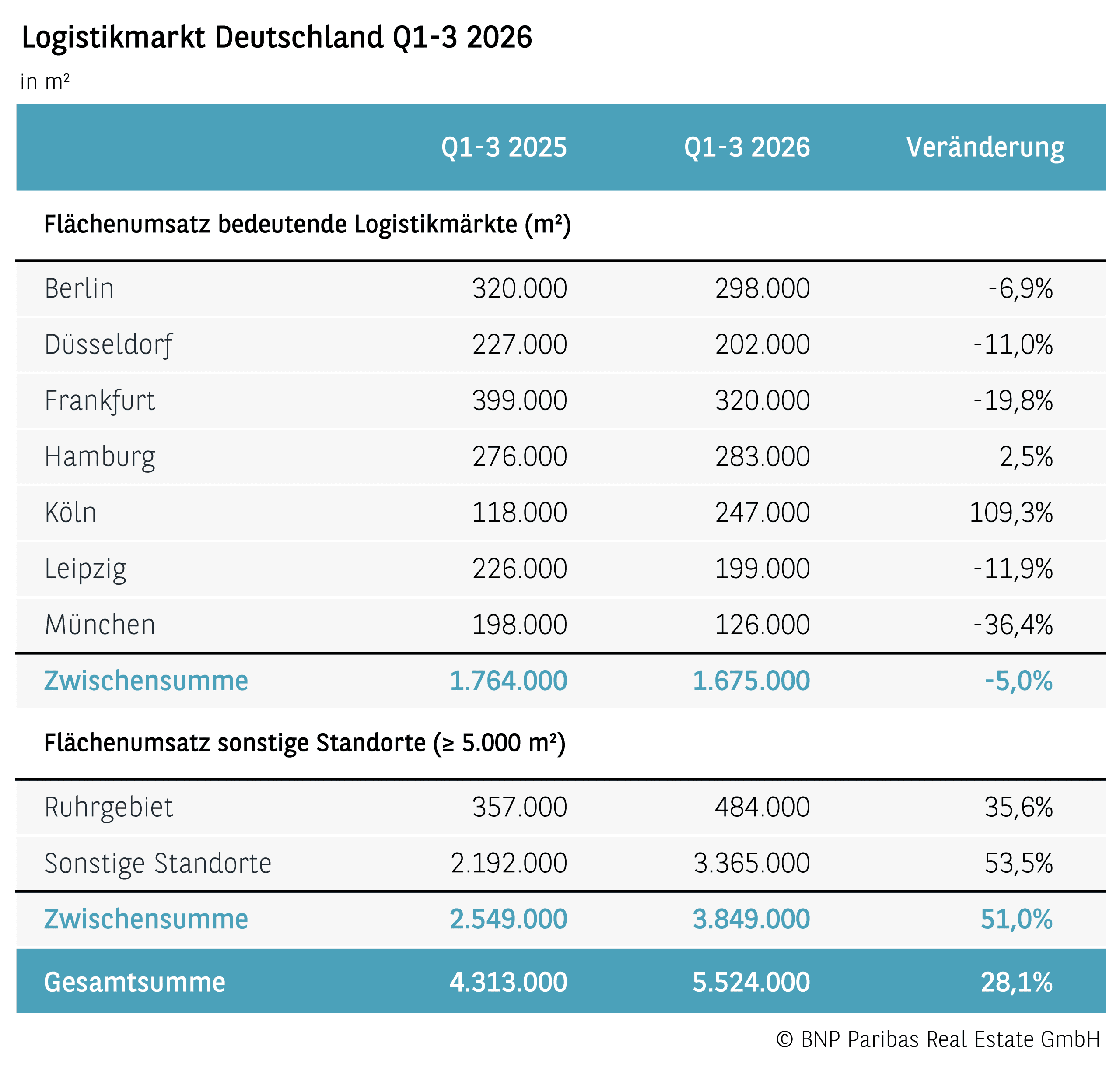
Demand in the nationwide warehouse and logistics space market remains high. After the first three quarters of 2026, take-up totalled 5.5 million m², representing a 28 per cent increase compared with the same period last year and also a significant 9 per cent above the ten-year average. Momentum has steadily increased over the course of the year, as reflected in rising quarterly figures. The third quarter, with just under 2.2 million m², saw a further 23 per cent increase compared with the second quarter, achieving the highest figure since the second quarter of 2022. These are the findings of an analysis by BNP Paribas Real Estate.
As a result, take-up continues to rise – despite moderate economic growth, the war in Iran which has been ongoing since the end of February and the blockade of the Strait of Hormuz, rising energy prices and accelerating inflation, US tariff policy and the war in Ukraine. “The key drivers of the current momentum are, on the one hand, logistics service providers handling business for e-commerce companies from Asia, as well as for long-established large corporations, and, on the other hand, companies operating in the armaments and defence sector. Furthermore, manufacturing companies that are optimising or expanding their operations are driving significant turnover in commercial space. Overall, there are again considerably more large-scale contracts on the books than in the same period last year, alongside a high number of deals being finalised,” explains Christopher Raabe, Managing Director and Head of Logistics & Industrial at BNP Paribas Real Estate GmbH.
Strong rise in turnover outside the major logistics hubs
It is primarily the locations outside the major logistics hubs that have seen a significant increase of 51 per cent compared with the same period last year, achieving the second-highest turnover of the past ten years. They stand out in particular for their better availability of space – especially in the large-scale segment – and more attractive price levels. The situation is different in Germany’s top logistics markets (Berlin, Düsseldorf, Frankfurt, Hamburg, Cologne, Leipzig and Munich), where a total volume of just under 1.7 million m² was recorded. This represents a decline of around 5 per cent compared with the previous year and falls 8 per cent short of the long-term average. In some of these markets, requests for space cannot always be fully met due to a lack of suitable supply. The overall decline in construction activity is evident here, which is also reflected in a falling share of new-builds in total space take-up. Nationwide, this share has fallen to 55 per cent – the lowest level in the last ten years.
When comparing the major cities, the Cologne market stands out in particular, having more than doubled its figure from the previous year to a current 247,000 m²; together with Hamburg (283,000 m²; +3 per cent), which has at least seen a slight increase, it is the only major city to have recorded a rise in take-up. Nevertheless, Frankfurt tops the ranking with 320,000 m²
(-20 per cent), ahead of Berlin (298,000 m²; -7 per cent). Despite an above-average result of 202,000 m², Düsseldorf is down 11 per cent on the same period last year, and Leipzig, too, fails to reach last year’s level despite a very strong third quarter (199,000 m²; -12 per cent). Munich has been particularly hard hit by a shortage of space; it is still awaiting major deals this year and, at 126,000 m², remains a good 36 per cent below the previous year’s figure. The Ruhr region, by contrast, achieved record take-up of 484,000 m², an impressive 36 per cent higher than the previous year.
High demand from logistics service providers
When it comes to the sectoral breakdown of nationwide space take-up, logistics service providers stand out with a market share of almost 45 per cent. They alone account for 2.5 million m², which is the highest figure of the past ten years. As e-commerce companies increasingly outsource their operations to logistics service providers, the share accounted for by retail companies, by contrast, remains low at just 15 per cent. Manufacturing companies also account for an above-average amount of space turnover, contributing 31 per cent to total turnover.
Rents are rising in some locations
Both prime and average rents have risen compared with the third quarter of 2025. On average across all locations, prime rents have increased by 4.3 per cent and average rents by 4.9 per cent. Compared with the second quarter, rent levels have risen particularly in Düsseldorf, Frankfurt, Cologne and the Ruhr region. Munich continues to command the highest rents, with prime rents reaching 11.25 EUR/m² (+7 per cent compared with Q3 2025). Whilst the prime rent in Frankfurt currently stands at 9 EUR/m² (+10 per cent), Düsseldorf at 8.85 EUR/m² (+4 per cent), Hamburg at 8.80 EUR/m² (+4 per cent), Cologne at 8.60 EUR/m² (+12 per cent), Berlin at 8.30 EUR/m² (+1 per cent) and the Ruhr region at 8.10 EUR/m² (+3 per cent) remain within the range of 8 to 9 EUR/m². In Leipzig, the prime rent remains unchanged at 5.70 EUR/m².
Outlook
In general, it can be assumed that there will be little change in the geopolitical landscape – particularly with regard to the conflict in the Middle East – between now and the end of the year. However, the German economy is showing signs of a slight recovery, prompting the leading German economic research institutes to recently revise their forecasts for this year’s gross domestic product upwards (1.3 per cent). Alongside government spending on infrastructure, climate neutrality and defence, exports and industrial production in particular are on the rise.
Meanwhile, the nationwide logistics lettings market is currently showing strong momentum. This is reflected, on the one hand, in a very high overall number of leases and, on the other, in a noticeably higher volume of large-scale leases of 20,000 m² or more. It is this segment in particular that accounts for the difference compared with last year’s results. It remains to be seen whether the trend of rising quarterly results can continue in the remaining three months of the year, given the high volume recorded in the third quarter. Due to the recent decline in speculative new-build activity, there is less space available at short notice in sought-after locations, which is already somewhat limiting space take-up in some major logistics hubs and leading to corresponding shifts in demand. “Nevertheless, the final quarter should remain dynamic, as existing enquiries and large-scale contracts already under negotiation confirm that demand remains high. Accordingly, the full-year result should significantly exceed last year’s figure, which stood at just under 6.1 million m²,” says Bastian Hafner, Head of Logistics & Industrial Advisory at BNP Paribas Real Estate GmbH, summarising the outlook.