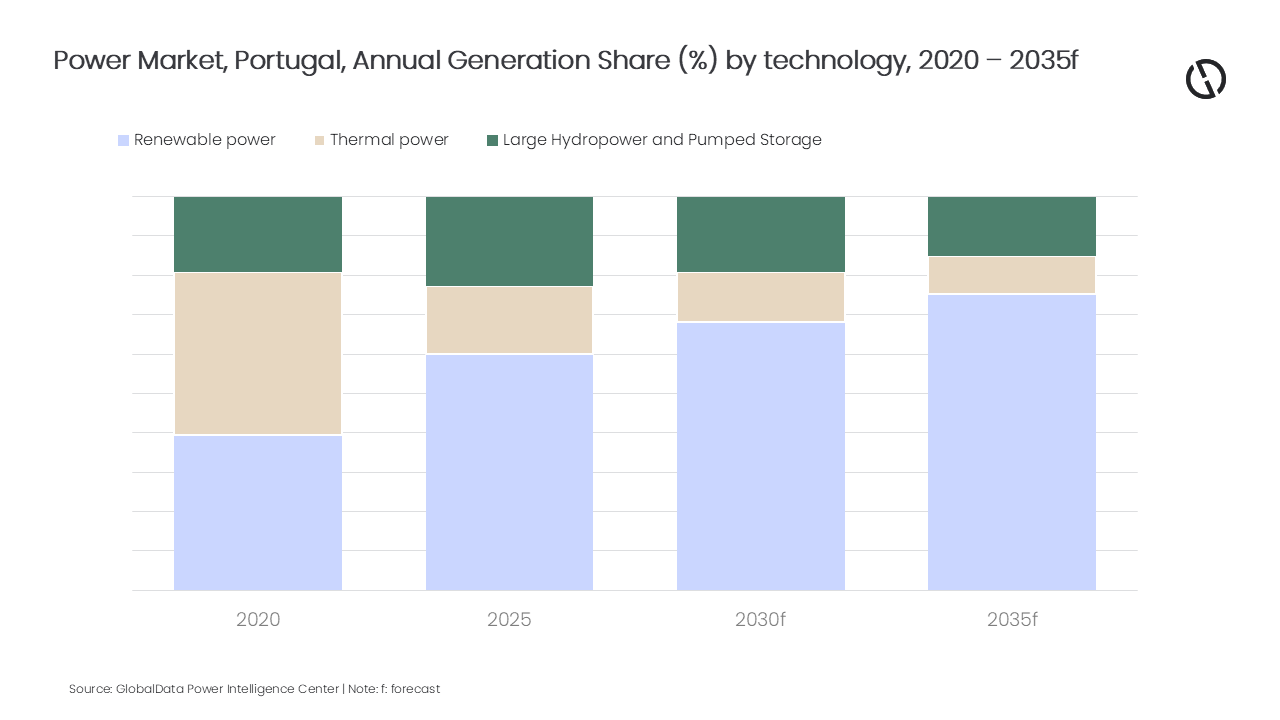
Portugal is rapidly moving away from fossil fuel dependence even as its expanding renewables strain grid reliability, spurring concerns that gas plants may still be needed longer than planned. Gas-fired plants will remain essential for firming, especially during low wind, solar lulls, or hydrological shortfalls, even as their utilization is expected to decline. says GlobalData, a leading intelligence and productivity platform.
GlobalData’s latest report, “Portugal Power Market Trends and Analysis by Capacity, Generation, Transmission, Distribution, Regulations, Key Players and Forecast to 2035,” reveals that electricity demand in the country is set to increase from 53TWh in 2025 to about 57.3TWh by 2030, with renewable capacity booming through solar PV, wind, and hydropower.
Attaurrahman Ojindaram Saibasan, Power Analyst at GlobalData, comments: “Portugal is pushing renewables hard in its best solar and wind zones, but without significant investment in storage, grid interconnection, and flexible dispatchable capacity, clean-energy growth may come with reliability trade-offs.”
Key challenges include permitting and grid-access delays, revenue uncertainty for storage and ancillary-services providers, and exposure to imported gas-price volatility. Meanwhile, coastal regions such as Alentejo and Algarve are attracting solar investment, and hybrid wind/solar plus storage projects are getting greater attention.
Portugal’s power system is coming under increasing pressure as renewable generation expands rapidly. By mid-2025, close to 30GVA of generation projects were queued for connection to the transmission grid, with a further 9GVA already granted access but still not online.
Bottlenecks are most visible in high-solar areas such as the Algarve, where summer tourism drives demand spikes on a network that was not built for current load patterns. These stresses are intensified by slow and complicated permitting. Grid-connection agreements can get stuck in multi-step approvals, and some developers submit “placeholder” requests that tie up capacity without building projects right away.
Saibasan adds: “Despite the hurdles, Portugal is moving ahead with hybrid technical solutions and regulatory changes that could significantly alter how new capacity is integrated. One example is the Cavaleira project in Estremoz, now operating commercially with solar paired with battery storage and designed to add wind later, all sharing a single grid connection.”
On the policy front, the European Grids Package adopted in December 2025 aims to cut permitting friction, make connection processes more transparent, and expand flexibility options, including more adaptable contract-for-difference structures. In parallel, a new 1GW interconnector between northern Portugal and Spain’s Galicia, commissioned in July 2026, strengthens cross-border transfer capability and supports Portugal’s ambition to reach a 15% interconnection level by 2030.
Saibasan concludes: “Portugal should look at accelerating grid modernization, streamlining connection processes, implementing capacity remuneration mechanisms, incentivizing storage, and expanding hydropower and pumped storage modernization. If executed, Portugal could deliver over 70% of its electricity from renewables by 2035, while relying on gas only during peak stress and maintaining reliability.”