

Private credit is regarded as an alternative to traditional bank financing. Yet the banks have by no means disappeared from the scene. A recent case involving Barclays illustrates just how closely the fund industry and the banking system remain linked through new financing structures.
One loan, two worlds
The UK’s Prudential Regulation Authority (PRA) is currently reviewing the regulatory treatment of derivative transactions through which Barclays provides financing for private credit funds. The focus is on so-called total return swaps (TRS), which Barclays is alleged to have classified under the trading book rather than the banking book, even though the underlying corporate loans are illiquid. Mirror hedging transactions with other market participants were apparently cited as the justification for this classification. Whether the chosen regulatory treatment is appropriate remains the subject of the investigation.
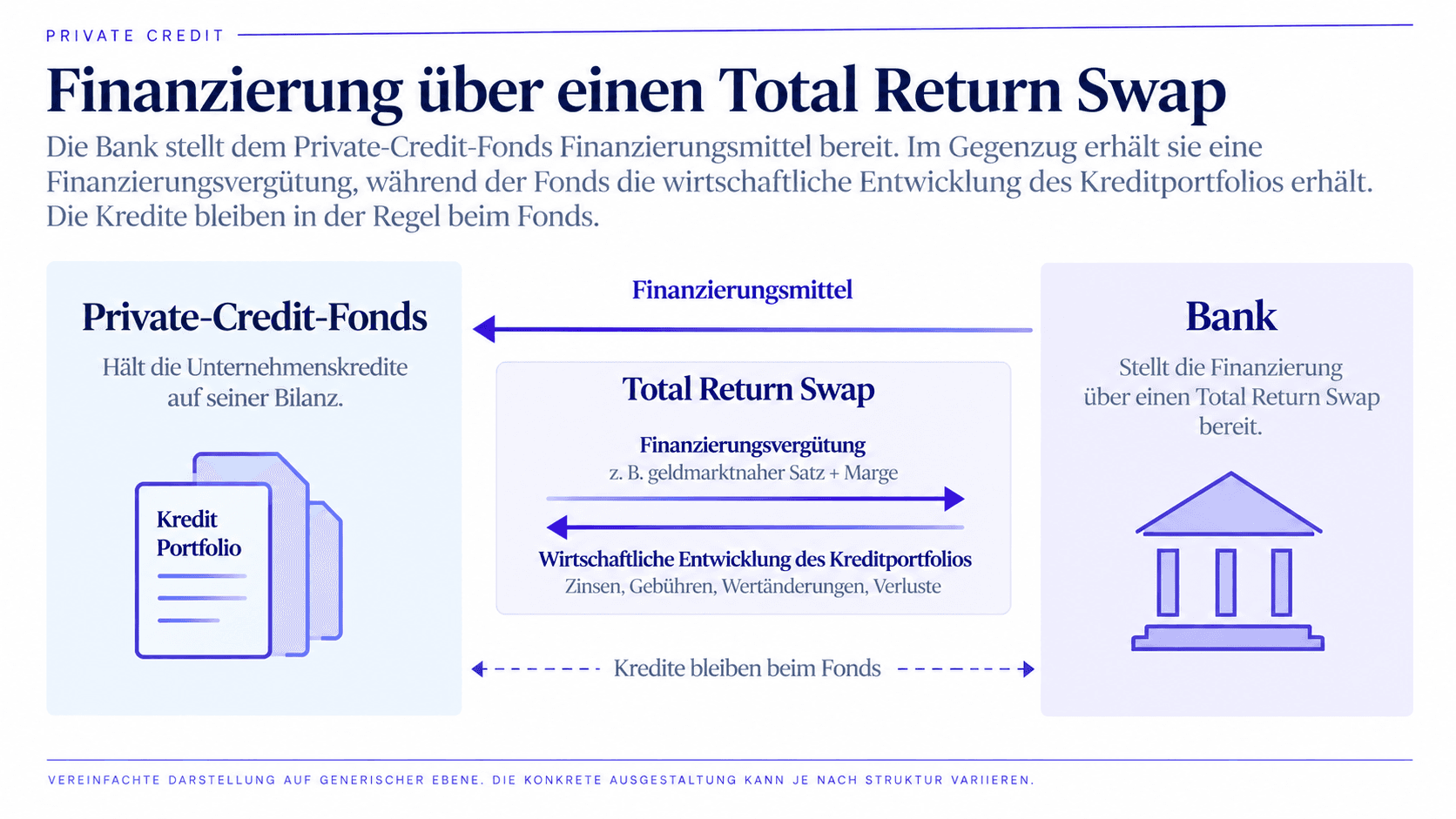
The mechanism can be described in simple terms as follows: private credit funds grant loans to companies and can finance their portfolios with the help of banks. Under an appropriate financing structure, the fund receives financing and pays the bank an agreed fee in return, for example a money-market-based interest rate plus a margin. At the same time, the fund can track the economic performance of a reference portfolio via a total return swap: The bank pays the fund the reference portfolio’s total return, including interest and changes in value, whilst the fund pays the agreed financing fee. In economic terms, the fund thus bears the opportunities and risks associated with the performance of the loans. However, whether the bank, for its part, is sufficiently protected against defaults, valuation risks and liquidity shortages depends on the specific terms of the contract.
Risk is taking on a new form
Classification as part of the banking book or trading book helps to determine the rules under which a bank must hold capital. A trading book position is not automatically lower risk or requires less capital.
However, an illiquid corporate loan does not become tradable simply because its economic performance is transferred via a derivatives contract. Hedging transactions can significantly reduce risks, but do not necessarily eliminate counterparty risks, valuation uncertainties or potential losses arising from the realisation of collateral.
As early as 2025, the PRA expressly warned against treating illiquid assets as tradable positions solely on the basis of their financial structuring, without demonstrating that the necessary conditions were met.
The key question is therefore: to what extent may the regulatory treatment of a financial instrument deviate from the characteristics of the underlying asset on which it is economically based?
At first glance, this sounds like a specialist issue for banking supervisors and regulatory lawyers. For the fund industry, however, it is a matter of hard economics: the amount of capital a bank must set aside for such transactions directly influences the terms on which it finances private credit funds. And, consequently, how much debt these funds can utilise and what returns remain for their investors. What begins in a bank’s trading book can therefore end up in the return calculations of a private credit fund.
The Return of the Banks
Private credit is often described as a shift in lending from the banking system to the fund industry. However, this view does not go far enough.
It is true that funds grant the loans. However, as soon as they finance their portfolios through banks, new economic links are forged between the two sectors.
The original credit risks do not necessarily have to be transferred back to the banks in full. However, funding risks, counterparty defaults and liquidity shortages can be transmitted to the banking system via these links.
📌 Conclusion
The Barclays case thus highlights a fundamental trend: lending is moving away from the banks, whilst the financing of lenders is, to some extent, returning to them.
Private Credit does not simply replace the banking system. It changes its role – from direct lender to financier of lenders.
Sources
Financial Times, 19 October 2026: BoE scrutinises Barclays over claim that traders misrepresented private credit exposure. Initial report on the prudential review.
Bank of England / PRA, 9 April 2025: Significant risk transfer financing: Prudential expectations. Prudential assessment of the risks associated with structured finance and illiquid collateral.
Bank of England, Financial Stability Report, December 2025: Background on the interconnections between banks and private markets. (See in particular Box F: Lending to private market funds in the 2025 Bank Capital Stress Test)