Private Debt

Private debt bridges the gap between equity and bank financing and has established itself as an attractive alternative to equity investments for institutional investors.

Private Debt comments

Five asset classes, one data center
ArticleCommentWeekly

Five asset classes, one data center

The AI boom is devouring immense capital for data centers and infrastructure, for example, which is reflected in very different segments of the portfolio. For institutional investors, the question arises as to whether this allocation allows sufficient conclusions to be drawn about the actual risks.


Rethinking Project Development: Financing Becomes a Success Factor
ArticleComment

Rethinking Project Development: Financing Becomes a Success Factor

Today, good projects often fail not because of the market, but because of financing. Why the right capital structure is becoming a decisive success factor and how alternative forms of financing such as private debt open up new scope for action for project developers.

Not All Private Credit Is Equal: The Structural Case for Real Estate Debt
ArticleComment

Not All Private Credit Is Equal: The Structural Case for Real Estate Debt

Recent stress in private credit exposed the cost of opaque collateral and concentrated risk but was largely confined to corporate lending rather than private credit as a whole. With ~EUR 617bn of European CRE loans maturing in 2026-2028 and Basel IV driving bank retrenchment, it offers a core fixed-income allocation.

Private Credit and the Wrong Side of the Balance Sheet
AnalysisCommentWeekly

Private Credit and the Wrong Side of the Balance Sheet

US private credit funds have recently seen strong redemptions and liquidity pressures, while Europe has remained largely stable. According to the analysis, the difference lies less in the loans than in the investor structure: retail-driven vehicles vs. institutional investors.

"For the real estate and credit markets, the interest rate pause does not mean relief, but stability"
Comment

"For the real estate and credit markets, the interest rate pause does not mean relief, but stability"

Statement by Prof. Dr. Steffen Sebastian, Chair of Real Estate Finance, IREBS Institute for Real Estate Economics, University of Regensburg on the interest rate decision of the European Central Bank.

"As long as no new inflation risks arise, we believe the ECB will continue to focus on continuity and a longer period of stable interest rates."
Comment

"As long as no new inflation risks arise, we believe the ECB will continue to focus on continuity and a longer period of stable interest rates."

The European Central Bank has decided to leave key interest rates unchanged, which was expected by players in the capital and real estate markets. Various experts commented on this, including Francesco Fedele of BF.direkt, who emphasized the importance of monetary stability.

Private equity and private credit: A recovery and a party?
AnalysisArticleCommentReport

Private equity and private credit: A recovery and a party?

In private equity, we’ve observed a lack of valuation correction and concentrated growth. Meanwhile, private credit is defined by softening yield and tight spreads, meaning asset selection will be key in 2026.

What’s next for Private Markets?
AnalysisArticleCommentReport

What’s next for Private Markets?

Market conditions over 2025 have largely been benign. Moderating inflation, lower policy rates, robust economic growth in the US and supportive fiscal policy in Europe helped private market asset classes deliver positive performance over the first half of 2025.

Collier's "Outlook 2026" – a year of opportunity in an early-cycle environment
ArticleCommentReport

Collier's "Outlook 2026" – a year of opportunity in an early-cycle environment

2026 will be a year of opportunities for the German real estate industry, characterized by a recovery of the economy and stabilization of the market. Private investors and international interest are shaping the transaction activity, while ESG-compliant space is in high demand.

Why the new ESMA rules do not slow down open-ended credit funds, but enable them
CommentWeekly

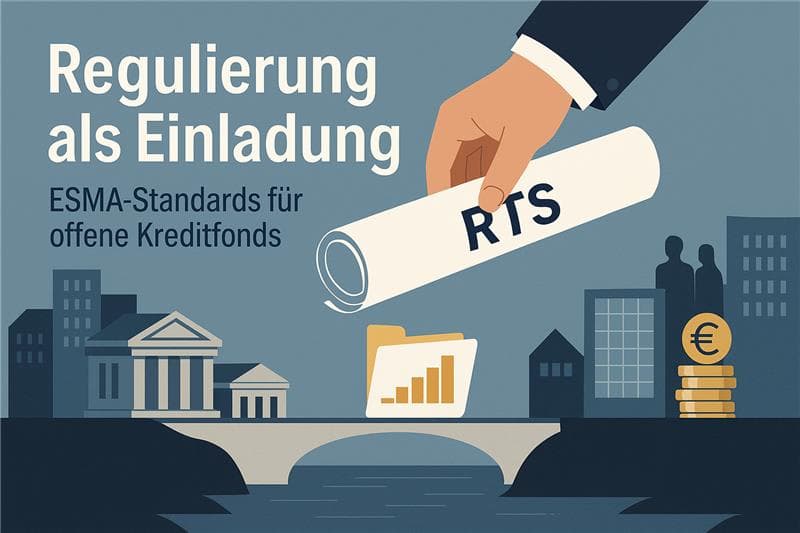
Why the new ESMA rules do not slow down open-ended credit funds, but enable them

At first glance, ESMA's new Regulatory Technical Standards seem technical, detailed and difficult to digest. But if you take a closer look, you will see that these rules are not a stumbling block, but an architecture of enablement.

Alternative Real Estate Debt: A Strategic Window in Europe’s New Cycle
ArticleComment

Alternative Real Estate Debt: A Strategic Window in Europe’s New Cycle

For institutions seeking yield enhancement with downside protection, this cycle offers the optimal entry point into European real estate debt strategies.

#Newsletter: Stay up to date!

Sign up for our newsletter and receive regular updates on the latest topics.

Register now