by Dr. James Tyrrell & Miriam Uebel
AI demand expands in scale and geography
Near-term demand for data-centre capacity remains strong globally. In Europe, 1.6 GW of capacity was absorbed during Q2 2026, more than the approximately 1.2 GW recorded in FY 2025.[1]
Indicators including hyperscaler capital expenditure, backlogs and lease commitments, remain strong. Short-term demand continues to outpace additions to live supply, supporting low vacancy and increased pre-leasing of projects that are still under development. However, the pipeline of under construction and planned capacity remains significant.
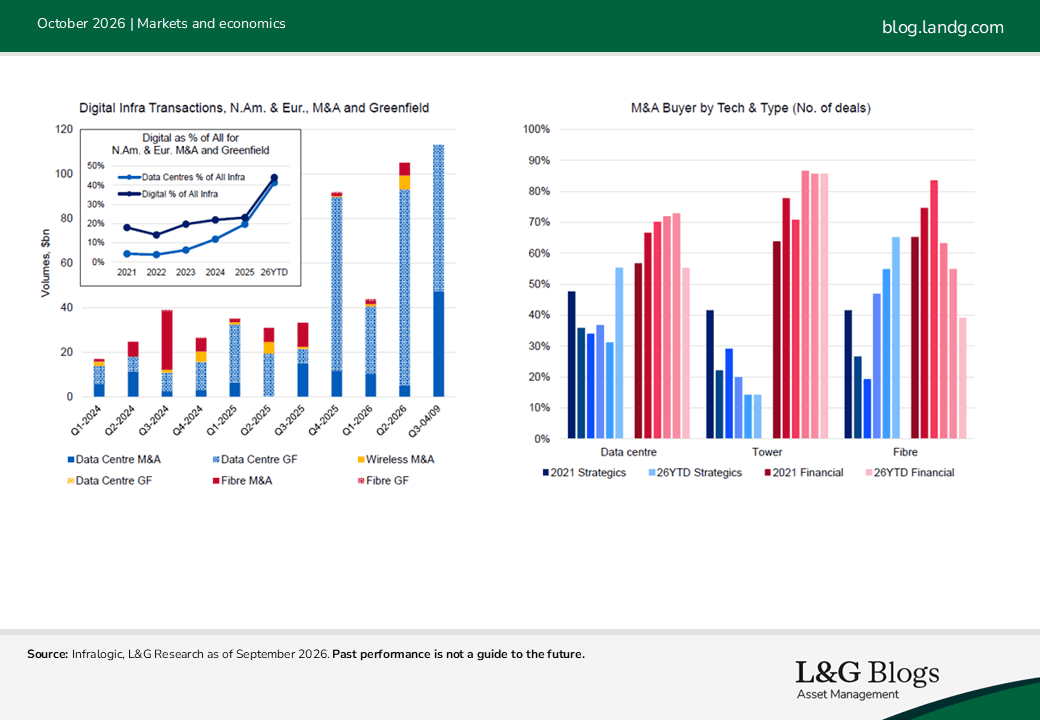
Data centres represented around 41% of all infrastructure M&A and greenfield transaction volumes across North America and Europe in 2026 to September. Strategic buyers such as other data centre platforms accounted for approximately 55% of data-centre M&A deals, up from 31% in 2025. Artificial intelligence (AI) is an important part of this shift: access to grid capacity, land, specialist cooling and development expertise can constrain organic growth, so acquiring an existing platform or pipeline may therefore provide a faster route to securing capacity.
New chips could transform AI revenue per megawatt
Advances in chip efficiencies are perhaps the most noteworthy recent development in the sector. The transition from Nvidia’s* Hopper chips to the newer Blackwell generation illustrates evolving AI economics.[2] Our illustrative estimates suggest that, for AI labs, annual token revenues could increase from around $21m/MW/yr on Hopper AI chips to approximately $86m/MW/yr on the newer Blackwell AI chips.[3] This is because the newer chips have higher AI efficiency and can generate significantly more tokens for the same power input. Even if token prices halved, revenue would remain around $43m/MW/yr.
For comparison’s sake, a neocloud, which leases data centre capacity, purchases Blackwell chips, and rents them out to the AI labs, charges $10m-$12m/MW/yr over a 5-year contract. Meanwhile a data-centre operator, who acquires grid power and builds the data centre, might receive $1.8m-$2.1m/MW/yr in annual rent from a neocloud. Newer AI chips, therefore, significantly raise the margins for the AI labs on selling tokens.
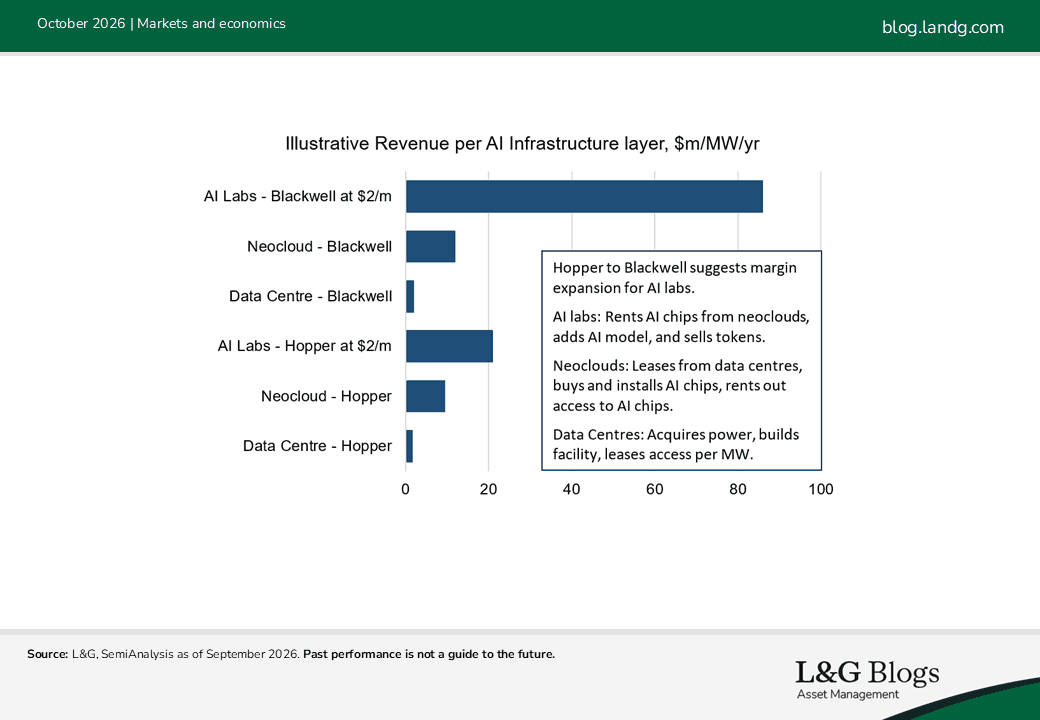
As newer chips produce more tokens from the same amount of power, AI providers will likely be able to reduce token prices while maintaining attractive economics. Revenue per MW will therefore, in our view, depend on the overall blend of chip generations and the market price of tokens. If the blended AI chip efficiency gains remain above decreases in token price, AI providers can generate more revenue per MW.
This illustrates how newer chips may create a larger profit pool above the physical infrastructure. This could give tenants greater capacity to pay higher rents and allow data-centre operators to capture part of the value created, particularly where power and suitable facilities remain scarce.
For investors, this raises the importance of tenant quality. Tenants using the latest chips may be better placed to remain cost competitive, while those reliant on older chips could face margin pressure.
New chips also have different infrastructure requirements. Blackwell systems require liquid cooling which adds to data centre capital expenditure, which operators may wish to pass through to higher rents. It also creates obsolescence risk for facilities that cannot be economically upgraded.
While power costs remain critical in the long-term, our view is that time-to-power remains most important in the near-term.
To give an example, the difference in power cost per MW in the UK vs Norway over a 20-year data centre lifetime is approximately $42m[4]. Therefore, at present, getting power online one year earlier can generate more revenue from token generation with Blackwell chips than the extra lifetime power costs of building in a location where power prices are higher. However, as AI technology matures and margins normalise, we expect power costs to become a more significant factor in influencing demand for future developments.
Token prices are the link between what users pay for AI and the revenues available to support the underlying infrastructure. Lower-cost Chinese open models are increasing competition, and are pressuring weighted average token prices. The weighted average token price reached $2 per million tokens through H1 2026 to below $1 by September, while AI-chip rental prices remained comparatively resilient.[5]
Importantly, the economics of the AI models that dominate usage will shape where value accrues. Higher-token-cost closed models could support stronger AI-lab and infrastructure margins, while lower-cost open models may compress revenue per token/MW but stimulate greater usage and infrastructure demand.[6]
Implications for Investors
he outlook for digital infrastructure remains supportive, but the distribution of returns is becoming more complex. It is clear this space is becoming increasingly dynamic and necessitating the expertise of specialist investors to navigate location and asset selection.
The interaction between chip efficiency and token pricing will become more important because value capture may shift between AI labs, neoclouds, and data centre operators.
For infrastructure investors, this influences asset selection. In the near term, time-to-power, delivery certainty, and the ability to support high-density, liquid-cooled deployments will potentially command a premium as the revenue per MW opportunity rises. The ability to identify assets and tenants that can remain competitive as technology, pricing and location requirements evolve will therefore be key to capturing this growth.
Assumptions, opinions, and estimates are provided for illustrative purposes only. There is no guarantee that any forecast will come to pass.
*For illustrative purposes only. Reference to a particular security is on a historic basis and does not mean that the security is currently held or will be held within an L&G portfolio. The above information does not constitute a recommendation to buy or sell any security.
[1] Frankfurt, London, Amsterdam, Paris, and Dublin
[2] See figure for descriptions of value-add from data centres, neoclouds, and AI labs.
[3] Capability-adjusted: DeepSeek R1 681B on H200 vs DeepSeek V4 1.6B on GB200 at 43 interactivity compared using Tokens/s/MW assuming 75% utilisation as per InferenceMAX by SemiAnalysis. Assumes token prices remains fixed at $2/m.
[4] Assumes fixed power costs (real 2025) over a 20-year period between the UK and Norway as of 25-H1 for large loads using > 150 GWh/y using average H1-25 EUR/USD exchange rates. Data centre lifetimes may vary.
[5] Bloomberg as of September 2026.
[6] OpenRouter, “GPT 5.6 Discounts & Jevons Paradox”, as of August 2026
More about Dr. James Tyrrell, Infrastructure Research Manager
LGIM: Dr. James Tyrrell
Disclaimer: Views in this blog do not promote, and are not directly connected to any L&G product or service. Views are from a range of L&G investment professionals, may be specific to an author’s particular investment region or desk, and do not necessarily reflect the views of L&G. For investment professionals only.