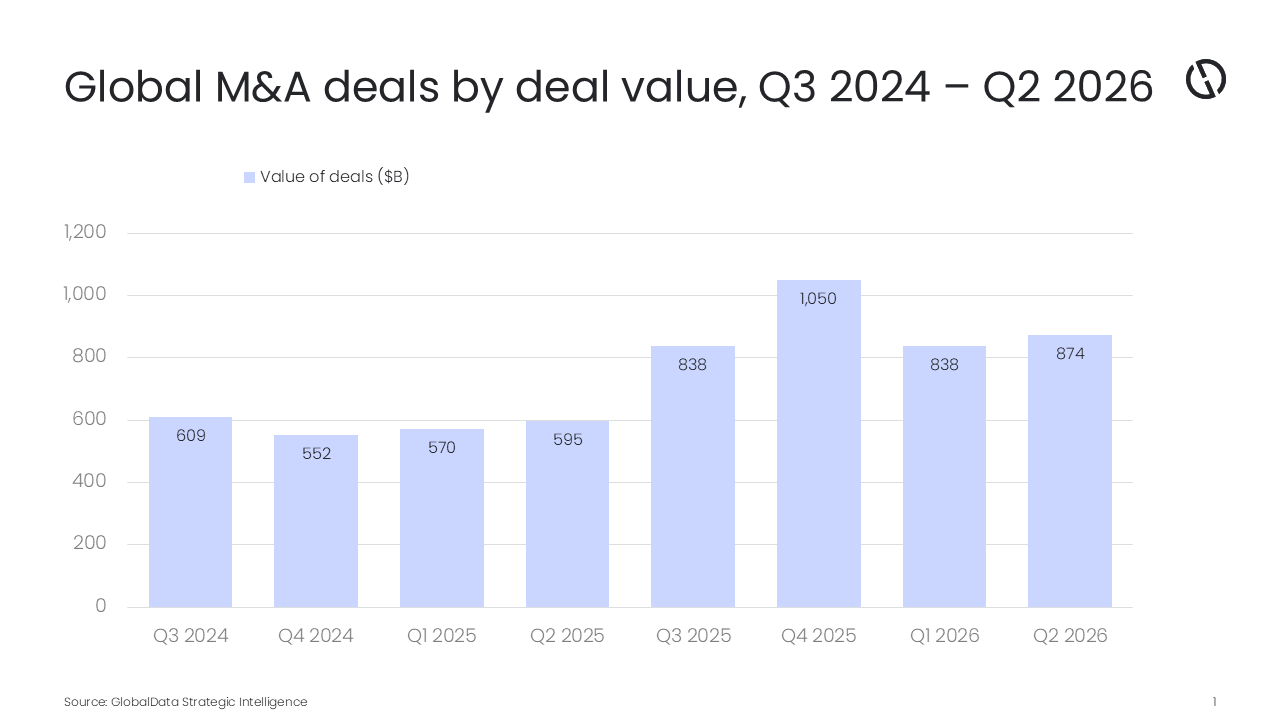
Global mergers and acquisitions (M&A) deals hit $1.7 trillion in the first half (H1) of 2026, up 47% from H1 2025, helped by a steady fall in interest rates and the impact of US tariffs on global supply chains. With $221 billion in supply chain-related transactions across 34 deals, covering sectors such as industrials, consumer, and materials, supply chain resilience was a key theme driving M&A momentum, reveals GlobalData, a leading intelligence and productivity platform.
GlobalData’s latest Strategic Intelligence report, “Global M&A Deals in H1 2026 – Top Themes by Sector: Strategic Intelligence,” reveals that in H1 2026, the combined value of mega-deals, defined as transactions valued at $1 billion or more, rose by 59% to $1.4 trillion, up from $0.8 trillion in H1 2025.
Priya Toppo, Strategic Intelligence Analyst at GlobalData, comments: “Geopolitical friction, evolving trade policies, structural labor constraints, stringent sustainability directives, and rapid technological adoption continue to drive M&A activity centered on supply chain strengthening. Companies across key verticals—most notably industrials, consumer goods, materials, and technology, media, and telecommunications (TMT)—are aggressively targeting capabilities that deliver supply chain localization, end-to-end visibility, and operational agility.”
The biggest supply chain deal was Unilever’s foods business merging with McCormick for $44.8 billion. It was followed by Sysco’s acquisition of Jetro Cash & Carry for $29.1 billion and QXO’s acquisition of TopBuild for $17 billion.
Toppo continues: “An ongoing trend is the dominance of North America in M&A deal activity, accounting for 1,006 deals worth $1.1 trillion in H1 2026. On the other hand, China and the Middle East and Africa, saw a YoY decline in deal value.”
Looking toward the second half of 2026, transactional sentiment remains selectively bullish, bolstered by anticipated monetary easing and corporate adaptation to revised trade frameworks.
Toppo concludes: “Nevertheless, large transactions remain subject to extended deal timelines and heightened antitrust intervention, particularly within the US regulatory environment.”