AI-enabled smart grids are revolutionizing energy production and distribution through real-time predictive analytics and machine learning, dynamically aligning supply with demand. AI is profoundly transforming grid ecosystems, optimizing operations, bolstering reliability and strengthening resilience. By integrating IoT-embedded infrastructure with advanced forecasting and optimization systems, utilities gain unprecedented efficiency, adaptability, and robustness. As AI-powered models project demand at micro-scales, empowering utilities to fine-tune load balancing, smart grids are set to reshape the power sector by facilitating the transition to cleaner energy and enhancing reliability, says GlobalData, a leading intelligence and productivity platform.
GlobalData’s latest report, “Smart Grid: Strategic Intelligence” reveals AI serves as the intelligent backbone of smart grids, driving optimization, stability, and security across energy networks. Companies such as Solcast and RisingStack use AI and satellite imagery to now-cast solar irradiance and forecast PV output, helping grid operators curtail less and schedule reserves more effectively. Likewise, Hornsdale Wind Farm’s AI systems, using atmospheric and performance data, are significantly improving forecasting accuracy, enabling better anticipation of variability and avoiding wasted capacity. Meanwhile, utilities such as National Grid harness sensor data to monitor critical systems and predict failures, significantly cutting downtime.
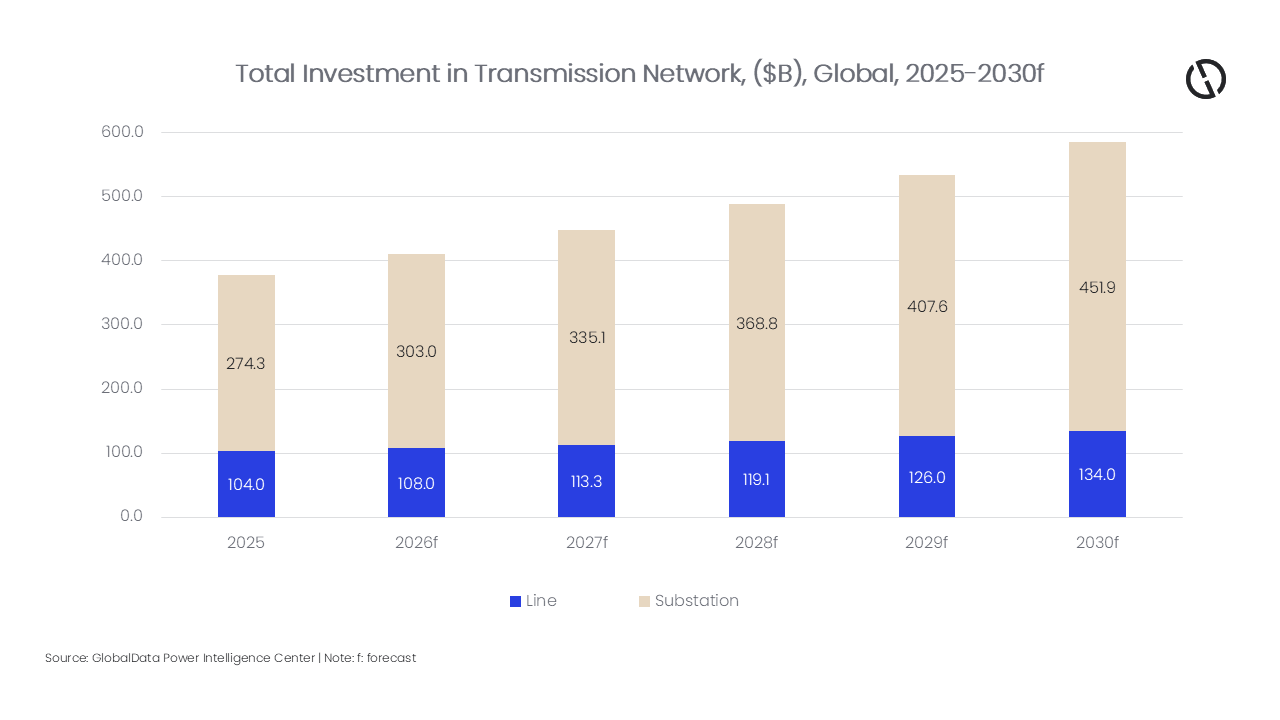
Rehaan Shiledar, Power Analyst at GlobalData, comments: “Government initiatives, renewable integration, the demand for a more resilient and efficient grid, and technologies such as smart meters, AI, and IoT are driving investment in the power transmission market. Global transmission investment in 2025 stood at $378.3 billion, increasing by 10.1% over 2024. The investment was primarily in substations at $274.3 billion, followed by transmission lines at $104 billion. The transmission investment is estimated to grow from $378.3 billion in 2025 to $586 billion in 2030 at a compound annual growth rate (CAGR) of 9.2%.”
Technological trends in the smart grid, particularly digital twins, microgrid development, and electric vehicle (EV) integration, are evolving rapidly to improve grid resilience, efficiency, and sustainability. These technologies are converging to create a more dynamic, decentralized, and intelligent power system that can handle the complexities of renewable energy and bidirectional energy flow.
Companies such as ABB Electrification is enhancing grid efficiency, resilience, and accelerating the energy transition through Enline’s Digital Twin modelling and Dynamic Line Rating (DLR) to improve transmission and distribution networks. Hitachi Energy and GE Vernova are supporting microgrid growth through distribution automation, grid control software, and integration of DERs and storage.
EV integration is increasingly recognized as one of the pivotal drivers in smart grid evolution, enabling a more flexible, resilient, and clean energy system. For instance, GNA Energy (India) launched „GNAi,“ an AI-powered platform for grid optimization and smart meter integration in 2026.
Shiledar adds: “Smart grid technologies are transforming the power sector by making electricity systems more adaptive, efficient, and sustainable. Smart meters and sensors enable real-time monitoring of power flows, helping utilities better balance supply and demand and reducing energy waste.”
Utilities such as EDF are using Distributed Energy Resource Management Systems (DERMS) to integrate solar panels, wind farms, and battery storage more smoothly into the grid, mitigating issues like voltage spikes and frequency fluctuations. Another example is virtual power plants (VPPs), which aggregate resources like residential solar panels, EV batteries, and flexible industrial loads to act as a single controllable asset for grid operators. Xcel Energy’s advanced VPP in collaboration with Itron and Tesla integrates residential battery systems, rooftop solar, EV chargers, and smart thermostats into Itron’s IntelliFLEX DERMS platform, enabling the aggregation and dispatch of DERs during peak load to stabilize the grid.
Shiledar concludes: “As renewable energy grows and electrification spreads through EVs, heat pumps, and more, the grid must evolve. Smart grid tools drive this evolution through automation, digital intelligence, and two-way communication. In essence, these solutions bolster energy security, cost efficiency, and ecological integrity, fostering a truly sustainable energy ecosystem.”