
The IAB Concept and Relevance to Renewable Energy Projects
1. Introduction to IAB (Investitionsabzugsbetrag)
The Investitionsabzugsbetrag (investment deduction amount; IAB) is a term defined in §7g German Income Tax Act. It describes a tax incentive primarily aimed at small business owners and self-employed or high net worth individuals and allows a taxable person to deduct up to 50% of the anticipated cost of a planned investment from its taxable income up to three years before the investment is made. This yields a significant tax deferral or refund up front, improving the investor’s liquidity. After the asset is acquired, the investor can still take advantage of accelerated depreciation of up to 20% of the investment amount in the year of purchase or any of the following four years (total 5 years), leading to a combined front-loaded tax benefit of up to 70%.
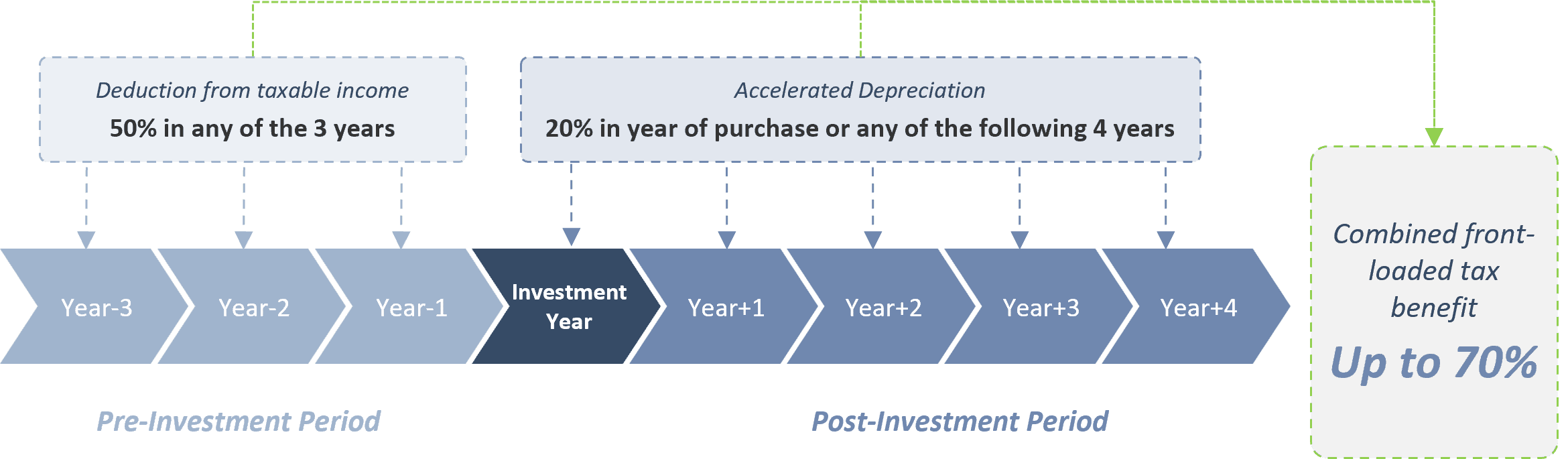
IAB was designed by the German legislator to encourage private capital to invest in new equipment and technologies, as it boosts liquidity and reduces risk at the point of investment. Renewable energy installations like solar PV arrays, wind turbines, and battery energy storage systems (BESS) may qualify as they are depreciable movable assets used in business. By offering an upfront tax break, the government effectively partners in the investment, making renewables more financially attractive and helping Germany meet its climate targets.
To qualify for IAB, the investment must be in specific, identifiable equipment – not just shares of a project company. Therefore, IAB-investments in renewable energy are structured as asset deals where the investor buys a portion of the physical plant (not equity in the SPV), such as an inverter and its associated PV modules. The assets must be movable and used predominantly in the investor’s business, where the investor often sets up a small business or partnership to own the asset and sell electricity. Only with such separable asset ownership can the investor claim the tax deduction and depreciation on their portion.
IAB (i.e. the deduction amount) is limited to EUR 200,000 p.a., meaning that individual investments usually do not exceed EUR 400,000. However, it is not uncommon for an individual to set up several companies such as a common partnership holding (GbR – Gesellschaft bürgerlichen Rechts) to invest multiple times in the same project
Advantages of IAB-Driven Renewable Energy Projects
2. Attractiveness of IAB Investments for Investors
Investing under the IAB scheme is particularly attractive to high-income individuals and profitable SMEs looking for tax-efficient, asset-backed opportunities. Key appeals for IAB-investors in renewables include:
Immediate Tax Relief & Higher Returns
- The tax shield provided by IAB effectively boosts the investment’s net return.
- By deducting 50% of the cost upfront, investors recover part of their capital via tax savings early on, which improves the project’s IRR.
- Combined with further depreciation, an IAB investor’s after-tax returns on a renewable energy project can significantly exceed those of an institutional investor who cannot utilise such a benefit.
Improved Liquidity & Flexibility
- By lowering the tax bill in advance, IAB frees up cash, making it easier for investors to take on these projects without straining their cash flow.
- Investors also often finance the remaining cost with bank loans (typically covering 60–80% of the purchase price), meaning their own cash outlay is relatively low.
Lower Risk, Asset-Backed Income
- Investors acquire a pro-rata share of a real, income-generating asset with long-term predictable revenues.
- For example, IAB-investors in PV parks receive steady cash flows from electricity sales, which are often contracted or regulated, reducing market risk.
- Banks financing the IAB-investor’s asset purchase view the loan to such investors favorably because it’s secured by both the personal credit of the investor and the project’s cash flow, creating a dual-recourse safety net.
Hence, IAB-investments combine tax savings with real assets – investors get accelerated tax relief and valuable assets with long-term cash flows in renewables, yielding a compelling risk-adjusted return.
3. Advantages to Developers: Selling to IAB Investors vs. Institutional Investors
- Potential for Higher Sale Prices (Tax-Value Premium): IAB investors price projects knowing roughly half their investment is offset by tax savings, allowing them to accept lower pre-tax returns. As a result, developers can achieve higher sale prices (≈EUR 750k – EUR 1m/MW PV), effectively sharing the tax benefit—reducing investor net cost while boosting developer revenue.
- Broad Pool of Ready Buyers: The IAB mechanism has created a large and growing class of private investors specifically interested in renewable assets for tax and ESG reasons, making it easier and faster for developers to find buyers for projects at COD, and demand often outstrips supply for quality renewable projects qualifying for IAB. This diversifies the sales risk and creates competitive tension.
- Upfront Cash via Down Payments: In the IAB model, investors typically pay ~20% upfront at signing (e.g. RtB), with the balance due at COD. These early payments provide developers with interest-free interim financing to fund initial construction, reducing equity needs while signaling strong investor commitment and supporting construction financing.
- Recurring Revenues from Long-Term Involvement: Since individual investors usually can’t operate the asset, the developer stays on as asset manager/O&M provider post-COD, retaining the SPV and grid while investors own the equipment—securing recurring fees and strengthening its operator track record.
- Strategic Relationships and Repeat Business: Satisfying a network of 20–100 IAB investors can be a strategic asset. If the investors’ experience is positive, they are likely to invest in the developer’s future projects (or reinvest their proceeds and tax savings). This is a different dynamic than one-off sales to institutions.
In summary, the IAB route aligns well with a “develop-and-flip” business model. Developers focus on bringing a project to ready-to-build and securing IAB investor commitments, then use bank financing to build. They exit at COD with a lucrative margin courtesy of the investors’ tax-driven pricing and later benefit through service contracts.
Payment Models for Project Purchase and Funding Implications
4. IAB Payments Models
Two main purchase price payment structures are commonly used in these transactions, each with different implications for financing the construction:
Milestone Payment Model
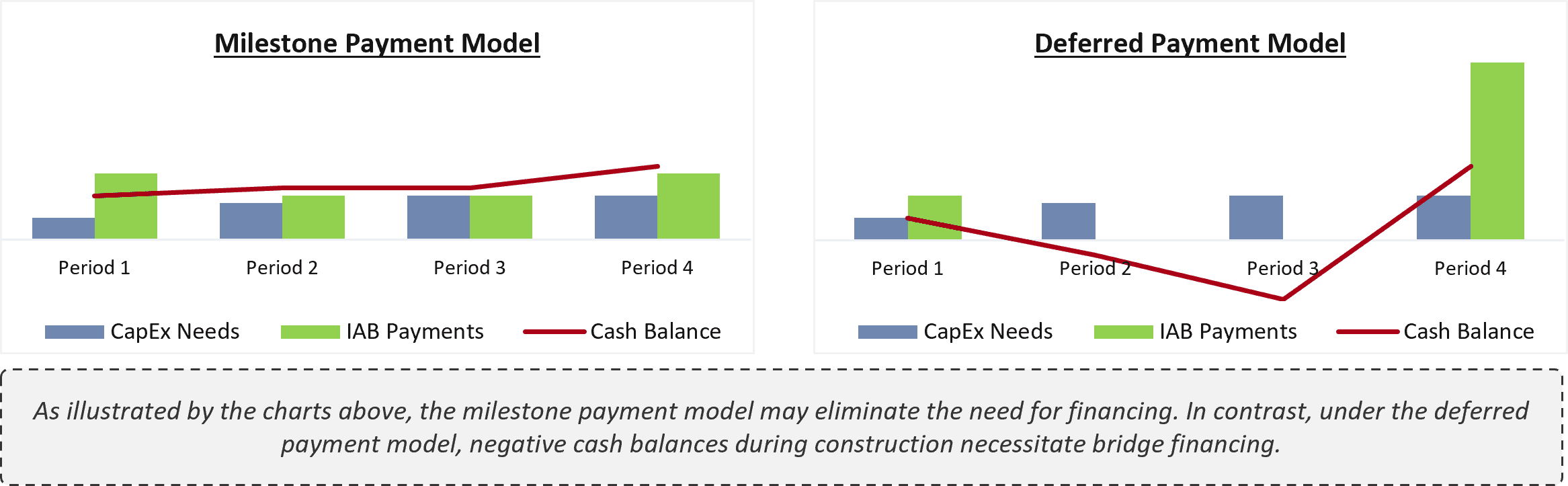
- The investor’s purchase price is divided into multiple installments spread over the construction period – for example, a sequence of 30% upon contract signing, 40% at mid-construction, and 30% at Commercial Operation Date (COD).
- In this model, the investor is effectively funding the project alongside the developer as it progresses, meaning lower debt needs and interest.
- However, such milestone structures are less common because they require each investor to commit more capital earlier and share construction risk.
- Furthermore, as investors often need time to arrange their own loan for the milestone or final payment, and investor-financing banks often won’t accept construction risk, such milestone payment models increasingly become a competitive disadvantage when seeking IAB-investors.
Deferred Payment Model
- The prevalent model for IAB deals, driven by investor expectations and necessary to secure the sale, is where the investor pays a small down payment (~20%) when the contract is signed or at ready-to-build stage, and the bulk (~80%) is only paid at COD.
- Investors often finance this COD payment with an investment loan from their local bank – an element which provides comfort to the sponsor as the COD payment is effectively underwritten by a highly creditworthy funds provider.
- This deferral of most of the price until COD makes the investment very attractive to investors but means that the developer must cover roughly 80% of the project cost until COD.
- This model essentially shifts the financing burden to the developer, who typically finances these CapEx by a construction debt facility that is repaid in one lump at COD from the investors’ final payments.
Some banks offer “global financing” solutions where they finance all the IAB investors for a given project through one developer-arranged facility. Developers who establish such arrangements make themselves more attractive partners to both investors and banks, smoothing the sales process on current and future deals.
The graph below illustrates a comparison of payment structures, highlighting how both investor payment schedules – milestone-based versus back loaded – impact the developer’s financing requirements:
Technical Requirements for IAB Eligibility & Feasibility
5.a. Identifiable Asset Allocation
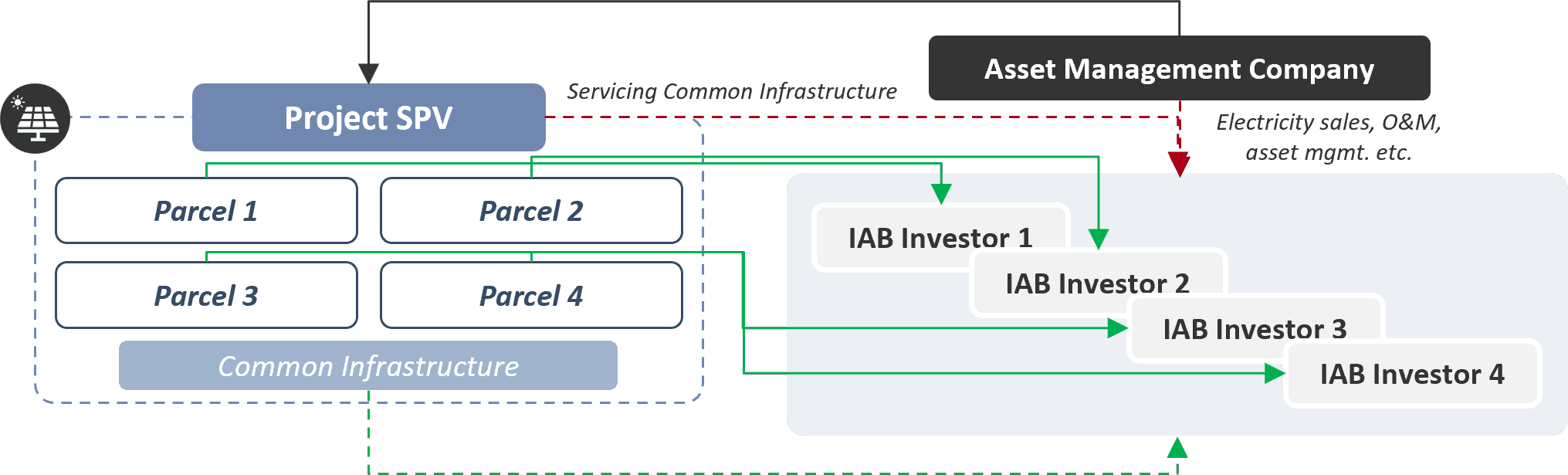
Each IAB investor must buy a specific part of the project’s hardware. The tax authority will not accept a vague fraction of a whole; it has to be an asset (or set of components) that is clearly distinguishable and separately useable.
Solar PV Plants
- This is achieved by subdividing the plant into independent parcels – typically by inverter or string, with the unit being metered to measure its production.
- The project company usually retains ownership of common infrastructure (like the grid substation) but grants usage rights.
Wind Farms
- The logical unit is usually a single wind turbine per investor. Each turbine can stand as a separate asset with its own revenue meter.
- However, since wind turbines are high-value, only larger investors can participate – this makes IAB-driven sales less common in wind unless scaled appropriately.
Battery Energy Storage Systems (BESS)
- BESS systems are often used alongside generation assets or to provide network services.
- For BESS to be IAB-eligible, an investor must buy an individual battery pack, which can be unequivocally identified as belonging to the investor.
- It is typically part of a bigger stack and uses the battery installation’s infrastructure.
5.b. Exclusive Revenue Allocation
Hand-in-hand with asset ownership is the need to allocate the electricity production and revenue from that asset to its owner. This means robust metering and accounting, such as each inverter, wind turbine battery pack having its own meter tracking the energy it produces, to split the revenues from power sales according to these metered outputs.
Key is that each investor’s return comes directly from their part of the plant’s performance, which is required for them to claim the asset is used in their business. If production cannot be distinctly allocated, it would undermine their claim of owning a specific business asset.
In all cases, meeting the letter of the law in terms of asset separation and revenue allocation is paramount. As long as each investor’s portion can be “wrapped up” as a standalone business asset with its own income and expenses, the IAB concept can be applied.
Lender Perspective and Role of r2 Advisors
6. Lender Perspective on Construction Financing
From the point of view of banks or other construction financiers, IAB-driven projects are approached as a short-tenor bridge loan – effectively a construction bridge to a pre-sold equity takeout at COD.
Unlike a merchant project, where repayment depends on future uncertain revenues, here the primary source of repayment is the IAB-investors’ equity payment at COD, which is contractually fixed. This makes the credit more akin to a receivables financing or bridge loan than a typical project finance loan.
Lenders consider several factors and typically set conditions such as:
- Pre-Sales & Exit Proceeds: The foremost concern is assurance that the loan will be repaid at COD by the investors’ final payments. Thus, lenders typically require the developer to pre-sell a large portion of the project (often at least ~80%) before or at financial close to de-risk the exit, as any unsold portion introduces uncertainty, which the bank may counter by reducing the loan amount. Another key metric is the ratio of the expected COD payment to the loan amount. Often, banks want the COD payments to represent an over-collateralization of the loan – e.g. the COD lump sum to be >120% of the loan principal, providing a buffer against any non-payment by investors at COD.
- Down Payments as Equity: Lenders view the investors down payments (~20%) plus the developer’s invested funds as the “equity first” portion of the project’s capital stack. The construction loan then effectively finances the balance of the cost. In practice, a loan-to-cost (LTC) ratio of ~80% is common, with any shortfall (net of down payments) being covered by the developer’s own funds.
- EPC Providers: As the final investor payments will only come in at COD, the lender effectively takes construction risk on the project. For this reason, banks and debt funds typically ask for tier 1 EPC providers and will review the terms of the EPC contract, which ideally comes with fixed price and turn-key deliverables.
- Credibility of Investors: The bank will underwrite not only the project’s technical merits but also the creditworthiness of the IAB investors – albeit in a limited way. Since the final repayment depends on investors honoring their contracts at COD, lenders want to ensure these investors are likely (and able) to pay. Often, the profile of IAB investors (wealthy individuals, profitable SMEs) means they are considered creditworthy, and the down payment is a sign of commitment. For added comfort, lenders will want to understand how the developer has assessed the IAB-investors’ ability to pay and may require that investor payments at COD go into a secured escrow or a debt repayment account, to eliminate any chance of funds being diverted.
- Assessment of Project Economics: Even though the loan is short-term, banks do assess the project’s fundamentals. They typically carry out a mini project finance analysis to ensure the project is sound. They consider the construction plan, the technology, EPC contract (turnkey construction contract) and its guarantees, permits (requiring them to be in place up front), and the projected cash flows of the plant.
- Developer’s Skin in the Game: Lenders typically expect the developer to contribute some hard equity or subordinated funding to the project, to ensure incentives are aligned. This can be in the form of absorbed development costs (e.g. all project development expenses have been paid by the developer and not reimbursed until the COD sale) or a cash equity injection. In many cases, by the time of financial close, the developer has already spent 5–10% of the project cost on development (permitting, grid studies, engineering). The lender sees that as the developer’s equity investment. They may also require the developer to fund any cost overruns, or to maintain a contingency reserve account that can cover unexpected costs or delays. Additionally, if the developer stands to make a large profit at COD, the lender might ask for a portion of that to be back-ended or conditional (meaning the developer only gets fully paid once the loan is completely settled). All these measures provide comfort that the developer will see the project through.
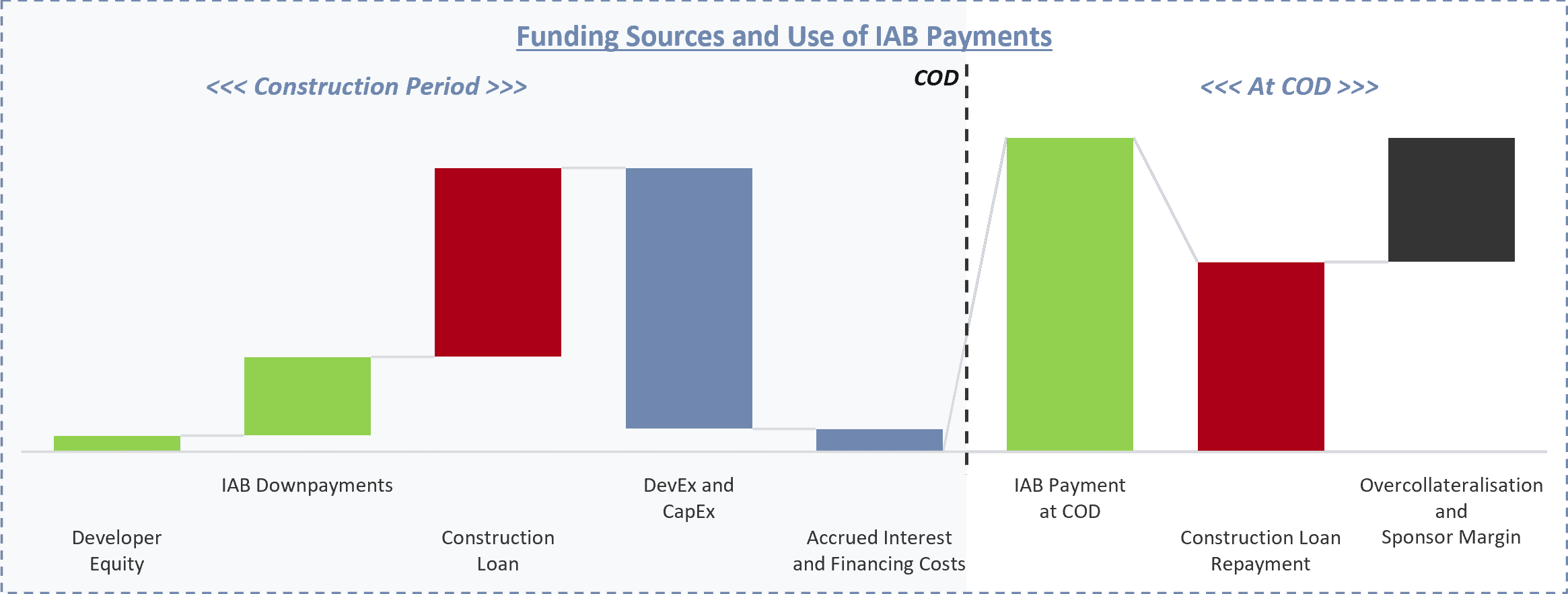
In summary, lenders are generally comfortable with IAB construction financing if the project is well-structured: i.e., permitted, fixed-price EPC in place, sale contracts secured, sufficient equity (down payment + developer funds) in the deal, and a healthy cushion between the sales price and the loan amount. They usually structure the facility with a maturity shortly after COD (to allow a bit of time for final payments to come in) and then require full repayment. Any portion of the project not sold to IAB investors by COD would need an alternative plan (e.g. refinance by a long-term loan or sponsor buy-out) – something the bank would have assessed in advance but likely prefers to avoid.
7. How r2 Advisors can Help
For lenders, IAB projects represent a secure, short-term lending opportunity, provided the project is structured correctly. r2 Advisors, a boutique investment banking firm based in Hamburg, London and New Delhi that provides corporate and asset finance solutions, have a strong understanding of the IAB concept and underlying business model, supported by its hands-on experience in this space.
r2 Advisors are therefore the ideal partner for project developers seeking financing solutions for their IAB projects, as well as for investors and lenders looking to engage in the growing market for IAB financing.
r2 Advisors combines this expertise with a demonstrated track record and established relationships with a network of investors who have a specific appetite for investing in IAB-based projects, enabling effective capital mobilization and successful transaction outcomes.