Markets

Research, market opinions and commentaries on the various asset classes, segments and regions.

All posts in this category

Chiara Aengevelt, geschäftsführende Gesellschafterin Aengevelt Immobilien. Bildquelle: Aengevelt Immobilien
Analysis Forecast

Aengevelt sees growth market for Defence Properties

Aengevelt sees Defence Properties as a fast-growing segment. With higher defense spending and more Bundeswehr personnel, the need for office, commercial and logistics space is increasing; in some cases up to 30% higher land prices. Opportunities for investors, but strict safety and ESG requirements.

Die Beschleunigung institutioneller Narrative
Comment Weekly

The Acceleration of Institutional Narratives

Institutional narratives are accelerating, diffusing from liquid to traditionally slow asset classes such as real estate and infrastructure. Topics rotate faster, attention organizes capital and influences perception, allocation and cost of capital.

Discussion

Six million jobs under pressure: Gastwelt calls for competitive location policy and new growth agenda

At the Guest World Summit in Berlin, DZG and industry associations campaigned for competitive location conditions: tax relief, less bureaucracy, lower energy costs and faster immigration. Around 220 executives discussed with federal politicians. The goal is a new growth agenda.

Außenansicht einer Produktionsimmobilie in Hannover-Laatzen, Quelle: BEOS
Analysis Report

Light Industrial Real Estate: Market Gains Stability in 2025

The German market for light industrial real estate was robust in 2025: the investment volume rose by 35% to EUR 1.61 billion.

News

Savills: Cross-border buyers return to the European office market

A Savills analysis shows that cross-border investors are returning to Europe's office market. Banks are financing prime properties again, with prime yields remaining at 4.9% in Q1/2026. Exemplary deals in Spain and Paris; in Germany, activity is increasing, especially through private and family offices.

Analysis Report

Joint press release by vdp and vdpResearch: Real estate prices to rise at the beginning of 2026

The vdp real estate price index shows an increase of 2.2% in the 1st quarter of 2026 compared to the previous year: residential +2.3%, office +1.9%, retail +1.5%. The effects of the Iran war are still hardly measurable. New trade indices developed with the Bundesbank are incorporated into the methodology.

Analysis

JLL: Victor Prime Office to tread water at the beginning of 2026

The office performance indicator Victor Prime Office increased by only 0.3 percent in the first quarter of 2026 compared to the previous quarter. Since the outbreak of the Middle East conflict, it has shown a sideways movement; the Iran war slowed down activities. The indicator level in prime locations was 174.5 points at the end of March.

Analysis Report

Savills: Energy price shock hits industrial and logistics markets

The Iran war is making oil and diesel more expensive and, according to Savills, is putting a strain on the German industrial and logistics market. Logistics users are acting more cautiously and demanding energy-available space; in the investment market, return expectations are rising and construction cost risks are slowing down revitalization.

Dr. Wulff Aengevelt, geschäftsführender Gesellschafter Aengevelt Immobilien (Credits: Aengevelt Immobilien)
Comment

“Aengevelt: Federal housing association does not solve any problems.”

Aengevelt criticizes the planned Federal Company for Affordable Housing as ineffective and without added value. Existing players such as BImA and KfW were sufficient; structural obstacles are the problem. Luczak and the EBZ Business School also express skepticism.

Discussion Quarterly Video

mrp hotels quarterly – Active hotel asset management becomes a decisive success factor in a volatile market environment

The current "mrp hotels quarterly" highlights that active hotel asset management is becoming a decisive success factor in a volatile market environment. Data from around 20 hotels in the DACH region show increasing occupancy (+2.3%) and RevPAR (+3.4%) in the first quarter of 2026, with only a slightly higher rate (+1.0%) and continued margin pressure from energy and personnel costs. Operational flexibility, closer cooperation between owners and operators and targeted investments, especially in energy efficiency, are required.

Comment Forecast

Family offices are increasingly focusing on housing stock / Nationwide trend is gaining momentum

DAVE and Arcadis are observing that family offices in Germany are increasingly acquiring existing apartments and are primarily in demand for residential portfolios with 100 to 800 units. Drivers include high construction costs, regulatory uncertainties and a difficult financing environment; the focus is on value-preserving, generational strategies. The trend is stimulating the market for larger residential portfolios and is likely to become even more important in view of the new construction situation.

Dr. Wulff Aengevelt, geschäftsführender Gesellschafter Aengevelt Immobilien (Credits: Aengevelt Immobilien)
Analysis Comment

Aengevelt: Shortage of craftsmen growing risk for property developers.

Aengevelt warns that the ongoing shortage of skilled workers in the construction trade further increases the risk of insolvency for property developers and project developers. In the past three years, 1,230 property developers have filed for bankruptcy; according to IW, there is a shortage of over 41,000 skilled workers in the finishing industry, which is fuelling construction time extensions and cost increases. Aengevelt recommends forward-looking scheduling and liquidity planning with a rolling 24-month horizon as well as back-up trades.

Analysis Forecast Survey

New study by IWG on Office 2050 and how the world of work will change by then

A new IWG study ("Work Reimagined: The Office of 2050") predicts that neural implants, AI, and immersive technologies will fundamentally change the workplace by 2050. Long commutes and the classic eight-hour day are set to disappear, while hybrid, distributed work models, smarter office environments, and a greater focus on well-being and flexibility are gaining traction. The methodology is based on a survey in March 2026 and supplementary DACH studies.

News

JLL: Worse mood pushes Difi into the red at the start of the year

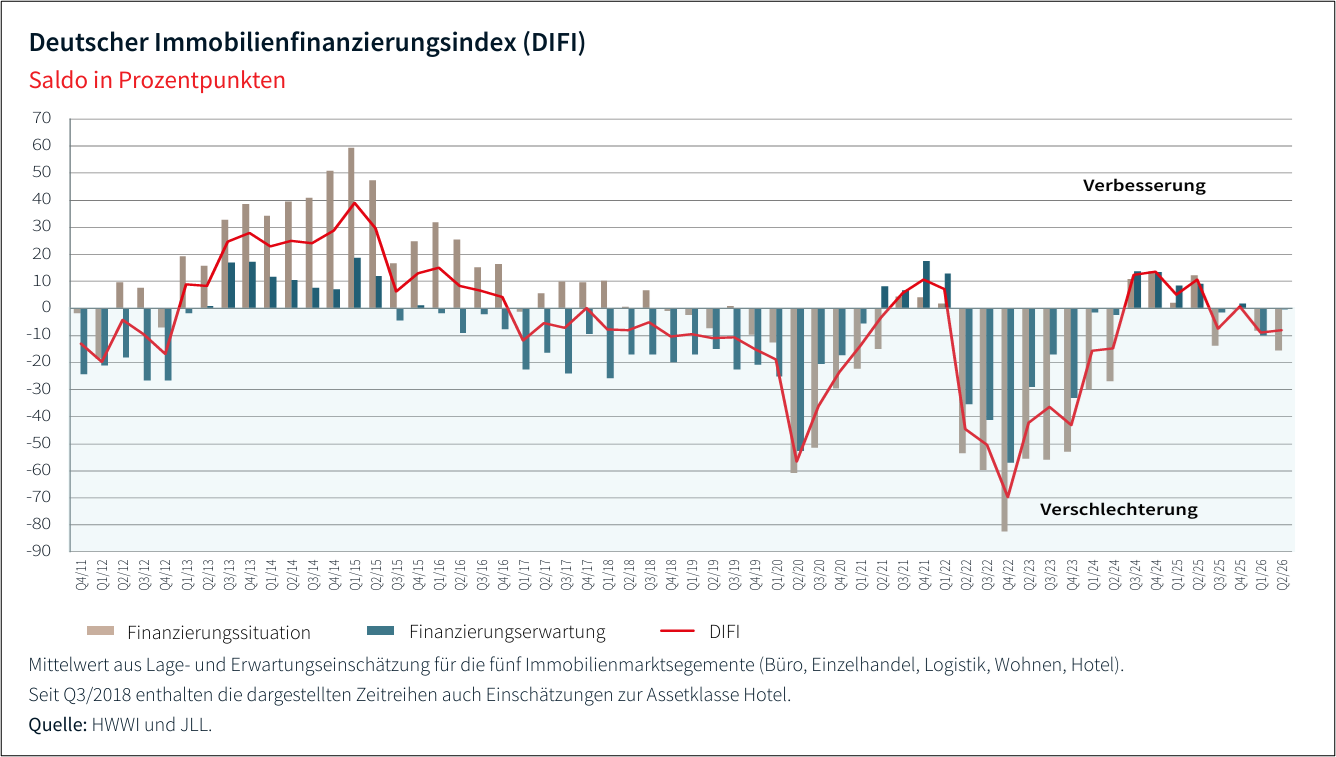
The German Real Estate Financing Index (Difi) fell by almost ten points to minus 9.1 at the beginning of 2026; The financing situation and expectations are assessed more pessimistically. Despite the gloomy climate, new lending business from Germany's major real estate banks increased significantly in 2025, while alternative financiers are expanding their offerings. Residential remains the best-valued asset class, but geopolitical uncertainties and higher interest rates are clouding the outlook.

Comment

Always the same agenda – and yet this time it could be different

Anyone who reads the agenda of INVESTMENTexpo 2026 understands the program. If you listen carefully, you have the chance to understand the market.

Thomas Wirtz, Geschäftsführer von INDUSTRIA Immobilien. Bildquelle: Andreas Henn
Survey

INDUSTRIA survey: Around 50 percent of institutional investors want to keep real estate quota constant

The INDUSTRIA survey "Residential Investment Trends 2026" among institutional investors shows: 50 percent want to keep their real estate allocation constant over the next twelve months, around 31 percent want to reduce it slightly and 5.6 percent want to reduce it more strongly; it is expected to rise at about 14 percent. Around 30.4 percent of planned real estate investments are accounted for by residential, the core orientation is increasing (91.3 percent), yield requirements are falling and the propensity towards Germany is rising to 74.2 percent. The survey ran from March 3 to April 21, 2026 and includes 36 responses.

News

Hines sees “strong buy” opportunity in premium offices in Europe – top German locations also benefit

Hines rates first-class office properties in Europe as "Strong Buy": Tight supply and above-average rental growth create attractive buying opportunities, especially in German A-locations. According to the study, prime rents have risen by 35.6 percent since Q4/2019, while construction activity has fallen sharply; the focus is on high-quality, centrally located areas.

Comment

Why residential real estate remains attractive in uncertain times

In an environment of geopolitical uncertainty, higher energy prices, inflation and rising government debt, residential real estate is gaining in importance as a real, high-yielding and comparatively stable investment. While German government bonds are losing their self-evident status as a "safe haven", long-term trends such as rental potential and recovery costs are supporting the asset class; private investors are also acting with a longer perspective. Property quality, energy efficiency, micro-location and diversification remain decisive – short-term crises do little to change the long-term positive picture.

News

APAC deal activity down by 6% YoY in Q1 2026, reveals GlobalData

Transaction activity in the APAC region declined by about 6% year-on-year in the first quarter of 2026, GlobalData said. While venture financing increased by 21%, M&A (-26%) and private equity deals (-42%) collapsed; China, on the other hand, saw about 38% more deals, while Japan, Australia, South Korea and Singapore saw significant declines.

Discussion

Logistics real estate market: tailwind despite geopolitical tensions

The rental market for logistics properties has started 2026 with new momentum. Driven by renewed growth in e-commerce and increased leasing by Asian users, demand remains high, while vacancies are low, but regional divergence and rents are stabilizing at inflation levels. At the same time, subletting is increasing and geopolitical risks such as the Iran war are increasing uncertainty.

Foto von ian kelsall auf Unsplash
News

Münchner Immobilienmarkt 2026 – Wachstum trifft auf Engpässe und steigenden Transformationsdruck

Despite solid fundamentals, the Munich real estate market is showing growing pressure to adapt in 2026: rising financing costs, uncertain capital markets and structural bottlenecks are slowing down investment. In the residential segment, rents are rising amid declining construction activity, vacancies in the office market are climbing to around 10 percent, while prime rents in prime locations continue to rise. Experts emphasize the need for faster approvals, integrated development concepts and the revitalization of existing stocks.

News

DAVE connects markets: Vienna benefits from cross-border investments

After the first quarter of 2026, the Viennese real estate market is showing signs of stabilisation: better financing conditions are stimulating demand, while supply – especially in new construction – remains scarce. Vienna also scores points in the commercial segment with low vacancy rates, stable rents and high demand for ESG-compliant space; cross-border investments with Germany are gaining in importance, as DAVE and cooperation partner Arcadis emphasize. For the coming months, the experts expect further stabilization and attractive opportunities for selective investments.

Ulrich Creydt, Steuerberater und Geschäftsführer der Ypsilon Group (Bildquelle: Ypsilon)
Comment

“Stabilization yes, new dynamics rather not”

Stefan Hoenen, Head of Commercial Real Estate at Hamburg Commercial Bank, comments on today's interest rate decision by the European Central Bank.

Comment

“Stabilization yes, new dynamics rather not”

Stefan Hoenen, Head of Commercial Real Estate at Hamburg Commercial Bank, comments on today's interest rate decision by the European Central Bank.

#Newsletter: Stay up to date!

Sign up for our newsletter and receive regular updates on the latest topics.

Register now

#Newsletter: Stay up to date! Sign up for our newsletter and we’ll keep you regularly informed about the latest topics.

Subscribe